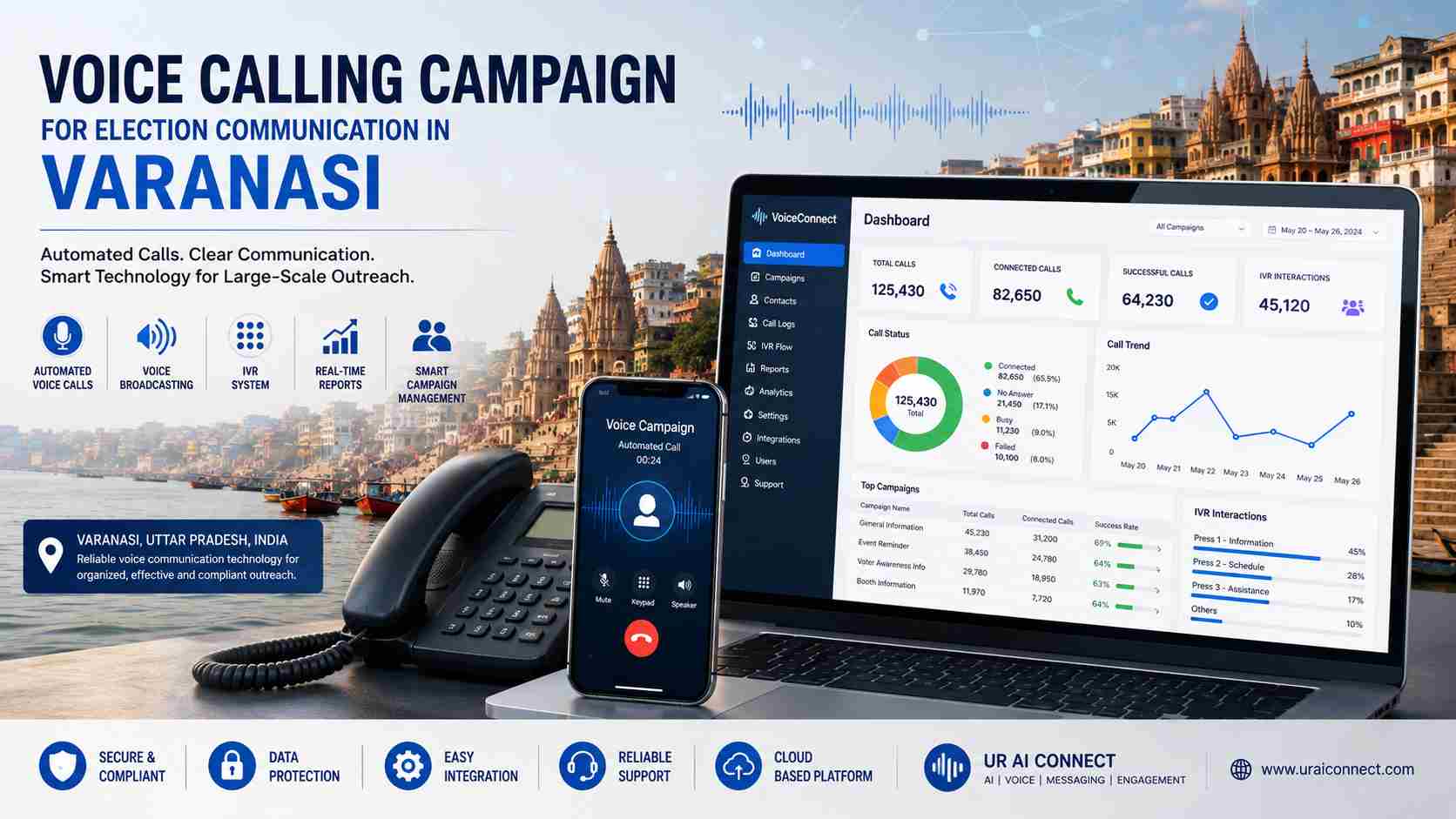
Election-related communication often involves large volumes of information, multiple communication channels, time-sensitive updates, and the need for organized call management. A Voice Calling Campaign for Election in Varanasi can use automated voice technology to distribute pre-recorded information, manage large-scale outbound calling workflows, provide IVR-based interactions, and monitor communication activity through a centralized platform.
Unlike manual calling, automated voice communication can handle repetitive calling tasks through software, reducing the need for teams to manually dial every number. Depending on the technology and regulatory framework applicable to a particular communication, organizations may use voice broadcasting, IVR, automated calling, or other communication tools.
For campaign communication teams evaluating a Voice Calling Campaign for Election in Varanasi, the important questions are not only about call volume. They also include how the calling system works, how recipient data is handled, how messages are recorded, how calls are monitored, how unsuccessful calls are managed, and what legal or regulatory requirements apply.
This guide explains the technology from a neutral and practical perspective. It does not recommend any candidate, political party, campaign position, or electoral choice. Instead, it focuses on voice communication technology, operational workflows, responsible use, compliance considerations, and provider-selection factors.
Understanding a Voice Calling Campaign for Election in Varanasi
A Voice Calling Campaign for Election in Varanasi is a technology-supported communication workflow in which automated systems can place outbound calls and deliver recorded or dynamically generated voice information to recipients. Depending on the system, recipients may simply listen to a message or interact with an IVR menu. Such systems can help organize large-scale communication while reducing repetitive manual calling work.
A voice calling campaign is essentially a structured outbound communication process. Instead of requiring a person to manually dial each number and repeat the same information, software can manage selected parts of the calling workflow.
The basic process may look like this:
Contact Data → Campaign Setup → Voice Message → Automated Calls → Recipient Interaction → Call Status → Reporting
For an election-related communication workflow, the system may be used for legitimate informational purposes such as distributing approved information, communicating schedules, sharing organizational updates, or handling inbound responses through an IVR system.
A Voice Calling Campaign for Election in Varanasi should therefore be understood as a communication technology rather than as a political persuasion technique.
The technology can support the delivery of information, but the content, recipient selection, timing, consent or other applicable permissions, and regulatory compliance remain important responsibilities of the organization conducting the communication.
What Is an Election Voice Calling Service?
An election voice calling service generally refers to a technology service that enables organizations or campaign communication teams to manage voice-based outbound communications through software.
A typical platform may provide features such as:
Contact-list management
Campaign creation
Recorded voice messages
Automated outbound calling
Call scheduling
Call-status monitoring
IVR menus
Call reports
Retry management
Call-duration information
Dashboard-based monitoring
Data organization
Integration capabilities
The exact features differ between providers.
A provider offering an election voice calling service in Varanasi may therefore function as the technology layer connecting a communication team with a voice-calling infrastructure.
It is important to separate the technology from the communication objective. The platform can automate calling, but it should not be treated as a mechanism for deceptive communication, voter manipulation, impersonation, or unlawful targeting.
How Automated Voice Calling Works
An automated voice calling workflow normally starts with a structured contact database. The organization prepares the information required by the calling platform and creates a campaign.
The next step is preparing the voice content.
The content may be recorded in advance and uploaded to the platform. Some systems can also support interactive voice flows, depending on the platform's capabilities.
Once the campaign is configured, the calling system can initiate calls according to the selected workflow.
A simplified process is:
Prepare communication data
Review the communication purpose
Prepare and approve the voice message
Configure the calling campaign
Set appropriate scheduling parameters
Initiate automated calls
Monitor call status
Review reports
Handle legitimate follow-up actions
Maintain appropriate records
For a Voice Calling Campaign for Election in Varanasi, the campaign team should also determine whether specific election, telecom, privacy, consent, or communication restrictions apply before the calls are initiated.
What Is Voice Broadcasting?
Voice broadcasting is the automated distribution of a recorded voice message through telephone calls.
Instead of an operator speaking separately to every recipient, the same approved recording can be delivered through an automated calling platform.
For example, a neutral informational announcement could be structured as:
Call Connected → Introduction → Information Message → Optional IVR Menu → Call Completion
The actual content should be reviewed for accuracy and compliance before distribution.
Voice broadcasting can be useful when the communication contains information that does not require a live conversation.
However, automation does not automatically make a communication lawful. The organization remains responsible for determining whether the communication can be made to the intended recipients through the selected channel.
What Is IVR Calling?
IVR stands for Interactive Voice Response.
An IVR system allows callers or call recipients to interact with a telephone system using keypad selections or, depending on the platform, speech recognition.
A basic IVR structure could be:
Welcome Message → Press 1 for Information → Press 2 for Schedule → Press 3 for Assistance → End Call
An election-related communication workflow could use IVR for neutral information retrieval where legally and operationally appropriate.
For example, a recipient might be presented with a menu that allows access to general event information, communication preferences, or a help route.
IVR is particularly different from one-way voice broadcasting because it allows interaction.
Bulk Voice Calling and Automated Calling
A bulk voice calling service for elections is designed around larger calling volumes than a conventional manual calling process.
The concept of bulk calling does not necessarily mean that every possible telephone number should be called. A responsible system should operate from an appropriately obtained and managed contact dataset.
Bulk calling technology may provide:
Automated dialing
Queue management
Call routing
Concurrent call handling
Retry logic
Status tracking
Reporting
IVR integration
Call recording where legally appropriate
Dashboard monitoring
For a Voice Calling Campaign for Election in Varanasi, scalability should therefore be considered together with compliance and data quality.
More calls are not automatically better communication. A smaller, accurate, appropriately managed communication list may be more operationally useful than an unnecessarily broad database.
Typical Voice Campaign Workflow
A campaign communication team can structure a voice campaign into several stages.
Stage 1: Communication Objective
The team first identifies why the call is being made.
Possible technology-oriented purposes include:
Providing general information
Communicating an event schedule
Delivering an approved announcement
Providing organizational information
Offering an IVR information service
Communicating operational updates
The objective should be documented before campaign configuration.
Stage 2: Data Preparation
The contact data is organized into an appropriate format.
Common fields may include:
Telephone number
Internal reference ID
Contact status
Relevant communication permission or status
Campaign group
Previous communication status
Sensitive or unnecessary information should not be collected merely because the platform can store it.
Stage 3: Message Preparation
The voice message should be:
Clear
Accurate
Easy to understand
Appropriately paced
Relevant to the stated communication purpose
Reviewed before deployment
If multiple languages are required for legitimate communication needs, the organization can prepare separate approved recordings where appropriate.
Stage 4: Campaign Configuration
The technology platform can then be configured with:
Campaign name
Voice recording
Contact list
Calling rules
Scheduling
Retry settings
IVR flow, if required
Reporting parameters
Stage 5: Testing
Testing should happen before large-scale deployment.
A test should verify:
Audio quality
Message accuracy
Caller identification where applicable
IVR keypad responses
Call routing
Reporting
Failed-call handling
Recording behavior
Opt-out or preference handling where applicable
Stage 6: Campaign Monitoring
During deployment, the communication team can monitor:
Calls attempted
Calls connected
Calls failed
Busy numbers
No-answer calls
Call duration
IVR responses
System errors
These measurements describe technical delivery. They should not automatically be interpreted as political support, voter preference, or election impact.
Practical Example of a Neutral Voice Workflow
Suppose an organization needs to communicate a general event-related announcement.
A technology workflow could be:
Approved Information → Recorded Voice Message → Contact Dataset → Automated Calling → Message Delivery → Call Status → Report
If an IVR system is included:
Approved Information → Automated Call → IVR Menu → Recipient Selection → Information Route → Completion
This example demonstrates the technology without creating political persuasion or targeting instructions.
Potential Use Cases
A Voice Calling Campaign for Election in Varanasi may involve different operational communication requirements.
Potential neutral use cases can include:
Information Distribution
A recorded message can communicate an approved informational announcement.
Event Communication
Organizations can use voice technology for operational event information where appropriate.
IVR Information Access
Recipients can access predefined information through keypad-based menus.
Communication Confirmation
Where appropriate and permitted, an automated workflow can help track whether a call was connected.
Follow-Up Management
Call status can help communication teams identify which records require legitimate operational follow-up.
Internal Campaign Operations
Technology can also support internal communication workflows between authorized teams.
Why Automation Can Reduce Manual Calling Work
Manual calling requires people to:
Dial numbers
Wait for connections
Repeat information
Record call outcomes
Maintain spreadsheets
Reattempt unanswered numbers
Automation can handle repetitive technical tasks through software.
This can allow staff to focus on activities that actually require human judgment, such as reviewing information, resolving exceptions, managing communication quality, and handling legitimate inbound interactions.
Automation does not eliminate the need for human oversight.
A responsible automated election voice campaign should have clearly defined ownership, monitoring, escalation procedures, and content review.
Voice Calling Versus Other Communication Methods
Different communication channels provide different capabilities.
Communication MethodAutomationScalabilityInteractionSuitable UseManual CallingLow to MediumLimited by staffHighHuman conversations and complex supportVoice BroadcastingHighHighLowPre-recorded informational communicationIVR CallingHighHighMedium to HighStructured self-service interactionSMSHighHighLowShort text-based informationRCSHighHighMedium to HighRich messaging and interactive communication
The correct channel depends on the communication objective, recipient expectations, technical requirements, and applicable rules.
Advantages of Automated Voice Communication
A properly configured system can offer several operational advantages.
Consistency:
A recorded message delivers the same approved information each time.
Automation:
The platform can manage repetitive dialing tasks.
Scalability:
Technology can support larger communication workflows than individual manual dialing.
Monitoring:
Dashboards can provide technical delivery information.
IVR Interaction:
Recipients can interact with structured menus.
Reduced Manual Work:
Teams do not need to manually repeat the same message for every call.
Centralized Management:
Campaign configuration, recordings, contacts, and reports can be managed through one workflow.
Limitations of Voice Campaign Technology
Automation also has limitations.
A voice call may fail because a number is busy, unreachable, inactive, or unavailable.
A recipient may disconnect before hearing the complete message.
Poor audio quality can reduce understanding.
An overly long message can create a poor communication experience.
Incorrect contact data can create delivery problems.
Most importantly, automation cannot replace regulatory review.
A platform may make it technically possible to place a large number of calls, but technical capability does not itself establish that the calls are permitted.
Measuring Technical Performance
A voice platform may provide metrics such as:
Total calls attempted
Calls connected
Calls not answered
Busy calls
Failed calls
Average call duration
IVR selections
Completion status
Retry status
These metrics should be interpreted carefully.
For example, a connected call means that the call reached a connection. It does not prove that the recipient listened to the entire message or agreed with its content.
Similarly, an IVR selection indicates an interaction with the system, not a political preference.
This distinction is especially important in election-related communication.
Planning, Technology, and Provider Selection for a Voice Calling Campaign for Election in Varanasi
A reliable Voice Calling Campaign for Election in Varanasi requires more than an automated dialer. Organizations should evaluate contact-data quality, voice infrastructure, IVR capability, reporting, security, message management, scalability, technical support, and applicable regulatory requirements. Provider selection should be based on documented capabilities rather than unsupported performance promises or election-outcome claims.
The technology selected for an election-related communication workflow should match the actual operational requirement.
A basic voice broadcasting workflow may require only recorded-message delivery and reporting.
A more advanced workflow may require IVR, call routing, multiple campaigns, integrations, dashboards, and detailed status tracking.
The communication team should define its requirements before selecting a provider.
Core Technology Components
A typical voice communication platform can involve several components.
Calling Infrastructure
This is the technical layer responsible for initiating outbound calls and connecting them to recipients.
Voice Application
The voice application manages the campaign logic, message playback, IVR menus, and call flow.
Contact Database
The database contains the telephone records and relevant campaign information needed for communication.
IVR Engine
The IVR engine handles keypad or voice-based interactions.
Reporting Dashboard
The dashboard provides information about campaign execution and call outcomes.
Integration Layer
APIs or integrations may connect the calling system with other business or communication applications.
Data Preparation and Management
Data quality is one of the most important operational factors.
A communication system cannot compensate for fundamentally poor data.
Before launching a Voice Calling Campaign for Election in Varanasi, organizations should review whether:
Telephone numbers are correctly formatted.
Duplicate records have been removed.
Invalid records are identified.
Communication permissions or applicable preferences are properly recorded.
Unnecessary personal information is excluded.
Data access is limited to authorized personnel.
Data retention practices are documented.
The exact requirements depend on the nature of the organization, communication, data source, and applicable laws.
Message Quality
A voice campaign should begin with a properly reviewed script.
The script should clearly communicate:
Who is communicating
Why the recipient is receiving the call
What information is being provided
What action, if any, is available
How the recipient can access further information where appropriate
A message should avoid misleading statements or attempts to disguise the identity or purpose of the communication.
Election-related communication requires particular care because public communications can be subject to election-specific rules and restrictions.
Language and Accessibility
Varanasi is part of Uttar Pradesh, where Hindi is widely used, while different audiences may have different language preferences.
Where legitimate communication requirements justify multilingual messaging, technology can support separate voice recordings.
For example, a platform could maintain:
Hindi recording
English recording
Additional language recording where appropriate
The important point is that language selection should serve legitimate communication requirements rather than being used as a mechanism for inappropriate political targeting.
Campaign Scheduling
Scheduling is an important technical feature.
A campaign may need to specify:
Start date
End date
Calling window
Retry policy
Maximum attempts
Time-zone configuration
Campaign priority
Election-related communication should not be scheduled solely according to technical convenience.
The organization should check the rules applicable to the election and the communication before scheduling calls.
This is particularly important close to polling periods.
Call Reporting
A good reporting system can help identify technical performance.
A report might show:
MetricMeaningAttemptedCalls initiated by the systemConnectedCalls successfully connectedNo AnswerRecipient did not answerBusyNumber was busyFailedCall could not be completedDurationLength of connected callIVR SelectionKeypad or menu interaction
Such reporting should be treated as operational data.
It should not be presented as proof of political support, voting intention, or electoral impact.
Security Considerations
Voice communication systems can process telephone numbers and other campaign-related information.
Organizations should therefore consider:
Access controls
Authentication
Data encryption where available
Secure API access
User permissions
Data backup
Logging
Data-retention policies
Vendor security practices
The exact security requirements depend on the system and information being processed.
Scalability
Scalability is another factor when evaluating a voice campaign service in Varanasi.
A provider should be able to explain its technical architecture and practical limits rather than simply promising unlimited performance.
Questions can include:
How many calls can the platform process?
What concurrency is supported?
How are call queues managed?
How are failures handled?
Can multiple campaigns run simultaneously?
Is IVR supported?
Is reporting available in real time or near real time?
Are APIs available?
How are technical incidents handled?
These questions help distinguish a genuine technology platform from a basic manual calling arrangement.
Choosing an Election Voice Calling Service Provider
Organizations evaluating an election campaign calling service Varanasi can consider several provider-selection criteria.
Technology Capability
The provider should have the required voice infrastructure and campaign-management functionality.
IVR Support
If interactive calling is required, the provider should explain its IVR capabilities.
Reporting
Campaign teams should understand what technical reports are available.
Integration
API or CRM integration may be useful when the calling system needs to work with other software.
Data Handling
The provider should explain how contact data is stored, processed, accessed, and retained.
Compliance Support
A provider should be able to explain the technical compliance mechanisms it supports. However, the organization using the service remains responsible for determining whether its communication is lawful and appropriate.
Customer Support
Technical support can be important during scheduled campaigns.
Transparency
Providers should avoid unsupported claims such as guaranteed election outcomes, guaranteed voter responses, or guaranteed communication success.
How UR AI CONNECT Can Support Voice Communication
UR AI CONNECT is a technology solutions provider specializing in AI, Voice, Messaging, and Customer Engagement solutions.
For organizations evaluating voice communication technology, UR AI CONNECT can be considered in the context of its voice calling and communication capabilities.
Relevant technology areas include:
Voice calling solutions
Automated calling
IVR solutions
Voice communication
Calling automation
Customer communication
Communication workflows
The role of a technology provider is to supply communication infrastructure and related capabilities. Decisions about campaign content, recipient data, legal compliance, and election-related communication remain with the organization conducting the communication.
Organizations interested in understanding available communication solutions can explore the UR AI CONNECT website at https://www.uraiconnect.com/.
Practical Technology Workflow With UR AI CONNECT
A generic workflow can be structured as:
Communication Requirement → Data Preparation → Message Approval → Voice Platform → Automated Calls → IVR, If Required → Monitoring → Reporting
This workflow keeps technology and communication governance connected.
For example, a communication team could first define the approved information that needs to be communicated. The team could then prepare the appropriate contact data and voice recording. After technical testing, the calling platform could be configured and monitored.
This structure can help reduce operational errors while maintaining human oversight.
When Manual Calling May Still Be Appropriate
Automated calling is not appropriate for every communication.
Manual calling can be more useful when:
The issue is complex.
A recipient needs individualized assistance.
A conversation requires judgment.
The communication requires detailed clarification.
The organization needs a human representative to handle an exception.
A hybrid workflow can therefore combine automated voice communication with human support.
For example:
Automated Information → Recipient Requests Assistance → Human Support
This approach uses automation for repetitive communication while preserving a human channel for situations that require individual attention.
Avoiding Over-Automation
Automation should be used where it creates a genuine operational benefit.
A system should not repeatedly call recipients simply because it can.
A sensible campaign design considers:
Communication purpose
Recipient expectations
Applicable permissions
Frequency
Message length
Calling windows
Opt-out or preference handling
Technical failure rates
Complaint handling
A well-designed automated voice campaign service Varanasi workflow therefore focuses on controlled communication rather than maximum calling volume.
Building an Operational Checklist
Before launching a campaign, a team can review the following:
Communication
Is the purpose clearly documented?
Has the message been reviewed?
Is the information accurate?
Is the caller identity clear?
Data
Is the contact data appropriately sourced?
Are duplicate records removed?
Are applicable preferences or permissions documented?
Is unnecessary personal information excluded?
Technology
Has the recording been tested?
Has the IVR flow been tested?
Is reporting working?
Is the calling infrastructure ready?
Are retry rules configured?
Compliance
Have applicable telecom requirements been reviewed?
Have election-specific requirements been checked?
Has the timing of the communication been reviewed?
Has the organization considered applicable restrictions around the polling period?
Operations
Who monitors the campaign?
Who handles complaints?
Who handles technical failures?
Who can stop the campaign if necessary?
This checklist is useful for any large-scale voice communication workflow.
Compliance, Responsible Communication, FAQs, and Key Takeaways
Election-related voice communication in India should be evaluated under both election-related requirements and applicable telecom communication rules. Organizations should check current Election Commission of India instructions, applicable election-law restrictions, and TRAI requirements relevant to the communication. In particular, the ECI has issued guidance concerning bulk SMS/voice messages during the 48-hour silence period, while TRAI regulates unsolicited commercial communication and consent/preferences.
Compliance should be treated as a core part of a Voice Calling Campaign for Election in Varanasi, not as an optional final check.
Two regulatory areas can be particularly relevant: election-related rules and telecom communication requirements.
The exact obligations depend on the nature of the communication, sender, recipient, technology, timing, and applicable law.
Election-Related Restrictions
The Election Commission of India publishes instructions for political parties and candidates and maintains guidance concerning the Model Code of Conduct.
The ECI's Model Code of Conduct states, among other things, that parties and candidates should avoid activities that may aggravate differences or create tension between communities, and that criticism should not be based on unverified allegations or distortion.
The ECI has also specifically addressed election-related political advertisements and bulk SMS/voice messages during the 48-hour period ending with the scheduled close of polling in the relevant polling area.
This means campaign teams should not assume that a technically scheduled voice campaign can continue simply because the platform is capable of making calls.
Election-specific timing and communication rules should be checked for the particular election and polling area.
Telecom Communication and UCC
TRAI defines unsolicited commercial communication, or UCC/spam, in relation to unwanted messages and voice calls. TRAI explains that communication may be considered UCC when it is neither based on the recipient's consent nor consistent with registered preferences, subject to the applicable framework and exceptions.
TRAI's sender guidance also describes registration, headers, content templates, and consent processes applicable to commercial communication.
However, election-related communication should not automatically be classified as ordinary commercial communication. The applicable requirements depend on the nature and purpose of the communication and the entities involved.
For that reason, an organization should obtain appropriate legal or regulatory advice when there is uncertainty.
Responsible Use of Automated Election Voice Calls
A responsible Voice Calling Campaign for Election in Varanasi should include several safeguards.
Clear Identification
The recipient should not be intentionally misled about who is communicating.
Accurate Information
Messages should contain information that has been reviewed by the responsible organization.
Appropriate Data
Contact information should be obtained and processed through appropriate channels.
Controlled Frequency
Repeated calling should be controlled rather than allowing unrestricted retries.
Human Oversight
A responsible person or team should be able to monitor the campaign.
Stop Mechanism
There should be a practical way to pause or stop a campaign if an error is discovered.
Complaint Handling
The organization should have a process for handling communication complaints.
Regulatory Review
Applicable telecom and election requirements should be reviewed before deployment.
Political Neutrality and Technology
A voice platform is a communication tool.
The same technology can potentially be used for many types of communication. Its technical features do not determine whether a particular message is politically appropriate, lawful, or compliant.
For this reason, a provider's role should be described accurately.
An election voice broadcasting service in Varanasi can provide infrastructure for voice broadcasting, but it should not be presented as a system that guarantees voter behavior or election results.
Similarly, an election IVR calling service Varanasi can provide interactive voice technology, but IVR selections should not automatically be treated as political preference indicators.
Technology reporting should remain technically accurate.
Responsible Data Practices
Data is one of the most sensitive operational areas of any large-scale communication campaign.
A communication team should know:
Where the contact data came from.
Why it is being used.
What information is stored.
Who has access.
How long the information is retained.
How inaccurate records are corrected.
How complaints are managed.
Data minimization is also useful.
If a calling campaign only needs telephone numbers and campaign-management identifiers, it may not need unrelated personal information.
Avoiding Deceptive Communication
An automated call should not be designed to falsely imitate another organization, person, authority, or institution.
The communication should not intentionally hide material information about its source or purpose.
This is particularly important in election-related communication because recipients may interpret a telephone call as an official communication if it is presented that way.
Communication Timing
Timing deserves separate attention.
A message that may be permissible at one point in an election cycle may become restricted at another point.
Therefore, a candidate voice calling campaign Varanasi workflow should include a timing review before deployment.
Campaign teams should verify the applicable rules for the specific election rather than relying on a generic assumption.
What Organizations Should Ask a Provider
Before selecting a voice communication provider, an organization can ask:
What voice calling infrastructure is available?
Does the platform support automated voice broadcasting?
Does it provide IVR?
What reporting is available?
How is contact data protected?
What integrations are supported?
How are failed calls handled?
Can campaigns be paused?
What technical support is available?
What compliance-related technical controls are supported?
How is data retained?
What documentation can the provider provide?
These questions help create a more transparent technology evaluation.
Frequently Asked Questions
What is a Voice Calling Campaign for Election in Varanasi?
A Voice Calling Campaign for Election in Varanasi is a structured voice communication workflow using automated calling technology. It can distribute approved voice information, manage outbound calls, provide IVR interaction, and generate technical reports. The technology itself does not determine the legality or appropriateness of a communication; organizations must assess applicable election, telecom, data, and other requirements.
How does automated voice calling work?
Automated voice calling uses software and telecommunications infrastructure to initiate calls and play a pre-recorded or system-generated voice message. Depending on the platform, the recipient may also interact through an IVR menu. The system can track technical outcomes such as connected, unanswered, busy, or failed calls.
What is an election voice calling service?
An election voice calling service is a technology service that provides voice communication infrastructure for election-related organizational communication. Depending on the provider, it may include automated dialing, voice broadcasting, IVR, scheduling, reporting, and integrations. The service should be evaluated based on its actual technical capabilities and the communication requirements involved.
What is voice broadcasting?
Voice broadcasting is the automated delivery of a recorded voice message through outbound telephone calls. It is generally designed for one-way information delivery. Unlike a live call, the same approved recording can be delivered through an automated workflow. Organizations should still verify that the communication, recipients, timing, and delivery method comply with applicable requirements.
What is an IVR calling service?
An IVR calling service allows recipients to interact with an automated telephone system using keypad selections or supported voice interaction. For example, a system may present several information options and route the recipient according to the selected option. IVR can make automated communication more interactive than a simple recorded announcement.
Can voice calls be automated?
Yes. Voice calls can be automated through specialized calling platforms. Such systems can initiate calls, play recordings, provide IVR menus, manage call queues, and generate reports. Automation does not remove the organization's responsibility for content accuracy, data management, recipient permissions where applicable, and compliance with relevant regulations.
What should be considered before choosing a voice calling provider?
Organizations should consider calling infrastructure, scalability, IVR functionality, reporting, data handling, integrations, technical support, campaign controls, security, and applicable compliance requirements. It is also useful to understand how failed calls, retries, call records, and campaign stoppage are managed before deployment.
What compliance factors should be considered for election-related voice calls?
Election-related communication should be reviewed against current Election Commission of India instructions and applicable election law, including restrictions around the polling-period silence window where relevant. Telecom requirements may also apply depending on the nature of the communication. TRAI maintains guidance concerning unsolicited communications, consent, registered preferences, and voice communication.
Is a bulk voice calling service the same as manual calling?
No. Manual calling requires a person to dial and conduct each conversation. A bulk voice calling system automates selected parts of the process, such as dialing and playing a recorded message. Manual calling may still be useful when a situation requires individualized conversation or human judgment.
How can organizations monitor an automated voice campaign?
Organizations can use platform dashboards and reports to monitor technical information such as attempted calls, connected calls, failed calls, no-answer calls, duration, and IVR interactions. These metrics should be interpreted as communication-delivery data and should not automatically be treated as evidence of political preference or electoral support.
How can UR AI CONNECT help with voice communication?
UR AI CONNECT provides technology solutions in AI, Voice, Messaging, and Customer Engagement. Its relevant communication areas include voice calling solutions, automated calling, IVR solutions, and communication automation. Organizations can evaluate these capabilities according to their specific technical requirements and applicable compliance responsibilities.
Is a Voice Calling Campaign for Election in Varanasi guaranteed to improve election results?
No technology provider should guarantee election results from an automated calling campaign. Voice technology can automate communication and provide technical delivery tools, but outcomes depend on many factors that cannot appropriately be guaranteed by a calling platform. Campaign technology should therefore be evaluated based on documented communication capabilities rather than electoral-outcome promises.