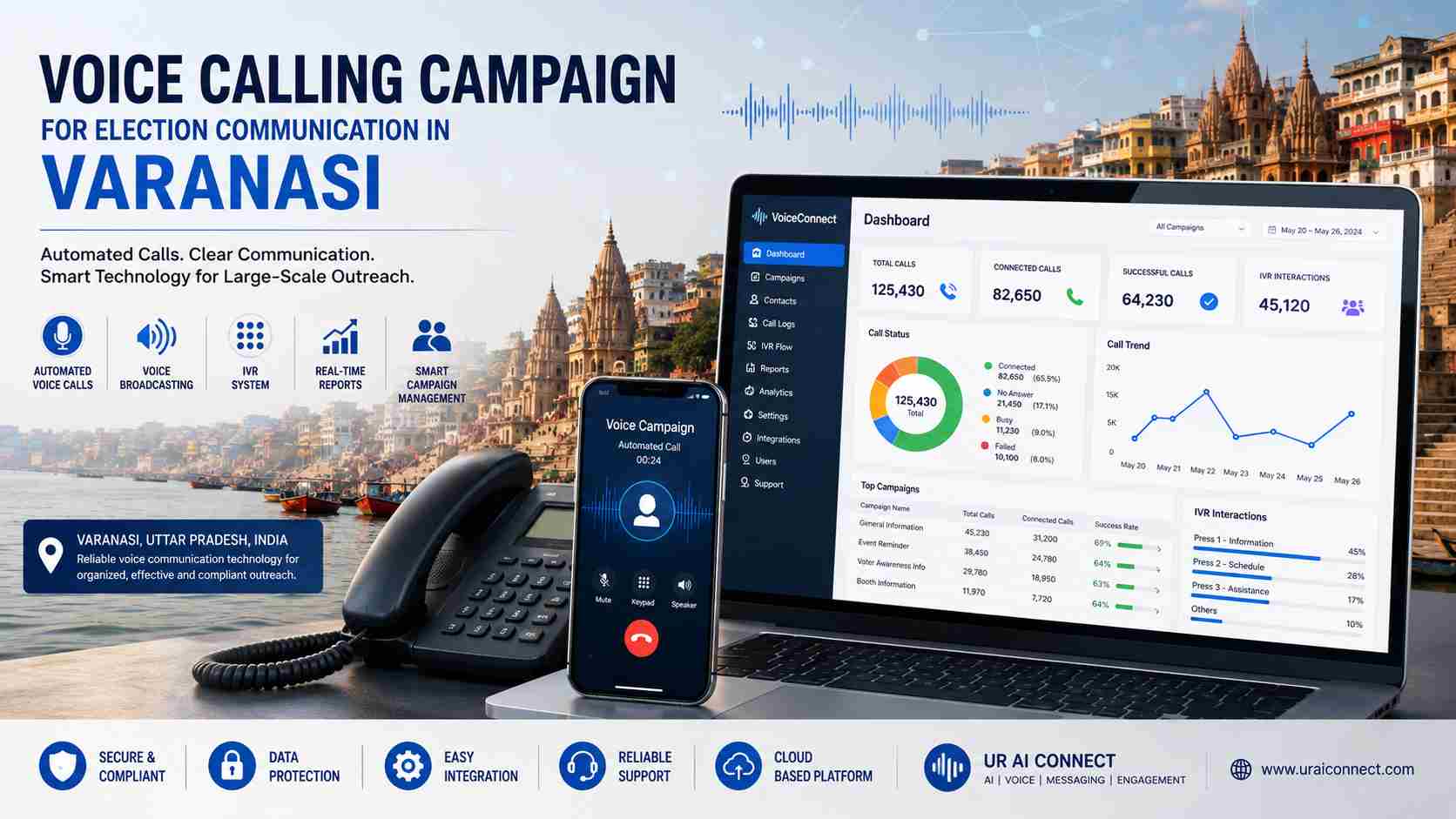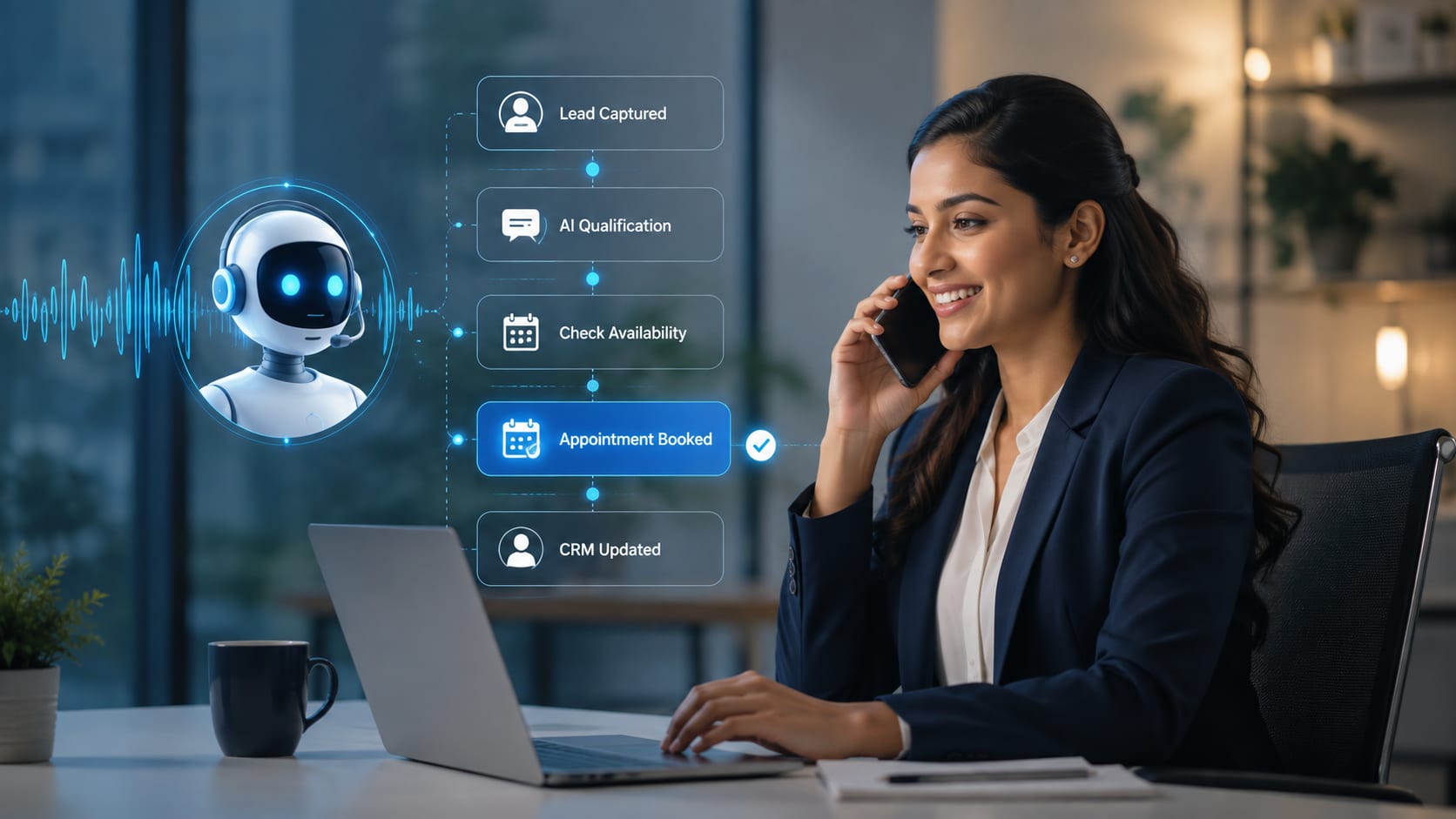
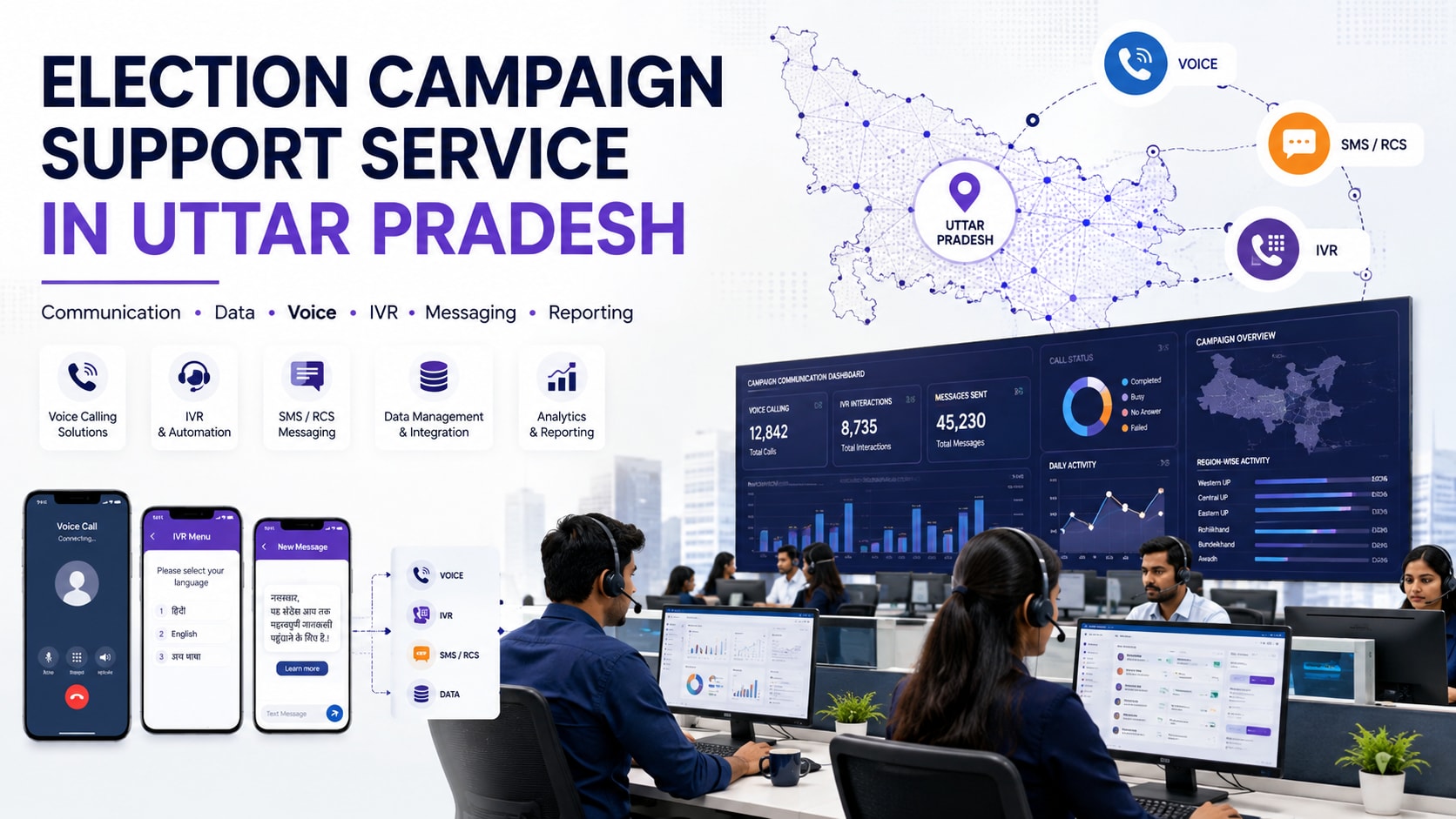
Election-related operations can involve large volumes of communication, coordination, data organization, scheduling, reporting, and administrative work. In a large state such as Uttar Pradesh, organizations involved in election activities may need structured technology and communication infrastructure to manage these activities efficiently.
An election campaign support service in Uttar Pradesh can include communication infrastructure, voice calling systems, IVR, SMS, RCS, WhatsApp Business communication, data management, campaign coordination, reporting, call-center support, and automated notifications. These services can help teams organize communication workflows while keeping operations measurable and manageable.
Campaign-support technology should be used responsibly. Communication systems should not be designed to manipulate voters, target people based on sensitive characteristics, spread misleading information, or bypass applicable laws and platform rules. Election-related communication should be planned with appropriate compliance, consent, data-security, and operational controls.
This guide explains what election campaign support services can include, how communication technology can support campaign-related operations in Uttar Pradesh, and what organizations should consider when selecting an election campaign service provider.
The objective is informational. This article does not support or oppose any political party, candidate, ideology, or electoral choice.
What Is an Election Campaign Support Service in Uttar Pradesh?
An election campaign support service in Uttar Pradesh is a collection of technology, communication, data-management, coordination, and reporting services that can help organizations manage election-related communication operations. Depending on the provider, services may include voice calling, IVR, SMS, RCS, WhatsApp Business communication, cloud call-center infrastructure, scheduling, notifications, analytics, and administrative support.
Understanding Campaign Support
Election campaigns can involve many operational activities beyond public messaging. Teams may need to coordinate communication schedules, manage contact information, organize incoming enquiries, monitor calls, maintain communication records, distribute approved information, and prepare reports.
An election campaign support company in Uttar Pradesh can provide technology infrastructure that helps organize these activities through centralized systems.
The exact scope of an election campaign support service in Uttar Pradesh can vary according to the organization, communication requirements, geographic coverage, technical infrastructure, and compliance requirements.
For example, one organization may mainly require a cloud-based calling system, while another may require a combination of IVR, SMS, RCS, WhatsApp Business communication, call-center support, and reporting.
The purpose of such technology should be operational efficiency rather than political persuasion.
Why Communication Infrastructure Matters
Communication is an important part of any large-scale organized operation. During election periods, communication requirements can increase because teams may need to coordinate people, schedules, information requests, field operations, events, internal teams, and public-facing communication.
A structured communication platform can help organizations:
Schedule approved communications
Maintain communication records
Organize incoming enquiries
Route calls to appropriate teams
Provide automated information
Monitor communication activity
Generate operational reports
Coordinate multiple communication channels
Reduce repetitive manual tasks
Centralize communication workflows
This does not mean that technology replaces human decision-making. Instead, technology can provide infrastructure that allows teams to manage repetitive communication and administrative tasks more systematically.
Campaign Coordination and Administration
Campaign coordination can involve many teams working simultaneously. Without a structured system, information can become fragmented across spreadsheets, phones, messaging applications, emails, and separate communication platforms.
A centralized communication system can help bring operational information into a more organized workflow.
For example, an organization may create a communication schedule containing:
Approved message content
Intended communication channel
Scheduled date and time
Responsible team
Communication status
Delivery or call information
Follow-up requirements
Reporting information
This approach makes it easier for administrators to understand what communication has been scheduled and whether it has been completed.
Data Organization for Election-Related Operations
Data management is another important part of campaign support.
An organization may need to manage contact records, communication histories, enquiry information, campaign schedules, internal team information, and reporting data.
Good data management should focus on accuracy, access control, security, retention policies, and responsible use.
An election campaign data services Uttar Pradesh workflow should not automatically mean collecting every possible piece of information about individuals. Instead, organizations should determine what information is genuinely necessary for a legitimate operational purpose and manage it appropriately.
A practical data-management system may include:
Contact database
Communication history
Call records
Message status
Enquiry records
Follow-up status
Team assignments
Campaign schedules
Reporting dashboards
Access permissions
Data should also be protected against unauthorized access, accidental disclosure, inappropriate sharing, and unnecessary retention.
Communication Across Uttar Pradesh
Uttar Pradesh is geographically large and contains a wide variety of urban, semi-urban, and rural areas. Communication infrastructure therefore needs to be scalable and flexible.
An organization operating across locations such as Lucknow, Varanasi, Kanpur, Agra, Prayagraj, Noida, Ghaziabad, Gorakhpur, Meerut, or Bareilly may have different operational requirements.
However, location alone should not determine how individuals are profiled or targeted.
A responsible election campaign management services UP approach focuses on operational requirements such as communication volume, language requirements, scheduling, team coordination, infrastructure availability, and reporting.
Voice Communication as an Operational Channel
Voice remains useful when organizations need to communicate information through telephone-based systems.
Voice communication infrastructure can support:
Outbound calling
Inbound call handling
Automated voice messages
IVR menus
Call routing
Call recording where lawfully appropriate
Call reports
Agent-based calling
Automated notifications
Call-center operations
The actual use of voice communication should always comply with applicable telecommunications requirements and election-related rules.
Technology should not be treated as a way to avoid regulatory requirements.
Interactive Voice Response and IVR
IVR, or Interactive Voice Response, allows callers to interact with a structured telephone menu.
A basic IVR workflow could be:
Incoming Call → Welcome Message → Menu Options → Information Selection → Appropriate Response
For example, an organization could use an IVR system to provide general information or route enquiries to different departments.
IVR can reduce the workload on human support teams when the same basic questions are received repeatedly.
A properly configured system can provide consistent information and help organizations understand broad operational demand through reports.
Automated Calling and AI Voice Technology
AI calling technology can automate certain parts of voice communication. Depending on the system, an AI voice agent may be capable of handling predefined conversations, answering common questions, collecting permitted information, or routing a call to a human team.
AI should not be presented as a replacement for all human communication.
Human oversight remains important, particularly where communication is complex, sensitive, unclear, or requires a decision that automated systems should not make.
An election campaign technology services UP solution can therefore combine automation with human support.
A possible workflow is:
AI Voice Agent → Basic Enquiry → Information Capture → Classification → Human Team
This can help separate routine communication from enquiries that require additional attention.
SMS and RCS Communication
SMS can be useful for short-form notifications and information sharing. RCS can provide richer messaging capabilities where supported by the recipient's device, network, and service environment.
Potential operational uses can include:
Schedule notifications
Event-related information
Confirmation messages
Approved informational communication
Service notifications
Follow-up messages
Internal coordination alerts
The suitability of a channel depends on the communication purpose, recipient permissions, applicable regulations, platform requirements, and message content.
Organizations should not assume that every communication method is permitted for every election-related purpose.
WhatsApp Business Communication
WhatsApp Business solutions can provide another channel for structured communication where the platform's policies and applicable rules allow the intended use.
Organizations may use approved templates, automated responses, customer-support style workflows, notifications, and human handover processes.
The platform should be treated as one component of a broader communication infrastructure rather than a replacement for compliance and communication planning.
Campaign Reporting
Reporting provides visibility into communication operations.
A campaign-support dashboard may show information such as:
Number of calls attempted
Number of calls connected
Call duration
Message delivery information
IVR interactions
Enquiries received
Follow-up status
Communication schedules
Team activity
Channel performance
Operational exceptions
Reports should be used to understand service operations rather than to make unsupported claims about electoral outcomes.
General Communication Infrastructure vs Political Persuasion
It is important to distinguish between technology infrastructure and political persuasion.
Communication infrastructure can include:
Cloud telephony
IVR
Call routing
Message delivery
Data organization
Reporting
Scheduling
Customer-support systems
Automated notifications
Political persuasion involves content designed to influence political opinions or electoral choices.
A technology provider can offer infrastructure without endorsing a political position.
This distinction is particularly important for an election campaign service provider Uttar Pradesh, because the provider should clearly define what technical services it supplies and what responsibilities remain with the organization using those services.
What Services Can Election Campaign Support Providers Offer?
Election campaign support providers can offer communication, calling, IVR, messaging, data-management, scheduling, reporting, call-center, and automation infrastructure. The exact services vary by provider. A suitable solution should be selected according to operational requirements, communication volume, technical integration needs, security controls, reporting requirements, and applicable compliance obligations.
Campaign Communication Support
Campaign communication support can provide the infrastructure required to organize approved communications across multiple channels.
Instead of managing each communication method separately, an organization may use an integrated platform to coordinate different activities.
For example:
Communication Planning → Content Approval → Scheduling → Delivery → Monitoring → Reporting
This process can reduce operational confusion and create a clear record of communication activities.
The content itself should be prepared and approved by the responsible organization according to applicable requirements.
Voice Calling Infrastructure
Voice calling solutions can support both automated and agent-assisted communication.
A typical platform may provide:
Caller management
Number management
Call scheduling
Call routing
IVR
Agent dashboards
Call records
Call analytics
Automated voice workflows
Follow-up management
For large operations, cloud-based infrastructure can allow teams to manage communication without maintaining a traditional physical call-center setup for every activity.
Cloud Call Center Support
A cloud call center can centralize communication through internet-based systems.
Features may include:
Agent login
Call distribution
IVR
Call queues
Call recording where permitted
Supervisor dashboards
Performance reports
Call history
Team management
For an organization operating across Uttar Pradesh, a cloud-based system can make centralized administration easier.
However, scalability should always be evaluated based on actual traffic and infrastructure capacity rather than assuming unlimited calling capability.
IVR Solutions
IVR is particularly useful for structured information access.
A basic example might be:
Press 1: General Information
Press 2: Event Information
Press 3: Connect With Support
Press 4: Repeat Menu
This type of system can help reduce repetitive calls handled manually.
A more advanced system may include multiple levels of menus, call routing, business-hours configuration, multilingual prompts, and reporting.
The menu should remain simple enough for callers to understand without unnecessary complexity.
Bulk SMS Communication
Bulk SMS platforms can send approved messages to large numbers of recipients through telecommunications infrastructure.
An organization considering bulk SMS should evaluate:
Sender registration requirements
Message templates
Consent requirements where applicable
Delivery reporting
Sender identification
Content controls
Opt-out or preference mechanisms where relevant
Regulatory requirements
TRAI's current guidance explains registration, headers, content templates, and consent-related processes for regulated commercial communication. Election-related communication may involve additional legal and regulatory considerations, so the appropriate classification should not be assumed.
RCS Messaging
RCS can provide richer messaging than traditional SMS in supported environments.
Depending on the implementation, RCS can support richer layouts, buttons, branding, media, and structured interactions.
For organizations, the benefit is primarily improved communication presentation and interaction capabilities.
However, availability and functionality can vary depending on device, carrier, platform, and implementation.
WhatsApp Business Solutions
WhatsApp Business communication can help organizations manage structured conversations where the intended use is allowed.
A communication workflow can include:
Message → Automated Response → User Selection → Information → Human Support
Businesses and organizations should review WhatsApp's current policies, approved use cases, templates, consent requirements, and restrictions before launching any communication program.
Data Management Services
Data management can include:
Data import
Data cleaning
Duplicate management
Contact organization
Field validation
Communication history
Access permissions
Reporting
Data export
Data retention management
Data quality is particularly important because incorrect records can lead to failed communications, duplicated communication, operational confusion, and inaccurate reporting.
A provider should explain how data is stored, processed, transferred, backed up, accessed, and deleted.
Lead and Enquiry Management
In a campaign-support context, "lead" or "enquiry" should generally be understood as an operational contact or information request rather than an assumption about an individual's political preference.
A support system can classify incoming requests according to operational categories.
For example:
General Enquiry → Information Request → Follow-Up Required → Resolved
This allows support teams to focus their attention on unresolved requests.
Communication Scheduling
Scheduling can help teams coordinate large communication programs.
A scheduling system may include:
Date
Time
Channel
Message
Responsible team
Approval status
Target communication group
Delivery status
Reporting status
Scheduling also provides an opportunity for an internal review before communication is released.
Automated Notifications
Automated notifications can reduce repetitive manual work.
Examples include:
Schedule reminders
Internal alerts
Status notifications
Communication completion alerts
Support-team notifications
System alerts
Automation should be configured with safeguards so that incorrect or unapproved information is not distributed automatically.
Campaign Analytics and Reporting
Analytics can show operational performance without attempting to predict electoral outcomes.
For example, an organization can measure:
Operational AreaExample MetricsVoiceCalls attempted, connected calls, durationIVRMenu selections, completed sessionsSMS/RCSSent, delivered, failedSupportEnquiries received, resolved, pendingSchedulingPlanned, completed, cancelledTeamsActivity levels, response timesReportingDaily, weekly, channel-wise summaries
These metrics can help managers identify operational bottlenecks.
They should not be presented as evidence that a candidate or political organization will win an election.
How UR AI CONNECT Can Support Communication Workflows
UR AI CONNECT is a technology and communication solutions provider offering services across AI, voice, messaging, and customer-engagement workflows.
For organizations evaluating an election campaign support service in Uttar Pradesh, relevant technology areas from UR AI CONNECT can include AI Calling, AI Voice Agents, Voice Calling Solutions, IVR Solutions, Cloud Call Center, Bulk SMS, RCS Messaging, WhatsApp Business Solutions, customer notifications, and automated communication.
The technology can be considered as communication infrastructure for appropriate campaign-related workflows.
For example, an organization may use a voice platform for structured calling, IVR for information requests, SMS or RCS for approved notifications, and reporting tools to monitor communication operations.
UR AI CONNECT should not be presented as guaranteeing votes, electoral success, campaign victory, or any political outcome.
More information about its communication solutions is available through the company's website: UR AI CONNECT
Example: A Neutral Campaign Communication Workflow
Consider a hypothetical organization that needs to coordinate a large number of campaign-related communication activities.
The organization could use the following process:
Step 1: Communication Planning
The team prepares an approved communication calendar.
Step 2: Content Review
Messages and scripts are reviewed by the responsible team.
Step 3: Channel Selection
The organization selects voice, IVR, SMS, RCS, WhatsApp Business, or another appropriate channel.
Step 4: Technical Setup
The communication provider configures the required infrastructure.
Step 5: Controlled Deployment
Communication begins according to the approved schedule.
Step 6: Monitoring
Delivery, calls, enquiries, and technical performance are monitored.
Step 7: Reporting
The organization receives operational reports.
Step 8: Follow-Up
Unresolved technical or communication issues are assigned to the appropriate team.
This workflow focuses on administration and communication infrastructure rather than political persuasion.
Responsible Use of AI in Election Communication
AI can improve automation, but it also creates additional responsibility.
AI-generated voice or automated conversational systems should be managed carefully.
Organizations should consider:
Clearly defined use cases
Human oversight
Accurate information
Appropriate disclosure where required
Data security
Error handling
Escalation to human agents
Audit records
Content approval
Compliance checks
AI should not be used to create deceptive identities, misleading communications, fabricated information, or manipulative voter-targeting systems.
Multilingual Communication Considerations
Uttar Pradesh has a diverse population and communication requirements can vary by location and audience.
Where multilingual communication is legitimately required, organizations may need to consider:
Language selection
Script accuracy
Voice pronunciation
Translation quality
Human review
Local terminology
Accessibility
Automated translation should not be treated as automatically accurate.
Important public-facing information should be reviewed before large-scale distribution.
How Can Organizations Choose an Election Campaign Support Provider in Uttar Pradesh?
Organizations should evaluate an election campaign support provider based on technical capability, communication channels, scalability, security, reporting, integrations, reliability, customer support, compliance processes, pricing, and service-level expectations. The provider should clearly explain what it supplies, how data is handled, how communication is monitored, and what responsibilities remain with the organization.
Technical Capabilities
The first evaluation area is technology.
Organizations should ask whether the provider supports the communication channels they actually require.
Questions may include:
Does the platform support voice communication?
Is IVR available?
Can calls be routed to human agents?
Is cloud call-center infrastructure available?
Are SMS capabilities available?
Is RCS supported?
Are WhatsApp Business workflows supported?
Are APIs available?
Can the platform integrate with existing systems?
Are real-time or scheduled reports available?
A provider should describe actual capabilities rather than making broad claims about unlimited functionality.
Communication Channels
Different communication channels serve different purposes.
Voice can support conversations and automated calling. IVR can provide structured information. SMS can deliver short notifications. RCS can provide richer messaging. WhatsApp Business can support structured conversations where permitted.
Organizations should select channels according to communication requirements rather than attempting to use every available channel.
A multi-channel platform can be useful when it provides centralized reporting and management.
Data Security
Data security should be a major consideration for any provider handling communication information.
Organizations should ask:
Where is data stored?
Who can access it?
Is access role-based?
Is data encrypted?
Are backups maintained?
How long is information retained?
How can data be deleted?
Are third-party processors involved?
What happens if an account is closed?
Are access logs available?
A provider should have clear policies rather than relying on general statements such as "your data is safe."
Data Minimization
Organizations should also consider whether they are collecting more data than they actually need.
A responsible system should collect information based on legitimate operational requirements.
For example, if a communication workflow only requires a telephone number and communication status, collecting unrelated personal information may increase unnecessary risk.
Data minimization can make systems easier to manage and reduce exposure.
Scalability
Election-related communication volumes can change significantly.
A provider should therefore explain how its infrastructure handles increased demand.
Questions can include:
What is the supported calling capacity?
How does the system handle peak traffic?
Are additional resources available?
What happens during traffic spikes?
Are there rate limits?
What redundancy is available?
How quickly can capacity be increased?
Scalability should be demonstrated through technical specifications and service commitments rather than vague claims.
Reporting
Reporting is essential for operational management.
A useful dashboard may allow an organization to view communication activity by:
Date
Channel
Campaign
Team
Communication status
Call status
Enquiry status
Reports should be understandable to both technical and non-technical managers.
Export functionality can also be useful when teams need to review or archive operational information.
Integration
Many organizations already use CRM, databases, call-center systems, websites, or internal software.
API and integration capabilities can reduce duplicate data entry.
For example:
CRM → Communication Platform → Voice/SMS/RCS → Status → CRM
A provider should clearly document API availability, authentication methods, data formats, rate limits, error handling, and support.
Customer Support
Technical infrastructure is only useful when support is available when problems occur.
Organizations should evaluate:
Support hours
Response times
Escalation process
Technical account management
Issue tracking
Emergency support
Documentation
Training
A dedicated support process can be especially useful during high-volume communication periods.
Reliability
Reliability should be evaluated through service architecture and measurable service-level expectations.
Important considerations include:
Infrastructure redundancy
Network availability
Monitoring
Backup systems
Disaster recovery
Incident management
Service-level agreements
A provider should explain how it handles service interruptions.
Compliance
Compliance is one of the most important areas for election-related communication.
Organizations should not assume that because a communication platform technically allows a message, call, advertisement, or campaign workflow, the activity is automatically legally permissible.
The Election Commission of India maintains the Model Code of Conduct and related election instructions. The ECI states, among other things, that election activities should avoid practices that aggravate differences or create mutual hatred and that certain restrictions apply to campaigning activities.
The ECI has also issued instructions concerning political advertisements on internet-based and social-media platforms, including pre-certification requirements in relevant circumstances, as well as treatment of online campaign expenditure under election-expense rules.
Because requirements can vary according to election type, communication method, content, timing, and other circumstances, organizations should verify the current rules with the appropriate authorities before deployment.
Telecommunications Requirements
Telecommunications regulations are another important consideration.
TRAI provides guidance for regulated commercial communication, including sender registration, registered headers, content templates, and consent-related processes. TRAI also maintains information concerning unsolicited commercial communications and voice-related regulatory frameworks.
Election-related communication should not automatically be classified as ordinary commercial communication. The responsible organization and its legal or compliance advisers should determine which requirements apply to the particular communication.
A technology provider should be able to explain its telecommunications infrastructure and compliance-support mechanisms without claiming that technology itself provides legal authorization.
Platform Rules
Communication platforms may have their own policies.
This can include rules governing:
Automated messaging
Bulk communication
Political content
Advertising
Business messaging
Account verification
User consent
Content restrictions
Platform rules can change, so organizations should check current documentation before launching a campaign-related communication program.
Pricing Considerations
Pricing may depend on:
Number of calls
Call duration
Number of agents
SMS volume
RCS usage
WhatsApp Business usage
IVR complexity
AI voice usage
API requirements
Reporting
Integration
Support
Setup fees
The lowest-cost provider may not necessarily provide the best value.
Organizations should compare the total operating cost, technical capabilities, reliability, support, and compliance-related features.
Service-Level Expectations
A written service agreement can clarify responsibilities.
It may define:
Availability
Support response time
Issue escalation
Data handling
Service limitations
Maintenance windows
Reporting
Billing
Termination
Data return or deletion
Clear expectations can prevent confusion during high-volume operations.
Questions to Ask Before Selecting a Provider
Before selecting an election campaign service provider Uttar Pradesh, organizations can ask:
What communication channels are supported?
What is the maximum supported communication volume?
How is data protected?
Can the platform integrate with existing systems?
What reports are available?
Is IVR supported?
Can automated and human calling be combined?
What customer support is provided?
What are the pricing components?
What compliance-support features are available?
How are communication records retained?
What happens if the service becomes unavailable?
The answers can help organizations compare providers more objectively.
Compliance and Responsible Communication
Election communication should be planned with appropriate legal and regulatory review.
The Model Code of Conduct and election instructions published by the Election Commission of India should be considered when applicable. The ECI's official resources include the Model Code of Conduct and a broader compendium of election-related instructions.
Organizations should also consider applicable telecommunications requirements, data-protection obligations, platform policies, consent requirements, and other relevant rules.
This article provides general informational guidance and is not legal advice.
Current rules can change depending on the election, jurisdiction, communication channel, timing, and regulatory direction. Organizations should verify applicable requirements through authoritative sources before launching election-related communications.
Practical Example: Managing a Large Communication Operation
Consider a hypothetical campaign office that needs to coordinate several communication activities.
The team may begin by preparing a communication calendar.
The calendar could contain:
Approved communication
Date and time
Channel
Responsible department
Technical status
Delivery status
Reporting requirements
The technical provider can then configure the required voice, messaging, or IVR infrastructure.
During deployment, supervisors can monitor system activity and review reports.
If an issue occurs, the support team can investigate it and document the resolution.
This approach creates an operational workflow without making assumptions about political preferences or electoral outcomes.
Practical Example: IVR for Information Requests
A hypothetical organization could use an IVR system to answer general information requests.
A caller might hear:
Welcome → Select Language → Select Information Category → Hear Information → Connect to Support if Required
The system could record operational information such as menu selections and call duration where appropriate.
The purpose is to make information access more organized.
The system should not be designed to pressure callers or manipulate individual electoral choices.
Practical Example: Communication Reporting
A support team may review a daily dashboard showing:
Calls attempted
Calls connected
Average call duration
IVR completion rate
Messages sent
Delivery results
Pending enquiries
Technical errors
Managers can use these reports to identify operational issues.
For example, if message delivery failures suddenly increase, the technical team can investigate the relevant communication channel.
This is an example of using analytics for service management rather than electoral prediction.
Frequently Asked Questions
What is an election campaign support service in Uttar Pradesh?
An election campaign support service in Uttar Pradesh can include technology and operational infrastructure for election-related communication and coordination. Depending on the provider, this may include voice calling, IVR, SMS, RCS, WhatsApp Business communication, cloud call-center systems, data management, scheduling, notifications, and reporting. Such services should be used responsibly and according to applicable election, telecommunications, privacy, and platform requirements.
What services are included in election campaign support?
Services can vary by provider but may include voice calling infrastructure, IVR, cloud call centers, SMS, RCS, WhatsApp Business communication, communication scheduling, data management, automated notifications, reporting, analytics, and technical integration. Organizations should evaluate services based on their actual operational requirements instead of selecting technology simply because it is available.
Can voice calling be used for election campaign communication?
Voice calling can be part of election-related communication infrastructure, but its use must follow applicable laws, regulations, telecommunications requirements, consent rules where applicable, election instructions, and platform or service-provider requirements. Organizations should determine the permitted use of a particular calling workflow before deployment rather than assuming that automated or bulk calling is automatically allowed.
What is the role of IVR in campaign communication?
IVR can provide a structured telephone interface through which callers select options to receive information or reach a support team. It can reduce repetitive manual work and provide consistent responses for common information requests. IVR can also generate operational reports, although organizations should ensure that the system is configured responsibly and complies with applicable requirements.
Can SMS and RCS be used for campaign communication?
SMS and RCS can provide communication channels for approved messages where their use is permitted. The exact regulatory and platform requirements depend on the nature of the communication, sender, recipient, content, timing, and applicable rules. Organizations should verify current requirements before sending large-scale election-related communications and should not assume that commercial messaging rules automatically cover every election communication.
What should organizations consider when choosing a campaign-support provider?
Organizations should evaluate technical capabilities, communication channels, scalability, security, reporting, integrations, reliability, customer support, pricing, and compliance processes. It is also important to understand who controls communication content, who manages data, how information is stored, what support is available, and what happens during technical failures.
How can campaign communication data be managed securely?
Data should be collected only for appropriate operational purposes and protected through access controls, secure storage, appropriate authentication, monitoring, retention policies, and controlled sharing. Organizations should ask providers about data storage, backups, access permissions, third-party processors, retention, deletion, and incident management. Data-security practices should be documented rather than based only on verbal assurances.
Can campaign communication services be scaled for large operations?
Many cloud communication platforms are designed to scale, but actual capacity depends on infrastructure, telecommunications providers, account limits, technical configuration, and service agreements. Organizations should ask for clear capacity specifications, peak-traffic handling procedures, redundancy information, and support arrangements before launching high-volume communication.
What technology can support election campaign communication?
Potential technologies include cloud telephony, IVR, AI voice systems, SMS, RCS, WhatsApp Business communication, call-center platforms, APIs, CRM integrations, reporting dashboards, scheduling systems, and automated notifications. The appropriate technology depends on the operational requirement. Technology should support organized communication and administration without being used for deceptive, manipulative, or unlawful activity.
Why is compliance important for election-related communication?
Election-related communication can be subject to election laws, Election Commission instructions, telecommunications rules, data-protection requirements, and platform policies. The Election Commission of India publishes the Model Code of Conduct and other election-related instructions, while TRAI publishes telecommunications guidance and regulations relevant to regulated communications. Requirements can change, so organizations should verify current rules before deployment.