
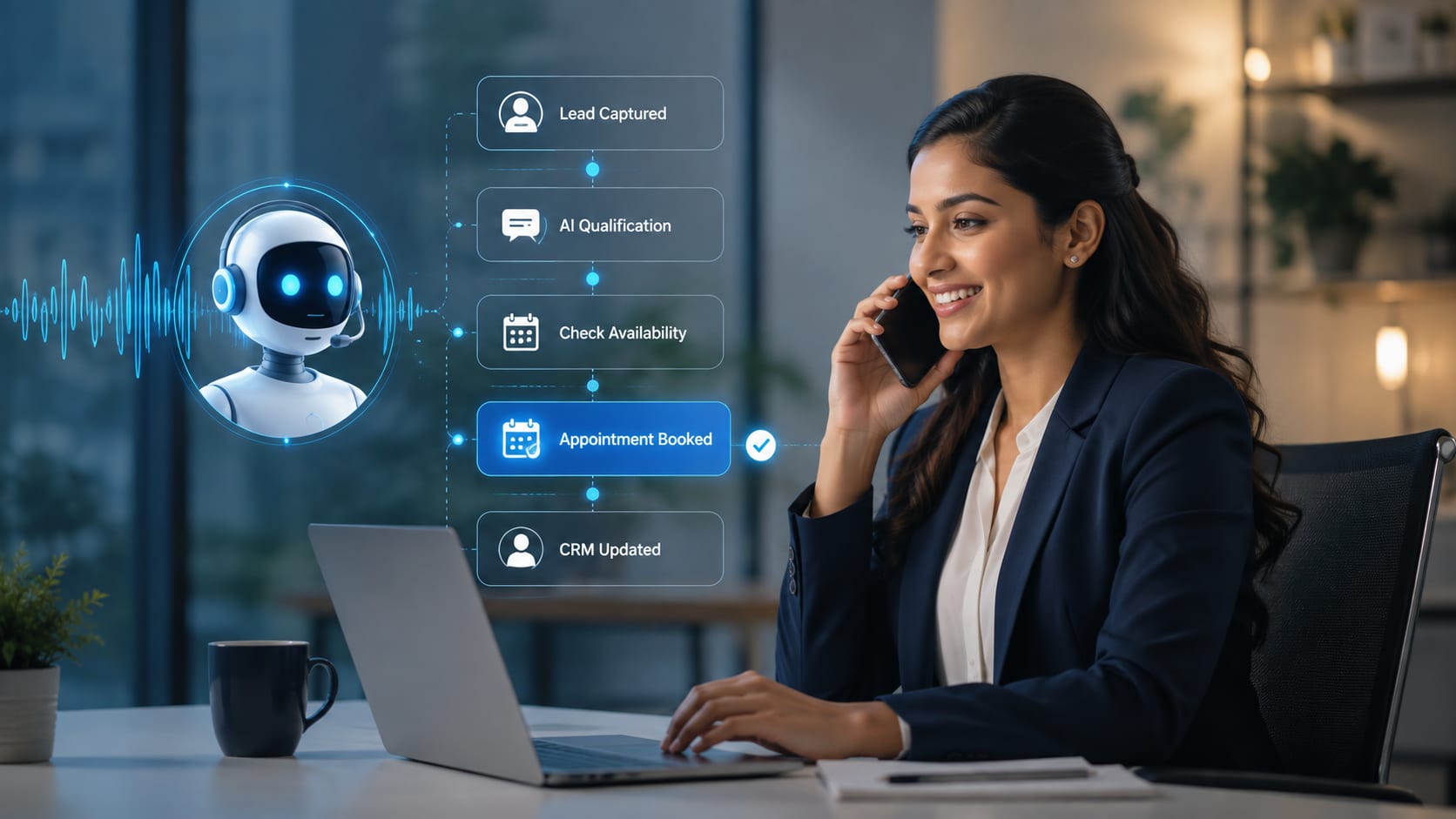
A lead becomes valuable when a business can move the conversation forward. A form submission, missed call, advertisement response, website enquiry, or WhatsApp message is only the beginning. If nobody responds quickly, asks the right questions, records the details, and provides a clear next step, the appointment opportunity can disappear.
AI voice bots for appointment leads are designed to automate this middle stage of the customer journey. Instead of leaving every first conversation to a salesperson or telecaller, an AI voice agent can contact or answer prospects, understand the purpose of the enquiry, ask predefined qualification questions, capture relevant information, and guide suitable prospects toward an appointment.
The important distinction is that appointment automation is not simply about making more calls. The useful workflow connects the conversation to qualification, calendar availability, CRM records, reminders, and human follow-up.
For Indian businesses, this workflow can become particularly relevant when leads arrive from several sources at once. Real estate enquiries may come from property portals and advertising campaigns. Education enquiries can increase during admission periods. Healthcare businesses may receive appointment requests throughout the day. SaaS companies may need to respond to demo requests while sales representatives are handling existing meetings.
UR AI Connect approaches this problem through an integrated communication model involving AI calling, messaging, CRM workflows, appointment setting, IVR, and human escalation. The underlying idea is straightforward: simplify the communication stack and make the next sales or service action easier to execute.
How Do AI Voice Bots for Appointment Leads Work?
AI voice bots for appointment leads work by connecting a lead source to an automated voice conversation, qualification workflow, scheduling system, and follow-up process. The AI can contact or answer a prospect, ask relevant questions, capture responses, offer available appointment options when integrated with a calendar, and pass complex conversations to a human representative.
An AI appointment workflow generally starts before the phone call.
A prospect may submit a form, respond to an advertisement, enquire through a property portal, call a business number, request information through WhatsApp, or become available for follow-up in a CRM.
The system then determines what should happen next.
A simple workflow can look like this:
Lead generated → Lead identified → AI call → Conversation → Qualification → Appointment option → Booking → CRM update → Reminder → Human follow-up
The voice bot is therefore one part of a larger appointment-setting process.
A business should not evaluate an AI voice agent only by asking whether it can speak naturally. The more important questions are whether it can follow the company's qualification rules, capture useful information, connect with business systems, respect configured communication requirements, and provide an appropriate handoff when automation reaches its limit.
UR AI Connect describes its AI calling workflow around inbound and outbound calling, qualification, appointment booking, CRM and calendar handoff, human escalation, campaign governance, and outcome reporting.
What Happens After a Lead Enters the System?
Consider a real estate enquiry.
A prospect fills out a form asking about a residential project.
Instead of placing the enquiry into a spreadsheet for later calling, the lead can enter a defined follow-up workflow.
The AI voice agent can establish:
The type of property required
Preferred location
Approximate budget
Purchase or rental requirement
Expected purchase timeline
Interest in a site visit
Preferred contact time
The responses can then be recorded as structured information.
A prospect looking for a property immediately and meeting the defined qualification criteria may be offered a site-visit appointment.
A prospect who is only researching may receive information and a later follow-up.
A prospect asking for detailed negotiation or a complex project-specific discussion can be transferred to a sales representative.
The difference is that the appointment process does not stop at “lead received.”
How Does AI Qualify an Appointment Lead?
AI qualifies an appointment lead by asking predefined questions and evaluating responses against business rules. The questions can cover requirements such as budget, location, timeline, service type, business size, course interest, or appointment purpose. Qualified prospects can then move toward scheduling or human sales follow-up.
The quality of qualification depends heavily on the questions.
Too many questions can make a conversation frustrating.
Too few questions can leave the sales team without enough context.
A useful qualification workflow identifies the information that actually affects the next business decision.
For a SaaS company, qualification might include:
Company type
Current software
Main business requirement
Number of users
Implementation timeline
Need for a product demonstration
For education:
Course of interest
Student level
Preferred intake
Eligibility
Counselling requirement
Preferred appointment time
For healthcare administration:
Appointment type
Preferred doctor or department
Preferred date
Preferred time
New or existing patient status
Rescheduling requirement
Clinical questions or decisions that require professional medical judgment should remain within an appropriate human-led process.
For real estate:
Property type
Preferred area
Budget range
Purchase or rental intent
Timeline
Site-visit interest
The AI should not attempt to collect information simply because it can. Each question should have a purpose.
How Can AI Voice Bots Book Appointments?
AI voice bots can book appointments when the voice workflow is connected to an appropriate scheduling or calendar system. The agent can establish the customer's preferred timing, check configured availability, offer suitable slots, confirm the selected appointment, and write the outcome back to the CRM or lead-management system.
The appointment stage is where many automation projects either become useful or remain disconnected.
An AI conversation that ends with “someone will call you later” has not necessarily completed the appointment workflow.
A stronger process can connect the conversation to actual availability.
For example:
The prospect confirms interest.
The AI identifies the appointment type.
The system checks configured calendar availability.
Suitable time slots are offered.
The prospect selects a slot.
The booking is confirmed.
The CRM receives the appointment information.
A reminder workflow is triggered.
A human representative receives the conversation context when required.
This approach reduces unnecessary back-and-forth between the prospect and sales team.
Appointment booking can also involve rescheduling.
If a customer cannot attend the original slot, the workflow can provide another available option rather than forcing a representative to manually coordinate every change.
What Happens When a Lead Needs a Human?
When a lead requires negotiation, detailed product knowledge, sensitive handling, or a decision outside the AI workflow, the conversation can be transferred or routed to a human representative. A useful AI appointment system should preserve relevant context so the customer does not have to repeat the entire conversation.
Human escalation is not a failure of AI.
It is an important part of responsible automation.
A voice agent can be useful for repetitive, structured interactions. Human representatives remain important for complex decisions, negotiations, exceptions, relationship-building, and conversations where judgment is required.
A well-designed handoff can include:
Lead name
Contact details
Reason for enquiry
Qualification responses
Appointment preference
Previous conversation summary
Required follow-up
Relevant CRM information
This is more useful than simply transferring a call with no context.
The human representative can then continue from the point where the AI stopped.
UR AI Connect's AI calling service describes warm transfer and CRM writeback as part of the workflow, allowing human teams to handle conversations that require escalation.
Why Do Appointment Leads Get Lost Before Booking?
Appointment leads are often lost because the process between lead generation and appointment booking is disconnected. Slow response, incomplete qualification, missed callbacks, unavailable sales staff, disconnected calendars, and weak follow-up can prevent a genuine enquiry from reaching a booked meeting.
Lead generation and appointment setting are different stages.
A campaign may generate a large number of enquiries, but those enquiries still need to be contacted and managed.
The common problems include:
Slow First Contact
A lead may arrive while sales representatives are busy.
Another lead may arrive after office hours.
A third may arrive during a weekend or holiday.
If every lead depends on an employee noticing a notification, opening a CRM, finding a phone number, and manually initiating the call, response consistency can become difficult.
AI calling can provide a structured first-response layer for suitable workflows.
Incomplete Lead Information
A CRM containing only a phone number does not provide much context to a salesperson.
A useful lead record may include:
Requirement
Budget
Location
Timeline
Interest level
Previous conversation
Objection
Requested appointment
Next action
The quality of CRM writeback therefore matters.
UR AI Connect's website emphasizes CRM notes and structured conversation outcomes rather than treating the phone number as the complete lead record.
Disconnected Calendars and CRMs
An AI agent may identify an interested prospect, but if the booking process is disconnected, the customer may still need to wait for a salesperson to coordinate the appointment.
The same problem occurs when a booking is made but the CRM is not updated.
Sales teams then have to reconcile information manually.
An integrated workflow aims to keep the conversation, appointment, and lead record connected.
Weak Follow-Up Processes
Some prospects are interested but not ready to book immediately.
They may request a callback.
They may need additional information.
They may ask to speak with another person.
They may want an appointment next week rather than today.
A good appointment system needs defined follow-up states rather than treating every conversation as simply “interested” or “not interested.”
What Can AI Voice Bots Do During an Appointment Conversation?
An AI voice bot can perform several structured appointment tasks, including answering common questions, collecting lead information, qualifying prospects, checking configured availability, booking or rescheduling appointments, sending follow-up actions, and recording conversation outcomes. More complex requests can be transferred to a human team.
The exact capability depends on the workflow, integrations, scripts, and business rules.
Answer Common Questions
Prospects frequently ask basic questions before agreeing to an appointment.
For example:
What service is available?
Which location does the business serve?
What type of appointment is available?
How long does the consultation take?
What information should the customer keep ready?
Is a particular time available?
An AI agent can handle approved informational responses without requiring a salesperson to repeat the same basic explanation.
For regulated or sensitive industries, the knowledge and escalation rules should be carefully defined.
Capture Qualification Information
Qualification should focus on information that helps the next person make a decision.
A real estate workflow may capture budget and location.
A SaaS workflow may capture company size and use case.
An education workflow may capture course interest and admission requirements.
The information should then become part of the lead record.
Offer Appointment Slots
The AI can ask for a preferred day or time and, where connected to the required scheduling system, offer available options.
This is particularly useful when appointment availability changes throughout the day.
The system should use actual configured availability rather than promising a slot that has not been confirmed.
Confirm and Remind Customers
A booked appointment is not necessarily the end of the workflow.
Confirmation and reminder communication can be useful for:
Consultations
Site visits
Product demonstrations
Admissions counselling
Service appointments
Follow-up calls
UR AI Connect also provides messaging, IVR, and voice services that can form part of broader appointment communication workflows.
Update the CRM
The CRM should capture more than “called.”
Useful fields can include:
Call outcome
Qualification status
Appointment status
Requested callback
Customer requirement
Objection
Escalation reason
Next action
Appointment date and time
This creates a usable operational record for the sales or service team.
How Should Businesses Build an AI Appointment Booking Workflow in India?
Businesses should build an AI appointment workflow around a defined lead source, qualification process, voice conversation, calendar connection, CRM writeback, human escalation, and reminder strategy. Indian businesses should also consider applicable communication rules, DND preferences, consent requirements, DLT processes where relevant, and the distinction between promotional and service communication.
A practical implementation can be divided into five stages.
Step 1: Define the Lead and Qualification Rules
Before selecting a voice bot, the business should decide what makes an appointment lead qualified.
For example, a real estate company might define a qualified site-visit opportunity as a prospect with:
Relevant property requirement
Suitable location
Defined budget
Reasonable purchase timeline
Interest in visiting the project
The exact criteria should come from the business rather than the technology vendor.
Step 2: Build the Conversation
The conversation should have a clear structure.
A basic flow can include:
Introduction
Reason for calling
Permission or appropriate context
Qualification
Customer questions
Appointment offer
Confirmation
Next-step explanation
The script should not sound like a long questionnaire.
Natural conversational design matters because prospects are more likely to disengage if the agent repeatedly asks unnecessary questions.
Step 3: Connect CRM and Calendar Systems
The voice workflow becomes more valuable when it can work with the systems already used by the business.
UR AI Connect states that its AI calling workflows can connect with CRM and calendar systems, including CRM platforms such as HubSpot and Zoho and Salesforce-ready webhooks.
The objective is not to create another isolated dashboard.
The objective is to make the conversation part of the existing sales process.
Step 4: Add Human Escalation
Every deployment should define when AI should step aside.
Escalation can be triggered by:
Customer request
Complex question
Negotiation
Sensitive issue
Low confidence
Business policy
Special customer category
Technical problem
The handoff should carry enough context for the human representative to continue efficiently.
Step 5: Add Messaging and Reminder Channels
Voice does not have to operate alone.
A customer may prefer a WhatsApp confirmation after a phone conversation.
Another customer may require an SMS reminder.
An IVR workflow may be suitable for a simple confirmation or rescheduling process.
RCS may be useful for certain rich messaging scenarios.
The purpose of multichannel communication is not to contact customers everywhere. It is to use the appropriate channel for the appropriate stage.
India-Specific Communication Considerations
Indian businesses using automated calling and messaging should pay attention to the communication category and applicable requirements.
TRAI's sender guidance explains concepts including registered headers and commercial communication requirements. TRAI also provides information concerning unsolicited commercial communication, customer preferences, and related regulatory frameworks.
Businesses should therefore avoid treating compliance as an afterthought.
Campaign configuration may need to consider:
DND or customer preference
Consent
Communication category
DLT requirements
Registered headers where applicable
Message or calling templates
Promotional versus service communication
Opt-out handling
Record keeping
The precise obligations depend on the communication and business scenario. Applicable rules should be checked before launching a campaign.
Which Businesses Can Use AI Voice Bots for Appointment Leads?
AI voice bots can support appointment workflows in industries where customers regularly request consultations, demonstrations, visits, counselling sessions, or service appointments. Common examples include real estate, education, healthcare administration, SaaS, professional services, automotive, recruitment, and selected local service businesses.
The workflow should be adapted to the industry rather than copied across every business.
Real Estate
Real estate is a natural appointment-setting environment because many enquiries ultimately need a site visit or sales consultation.
A workflow can look like:
Property enquiry → AI call → Location and budget qualification → Project interest → Site-visit slot → CRM update → Reminder → Sales representative
The AI can handle the initial information-gathering stage while the sales team focuses on property discussions, negotiation, and relationship building.
Education
Education businesses frequently manage admission enquiries, counselling requests, course questions, and appointment scheduling.
A possible workflow is:
Admission enquiry → AI call → Course interest → Eligibility information → Counselling slot → Confirmation → Reminder → Counsellor
The AI should not invent admission policies or eligibility criteria. The knowledge base should be based on approved information supplied by the institution.
Healthcare
Healthcare requires greater care because appointment administration and clinical advice are different activities.
A suitable workflow may be:
Appointment request → AI/IVR interaction → Department or appointment type → Available slot → Confirmation → Reminder → Human escalation
For clinical questions, the system should route the customer appropriately rather than attempting to provide unsupported medical advice.
UR AI Connect's healthcare offering specifically describes appointment agents, reminder workflows, inbound IVR, and human handling as relevant communication components.
SaaS and Technology
SaaS companies can use AI appointment workflows for demo requests.
A possible process is:
Demo request → AI call → Business requirement → Current solution → User count → Timeline → Demo booking → CRM update → Account executive follow-up
The AI can collect context before the sales representative enters the conversation.
Professional and Local Services
Professional services can use similar workflows for consultation requests.
Examples include:
Legal consultation intake
Financial service enquiries
Automotive service appointments
Recruitment screening calls
Home service requests
Business consulting calls
The qualification questions should match the service.
What Should Businesses Check Before Choosing an AI Voice Agent?
Businesses should evaluate an AI voice agent based on conversation quality, workflow flexibility, CRM and calendar integration, inbound and outbound capability, human escalation, reporting, communication governance, and suitability for the intended use case. The right system should fit the business process rather than forcing the business to redesign everything around the technology.
A useful evaluation should examine the complete workflow.
Conversation Quality
The agent should be able to handle natural interruptions and common variations in customer responses.
A good demonstration should test real questions rather than only a prepared script.
For example:
“I am interested, but I need next Saturday.”
“Can someone explain the pricing?”
“I already spoke to someone yesterday.”
“I want a different appointment.”
“Can I speak to a person?”
The objective is to see how the system behaves when the conversation moves away from the ideal path.
CRM and Calendar Integration
The AI voice agent should not become another isolated system.
Businesses should ask:
Can lead information be written to the CRM?
Can conversation outcomes be stored?
Can appointment details be recorded?
Can existing lead information be read?
Can calendar availability be used?
Can webhooks or APIs connect the workflow to existing systems?
UR AI Connect positions CRM writeback and calendar handoff as important parts of its AI calling workflows.
Inbound and Outbound Calling
Businesses should distinguish between inbound and outbound use cases.
Inbound AI can answer:
Website-generated calls
Missed-call callbacks
Existing customer enquiries
After-hours enquiries
Overflow calls
Outbound AI can support:
Fresh lead follow-up
Appointment confirmation
Reminders
Callbacks
Structured campaigns
Selected renewal or service workflows
The communication rules and customer expectations can differ between the two.
Human Handoff
The system should provide a clear answer to one question:
What happens when the AI cannot or should not continue?
The handoff process should be designed before launch.
An escalation can route the conversation to:
Sales
Support
Admissions
Front desk
Appointment desk
Specialist team
Human callback queue
India-Specific Communication Requirements
Businesses should examine how the provider approaches DND-aware calling, consent logging, campaign governance, and applicable telecom requirements.
TRAI publishes official information concerning commercial communication and unsolicited commercial communication. These resources should be consulted when planning campaigns that involve commercial calls or messages.
A provider should be able to explain how the workflow is configured without making blanket claims that every campaign is automatically compliant.
Reporting and Conversation Records
Useful reporting should help answer operational questions.
For example:
How many leads entered the workflow?
How many calls were answered?
How many conversations completed?
How many leads qualified?
How many appointments were booked?
Why were leads disqualified?
How many requested a callback?
Where did conversations drop?
How many required human escalation?
The goal is not to create an impressive dashboard.
The goal is to make the appointment process easier to understand and improve.
How Can UR AI Connect Fit Into an Appointment Lead Workflow?
UR AI Connect can fit into an appointment lead workflow by connecting AI calling with lead generation, qualification, appointment setting, CRM processes, WhatsApp, SMS, RCS, IVR, and cloud call-center capabilities. This supports a broader communication journey instead of treating AI calling as an isolated phone automation tool.
The company's positioning is centered on connecting communication channels and the middle of the funnel.
That distinction matters.
A business may already have:
A website
Google Ads
Meta Ads
Lead forms
Property portals
WhatsApp
A CRM
Sales representatives
The problem can occur after the lead arrives.
UR AI Connect's service model brings lead generation, calling, messaging, appointment setting, and CRM workflows into the same operational conversation.
For example:
Advertisement → Lead form → AI calling → Qualification → WhatsApp information → Appointment → Reminder → CRM update → Human sales follow-up
This can be particularly relevant for businesses that currently use different vendors for lead generation, calling, messaging, and appointment setting.
The company's service ecosystem includes AI Calling Agent, Inbound Calling, Outbound Calling, Lead Qualification Calls, Appointment Booking, WhatsApp Marketing, Bulk SMS, RCS SMS, IVR, Cloud Call Center, Lead Generation Campaigns, DND Filter Services, and Digital Marketing.
The practical objective is not to automate every customer interaction.
It is to automate the repetitive parts while keeping people involved where their judgment and relationship skills are most valuable.
When Should a Business Use AI Instead of Manual Calling?
AI is most suitable when the calling process contains repetitive questions, predictable qualification criteria, appointment scheduling, confirmations, reminders, or routing. Manual calling remains valuable when conversations require negotiation, complex judgment, relationship management, specialist knowledge, or exceptions that are difficult to define in advance.
A business can begin by identifying repetitive work.
For example, if sales representatives spend much of the day asking the same five qualification questions, an AI workflow may be suitable.
If every conversation is highly customized and depends on negotiation, human calling may remain central.
The strongest approach is often a combination.
AI can handle:
First response
Basic qualification
Appointment options
Confirmation
Reminder
Routine follow-up
Routing
Humans can handle:
Negotiation
High-value prospects
Complex questions
Sensitive situations
Closing
Exceptions
Relationship management
This division creates a practical AI-plus-human operating model.
What Does a Complete Appointment Lead Journey Look Like?
A complete appointment lead journey connects acquisition, immediate response, qualification, scheduling, confirmation, CRM updates, reminders, and human follow-up. The lead should move from enquiry to a clearly defined next action instead of being left in a spreadsheet, inbox, or disconnected calling queue.
Consider a complete real estate workflow.
Stage 1: Lead Generation
A potential buyer submits an enquiry through a landing page or property portal.
Stage 2: Lead Capture
The lead enters the CRM with source information.
Stage 3: AI Response
The AI calling agent initiates an appropriate follow-up or handles the incoming call.
Stage 4: Qualification
The agent asks approved questions regarding property requirement, location, budget, and timeline.
Stage 5: Appointment
The customer expresses interest in visiting the project.
Stage 6: Calendar
The workflow offers suitable configured appointment slots.
Stage 7: CRM Writeback
The appointment and conversation summary are recorded.
Stage 8: Reminder
The customer receives an appropriate reminder through the configured communication channel.
Stage 9: Human Follow-Up
The sales representative receives the lead with relevant context.
Stage 10: Outcome
The appointment can then be marked according to the actual business outcome.
This creates a closed-loop process.
The same structure can be adapted to education, SaaS, automotive, professional services, and other appointment-driven businesses.
How Should Businesses Start With AI Appointment Automation?
Businesses should begin with one clearly defined appointment workflow rather than attempting to automate every call immediately. The first workflow should have a clear lead source, limited qualification criteria, a defined appointment action, CRM integration, escalation rules, and measurable operational outcomes.
A practical rollout can follow this sequence:
Choose one lead source.
Start with website leads, portal leads, advertising leads, or inbound calls.Choose one appointment objective.
Examples include site visits, demos, counselling sessions, consultations, or service appointments.Define qualification criteria.
Only collect information that affects the next decision.Write the conversation flow.
Include introduction, questions, responses, objections, appointment logic, and escalation.Connect the CRM.
Ensure that conversation outcomes become usable records.Connect the calendar.
Appointment availability should reflect the actual scheduling system.Configure human escalation.
Define when the AI should stop and a person should take over.Add reminders.
Use the appropriate voice or messaging channel.Review conversations.
Identify misunderstood questions, unnecessary steps, and drop-off points.Expand only after the first workflow is stable.
This approach reduces the risk of building a technically impressive system that does not solve the actual business problem.
Frequently Asked Questions
What is an AI voice bot for appointment booking?
An AI voice bot for appointment booking is a conversational voice system that can communicate with customers by phone and support appointment-related tasks. Depending on the workflow, it can answer common questions, qualify an enquiry, collect appointment preferences, access configured scheduling information, confirm a booking, and route complex conversations to a human representative.
Can AI voice bots qualify leads?
Yes. An AI voice bot can qualify leads when the business defines clear qualification criteria and the conversation is configured around relevant questions. For example, a real estate workflow may ask about property type, preferred location, budget, and purchase timeline. The results can then be categorized and routed according to predefined business rules.
Can AI voice bots book appointments automatically?
AI voice bots can support automated appointment booking when the required calendar or scheduling system is integrated with the workflow. The system can collect preferences, identify available configured slots, confirm the customer's choice, and record the appointment. Exact functionality depends on the scheduling system, integration, and implementation.
Can an AI calling agent transfer a customer to a human?
Yes. Human escalation can be built into an AI calling workflow. A transfer may occur when the customer asks for a person, the conversation becomes too complex, a business policy requires human involvement, or the AI cannot confidently handle the request. Passing conversation context to the human representative can make the handoff more useful.
Can AI voice bots make outbound calls?
Yes. AI voice agents can be configured for outbound workflows such as fresh lead follow-up, appointment confirmation, reminders, callbacks, and other structured communication. Outbound campaigns require appropriate configuration around customer preferences, consent, communication categories, and applicable Indian telecom requirements.
Can AI voice bots answer inbound calls?
Yes. Inbound AI calling can handle enquiries, identify the purpose of the call, collect information, route customers, support appointment workflows, and transfer calls to human teams. It can also provide overflow and after-hours coverage when configured for those use cases.
How much does an AI appointment booking agent cost in India?
There is no single standard price for an AI appointment booking agent. Cost can depend on call volume, conversation duration, integrations, languages, workflow complexity, telephony infrastructure, CRM requirements, support, and implementation scope. Businesses should evaluate the complete workflow rather than comparing providers only by cost per minute or call.
Is AI calling legal in India?
AI calling is not a simple “legal or illegal” category because requirements can depend on the type of communication, purpose, consent, customer preference, and applicable telecom rules. Businesses conducting commercial communication should review applicable TRAI requirements, DND/NCPR considerations, DLT processes where relevant, and campaign-specific obligations before deployment.
Can an AI voice agent integrate with a CRM?
Yes, CRM integration can allow an AI voice agent to read relevant lead information and write conversation outcomes back into the business system. Depending on the implementation, this may include qualification details, call outcomes, appointment information, notes, callbacks, and escalation status. Integration capabilities depend on the CRM and technical setup.
Should AI replace human appointment teams?
AI does not need to replace the human appointment team to be useful. In many workflows, AI is better positioned as a first-response, qualification, scheduling, reminder, and routing layer, while humans handle complex questions, negotiation, exceptions, and relationship-based conversations. The appropriate balance depends on the business process.
Conclusion
Appointment generation does not end when a lead fills out a form.
The more important question is what happens next.
A useful appointment workflow needs timely communication, relevant qualification, accurate scheduling, CRM updates, reminders, and a clear human handoff when required. Without those connections, businesses can generate enquiries without consistently moving them toward meetings.
AI voice bots for appointment leads can automate a meaningful part of this middle-funnel process. They can respond to suitable enquiries, conduct structured conversations, capture information, qualify prospects, support appointment booking, and keep follow-up moving.
The technology works best when it is treated as part of a complete workflow rather than as a standalone calling tool.
For Indian businesses, that workflow should also account for communication preferences, DND considerations, DLT requirements where applicable, consent, campaign governance, CRM integration, and human escalation.
UR AI Connect's approach connects AI calling with appointment booking, lead qualification, CRM workflows, WhatsApp, SMS, RCS, IVR, cloud call-center capabilities, and lead-generation services. This reflects a broader operating principle: “Simplify the stack. Book the meeting.”
Businesses evaluating AI appointment automation can begin with one repetitive workflow, define the qualification rules, connect the CRM and calendar, establish human escalation, and then expand based on operational requirements.
The goal is not simply to make more calls.
The goal is to make sure the right conversations lead to the right next step.
Businesses evaluating AI calling, appointment automation, lead qualification, or follow-up workflows can explore the relevant UR AI Connect service or request a conversation about their existing customer journey.
