Businesses depend on phone communication for sales, customer support, lead generation, appointment scheduling, order updates, and follow-ups. However, traditional calling operations can become difficult to manage when call volumes increase, customers expect faster responses, or employees spend too much time handling repetitive conversations.
An AI call center can help businesses automate many routine voice interactions while keeping human employees involved when conversations require judgment, empathy, or specialized knowledge. AI voice agents can handle inbound and outbound conversations, collect information, qualify leads, answer common questions, schedule appointments, and support follow-up workflows.
The technology is particularly useful for organizations that need to communicate with many customers without making every interaction dependent on a human agent.
This article explains the 10 major benefits of using an AI call center, how AI voice calling works, where human agents remain important, and what businesses should consider before choosing an AI calling solution.
What Is an AI Call Center and How Does It Work?
An AI call center is a customer communication system that uses artificial intelligence, voice technology, automation, and business workflows to handle telephone conversations. Depending on the implementation, an AI voice agent can receive inbound calls, make outbound calls, understand spoken language, respond conversationally, collect information, update workflows, and transfer appropriate conversations to human representatives.
Unlike a traditional call center, where most conversations are handled manually, an AI-powered call center can automate repetitive parts of the communication process.
A typical AI calling workflow can include:
A customer or prospect calls the business, or the system initiates an approved outbound call.
The AI voice agent identifies the purpose of the conversation.
Speech recognition converts spoken language into information the system can process.
The AI determines an appropriate response based on its configured workflow and available information.
The system asks questions, provides information, or performs an approved action.
Relevant information can be passed into a CRM or business application.
A human agent can take over when the conversation becomes complex or requires human judgment.
Call information can be recorded or analyzed according to the organization's policies and applicable requirements.
The exact capabilities depend on the technology provider, integrations, business process, language requirements, and configuration.
How Do AI Voice Agents Handle Customer Calls?
AI voice agents handle conversations by combining speech recognition, language processing, conversational logic, voice synthesis, and business rules.
The goal is not simply to play prerecorded messages. A properly designed voice agent can respond dynamically to what the caller says.
For example, a customer may call a service business and ask about availability. Instead of requiring an employee to answer every basic question, the AI system can identify the request, collect relevant details, provide approved information, and potentially move the conversation toward scheduling.
Outbound calling can follow a similar process. A business may have a list of leads that require initial qualification. An AI voice agent can contact those leads, ask predefined questions, identify interest, and route appropriate prospects to a sales representative.
The quality of these conversations depends heavily on the design of the workflow. Poorly structured AI calling can create frustration, while carefully designed workflows can make routine conversations faster and more consistent.
How Does AI Connect With CRM and Business Workflows?
An AI call center becomes more useful when it connects with the systems a business already uses.
CRM integration can allow information collected during calls to become part of a wider customer workflow. Depending on the available integration, a system may create or update records, capture call outcomes, trigger follow-ups, or pass qualified leads to sales teams.
For example, an education company may receive inquiries about a course. An AI voice agent can collect the prospect's preferred course, availability, and basic requirements. The resulting information can then support a sales or admissions workflow.
The same concept can apply to real estate, healthcare administration, automotive businesses, travel companies, e-commerce operations, financial services, local services, and B2B organizations.
Integration matters because automation is most valuable when it reduces work across the entire process rather than automating only the phone conversation.
When Should a Call Move From AI to a Human Agent?
An AI call center should not be treated as a requirement to eliminate human representatives. Human escalation is often an essential part of a reliable voice automation strategy.
A call may need human intervention when:
The customer has a complex or unusual problem.
The conversation involves sensitive information.
The caller requests a human representative.
The AI cannot confidently understand the request.
A complaint requires judgment or empathy.
A sales conversation reaches a high-value stage.
The request falls outside the AI's approved workflow.
A business policy requires human review.
The strongest implementations generally define clear boundaries between automated and human interactions. AI can handle predictable, repetitive tasks while employees focus on conversations where human judgment creates greater value.
What Are the 10 Major Benefits of Using an AI Call Center?
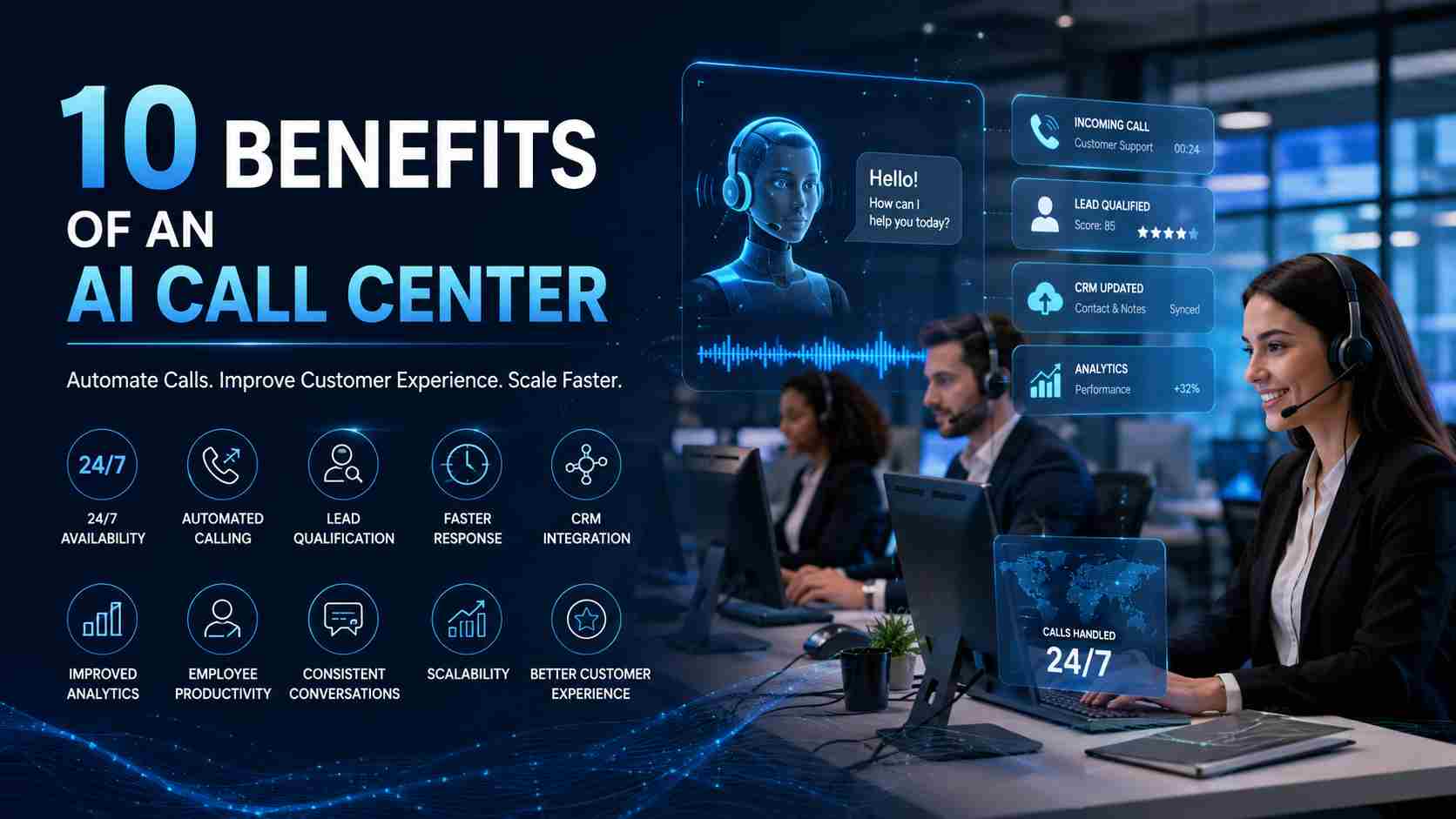
An AI call center can benefit businesses by automating repetitive communication, extending availability, improving response speed, supporting lead qualification, handling higher call volumes, and providing structured call information. The actual benefit depends on the business process, implementation quality, integrations, customer expectations, and the types of conversations being automated.
Benefit 1 — How Can an AI Call Center Reduce Operating Costs?
An AI call center can reduce some communication-related operating costs by automating repetitive calls and allowing human employees to spend more time on complex or high-value interactions. The financial impact depends on call volume, staffing requirements, technology costs, integration needs, and the percentage of conversations suitable for automation.
Traditional call centers require human agents to perform many repetitive activities.
These can include:
Answering frequently asked questions
Confirming appointments
Collecting basic information
Calling leads for initial qualification
Providing routine updates
Sending follow-up calls
Checking customer requirements
Recording basic call outcomes
When these tasks are suitable for automation, an AI voice agent can handle part of the workload.
The purpose is not necessarily to remove employees. A better approach is to use automation to change how employees spend their time.
For example, a sales representative who previously spent several hours calling unqualified leads may instead receive a smaller group of prospects that have already completed an initial qualification process.
A practical business scenario
A real-estate company may generate inquiries from multiple campaigns. Sales employees cannot immediately speak with every person.
An AI voice agent can conduct an initial conversation, identify whether the prospect is interested in buying or renting, collect basic preferences, and determine whether the person wants a follow-up from a representative.
The sales team can then concentrate on prospects that meet predefined criteria.
Who benefits most?
Businesses with high volumes of repetitive calls can potentially gain the most value.
This includes:
Lead-generation companies
Real-estate businesses
Education providers
Service companies
Appointment-based businesses
E-commerce businesses
Automotive companies
B2B sales teams
What should businesses consider?
AI automation still involves technology and implementation costs. Businesses may need telephony infrastructure, integrations, monitoring, configuration, testing, and ongoing optimization.
Therefore, the right question is not simply whether AI is cheaper than humans. The better question is which parts of the communication workflow can be automated responsibly while improving overall productivity.
Benefit 2 — How Does 24/7 Availability Improve Customer Communication?
An AI call center can support customer communication outside traditional working hours because software-based voice agents can operate continuously when the underlying telephony and service configuration supports it. This can help businesses respond to inquiries that would otherwise wait until the next working day.
Customers do not always call during convenient business hours.
A potential customer may search for a service in the evening. A patient may need information after normal office hours. A traveler may need assistance outside a company's standard schedule. A prospect may respond to an advertisement late at night.
A traditional operation may send that customer to voicemail or require the customer to call again later.
An automated voice system can provide an immediate response for supported requests.
24/7 communication can help businesses with:
Initial inquiries
Appointment requests
Basic customer questions
Lead collection
Information gathering
Call routing
Status requests
Follow-up workflows
However, 24/7 availability should not be confused with unlimited capability.
An AI system still needs clear workflows and escalation rules. If a customer asks a question outside the system's approved knowledge or process, the system should respond appropriately rather than inventing an answer.
Benefit 3 — How Can AI Calling Improve Response Times?
AI calling can improve response times because automated systems can begin handling suitable interactions without waiting for a human employee to become available. Faster initial communication can be particularly useful for businesses where leads or customer requests need timely attention.
Consider a company that receives a new inquiry through a website.
A manual process may involve:
A form is submitted.
An employee receives a notification.
The employee finishes another task.
The employee checks the lead.
The employee makes a call.
The prospect answers or misses the call.
The employee tries again later.
An automated workflow can shorten parts of this process.
A configured AI voice agent can contact an eligible lead, introduce the business, ask qualifying questions, and collect information.
This does not guarantee a sale. It simply reduces unnecessary waiting between an inquiry and the first communication attempt.
Faster responses can be useful for:
Advertising campaigns
Real-estate inquiries
Education admissions
Service bookings
Automotive inquiries
Event registrations
B2B lead generation
The quality of the conversation remains important. Speed without relevance can create a poor customer experience.
Benefit 4 — How Can AI Improve Lead Qualification?
AI voice agents can improve lead qualification by asking consistent questions and organizing responses before a sales representative becomes involved. This can help sales teams separate suitable prospects from inquiries that do not meet predefined requirements.
Lead qualification often involves repetitive questions.
For example, a real-estate business may need to understand:
Preferred location
Property type
Budget range
Purchase timeline
Financing requirements
Preferred contact time
An AI voice agent can ask these questions according to an approved conversation flow.
A B2B company may use different criteria, such as:
Company size
Business requirement
Current solution
Expected timeline
Decision-making role
Product interest
The AI can collect information and categorize the call outcome.
A human sales representative can then focus on conversations that require deeper consultation.
An important limitation
AI qualification should not be treated as a perfect decision-making system.
Some customers may provide incomplete information. Others may have unusual requirements. A prospect who initially appears unsuitable may become valuable later.
For that reason, qualification rules should be reviewed regularly, and businesses should provide appropriate routes for human review.
Benefit 5 — How Does AI Calling Improve Employee Productivity?
AI calling can improve employee productivity by reducing repetitive communication work. Employees can spend less time on routine calls and more time on activities requiring relationship-building, problem-solving, negotiation, and professional judgment.
A customer support employee may spend part of the day answering the same basic questions.
A sales employee may repeatedly call leads simply to discover whether they are interested.
An administrative employee may make confirmation calls that follow nearly identical scripts.
Automation can handle appropriate parts of these workflows.
This can create a different division of labor:
AI handles:
Routine questions
Initial qualification
Confirmations
Basic information collection
Standard follow-ups
Call routing
Human employees handle:
Complex problems
Negotiation
Sensitive cases
High-value sales conversations
Complaints requiring judgment
Relationship management
This model can help organizations use employee time more effectively.
The objective is not to make employees irrelevant. It is to reduce the amount of human time spent on predictable work.
Benefit 6 — How Can AI Create More Consistent Customer Interactions?
An AI-powered call center can provide consistent conversations because the system follows configured workflows, instructions, knowledge sources, and business rules. This can reduce variation in how routine information is presented to customers.
Human employees naturally communicate differently.
One employee may provide a detailed explanation. Another may provide a shorter answer. A third may forget to ask an important qualifying question.
For routine processes, consistency can be useful.
A structured AI workflow can ensure that certain required questions are asked in an appropriate order.
For example, an appointment workflow may include:
Identify the customer.
Understand the appointment request.
Confirm relevant details.
Check available options through an integrated system where supported.
Confirm the selected option.
Provide next steps.
Record the outcome.
Consistency is particularly valuable when a company has many employees or operates across multiple locations.
Still, consistency should not mean robotic communication. Natural language, appropriate pacing, language support, and clear escalation can make automated interactions more useful.
Benefit 7 — How Do Automated Follow-Ups Improve Lead Management?
Automated follow-ups can help businesses maintain communication with prospects and customers without relying entirely on employees to remember every call or callback. An AI calling workflow can be configured to initiate appropriate follow-up activities based on business rules and customer status.
Follow-up is one of the areas where many businesses lose opportunities.
A lead may show interest but remain undecided. A customer may request a callback. An appointment may require confirmation. A prospect may ask for additional information.
Manual follow-up depends on employee availability and process discipline.
An automated workflow can support these situations.
For example:
Initial inquiry → AI call → qualification → follow-up → human sales call
The AI can handle routine communication while a human employee becomes involved when the prospect shows stronger intent.
Follow-ups can also be useful for:
Appointment reminders
Service confirmations
Renewal reminders
Feedback requests
Lead nurturing
Quote follow-ups
Event reminders
Customer notifications
Businesses should configure frequency and communication rules carefully. Excessive automated calling can frustrate customers and may create regulatory or compliance issues depending on the market and use case.
Benefit 8 — How Can AI Handle High Call Volumes?
An AI call center can help businesses handle spikes in call volume because software-based agents can automate suitable conversations without requiring one human employee for every initial interaction. The practical capacity depends on the provider's infrastructure, telephony setup, concurrency limits, and workflow design.
Call volumes are not always predictable.
A business may experience a sudden increase because of:
A marketing campaign
Seasonal demand
A product launch
An event
A service disruption
A promotional offer
Admission season
Property campaigns
Holiday shopping
A traditional call center may struggle if staffing levels cannot increase quickly.
AI automation can provide another layer of capacity for routine conversations.
Traditional Call Center vs AI Call Center
CategoryTraditional Call CenterAI Call CenterAvailabilityUsually based on staff schedulesCan support extended or 24/7 workflowsScalabilityOften requires additional staffingSoftware can support additional automated interactions, subject to capacityResponse speedDepends on agent availabilityAutomated responses can begin immediatelyRepetitive task automationLimited unless separately automatedDesigned to automate suitable repetitive interactionsCall handlingPrimarily human-ledAI-led, with human escalation where appropriateLead qualificationUsually performed by sales agentsCan be automated for predefined criteriaData and analyticsDepends on call-center platformCan capture structured interaction data when configuredHuman interventionCentral to most conversationsUsed for complex, sensitive, or high-value conversations
AI does not eliminate the need for human expertise. Instead, it can add another layer to the communication infrastructure.
For example, during a high-volume campaign, an AI system can handle initial questions while human representatives focus on qualified or complex conversations.
Benefit 9 — How Does AI Improve Call Data and Analytics?
AI calling systems can structure information from conversations and connect call outcomes with business workflows. Depending on the platform, businesses may be able to review call outcomes, categorize interactions, monitor common questions, and identify patterns that can improve future workflows.
Traditional phone conversations can generate useful information, but that information may remain difficult to organize if it is stored only in individual employee notes.
A digital AI call center can potentially structure information such as:
Call outcome
Customer intent
Lead qualification responses
Requested follow-up
Appointment information
Frequently asked questions
Escalation reason
Conversation status
This information can help businesses identify operational problems.
For example, if many callers ask the same question, the business may need clearer information on its website or a better automated workflow.
If many leads fail at the same qualification stage, marketing or sales criteria may need review.
If many customers request human escalation at a specific point, that part of the AI workflow may need improvement.
Analytics therefore should not be viewed only as reporting. It can become part of continuous process improvement.
Benefit 10 — How Can AI Improve Customer Experience and Scalability?
AI can improve customer experience when it makes routine communication faster, more accessible, and easier to complete while providing a clear path to human support. It can also help businesses scale communication without requiring every increase in call volume to result in proportional manual effort.
Customer experience is not simply about automation.
A customer wants:
A quick response
Accurate information
Easy communication
Clear next steps
Convenient availability
The ability to reach a human when necessary
An AI call center can support these expectations for suitable interactions.
For example, a customer may not need a human representative to confirm an appointment. But if the customer has a complaint involving a complex situation, human support may be far more appropriate.
The strongest approach is therefore a blended model.
AI + human collaboration
AI handles predictable communication.
Human employees handle conversations that require judgment.
This approach can improve scalability while maintaining an appropriate level of human involvement.
How Can Businesses Choose the Right AI Call Center Solution?
Businesses should choose an AI call center based on actual communication workflows rather than selecting a platform simply because it offers many AI features. Important considerations include voice quality, languages, inbound and outbound calling, CRM integration, human escalation, analytics, security, compliance, scalability, and implementation requirements.
A useful evaluation should begin with the business problem.
Instead of asking:
“Which AI call center has the most features?”
A business can ask:
“Which communication tasks create the most repetitive work, delays, missed opportunities, or customer friction?”
That question usually produces a more practical starting point.
What AI Calling Features Should Businesses Evaluate?
Relevant features can include:
Inbound AI calling
Outbound AI calling
AI voice agents
Conversational AI
Automated follow-ups
Lead qualification
Appointment scheduling
Call routing
IVR integration
CRM integration
Call analytics
Human transfer
Multi-language support
Workflow customization
Call monitoring
Reporting
Not every business needs every feature.
A small service business may primarily need inbound call handling and appointment scheduling.
A sales organization may prioritize outbound calling and lead qualification.
A healthcare-related organization may place greater emphasis on privacy, security, human escalation, and carefully controlled workflows.
How Important Are CRM and Software Integrations?
CRM and software integrations can be extremely important because an isolated AI voice system may automate the conversation without completing the wider business process.
Suppose an AI agent qualifies a lead but the result never reaches the sales team.
The call was automated, but the workflow was not.
A useful implementation should connect the conversation to what happens next.
Depending on the available system, that may include:
Updating a customer record
Recording a call outcome
Creating a task
Triggering a follow-up
Routing a lead
Updating appointment information
Sending information to another application
Integration requirements should be defined before implementation rather than discovered after deployment.
What Should Businesses Know About Security and Compliance?
AI call center deployments can involve customer information, call recordings, contact details, business data, and other potentially sensitive information. Security and compliance should therefore be treated as core implementation considerations rather than optional technical details.
NIST's AI Risk Management Framework identifies characteristics such as validity and reliability, safety, security and resilience, accountability and transparency, explainability and interpretability, privacy enhancement, and fairness with harmful bias management as considerations for trustworthy AI.
Businesses should evaluate:
What data the system collects
Where data is stored
Who can access it
How long information is retained
Whether calls are recorded
How recordings are protected
How integrations handle customer data
How human escalation works
What applicable laws and industry requirements apply
Calling regulations also vary by jurisdiction and use case. For example, the U.S. Federal Communications Commission has stated that AI-generated voices fall within the definition of “artificial” voices under the Telephone Consumer Protection Act for relevant robocall contexts.
Businesses operating in different countries should therefore obtain appropriate legal and compliance guidance rather than assuming that a calling workflow is permitted simply because the technology can perform it.
When Is an AI Call Center a Good Investment?
An AI call center can be a strong candidate when a business handles a meaningful volume of repetitive, structured conversations and has clear rules for when automation should stop and human support should begin.
Suitable situations may include:
Large numbers of inbound inquiries
Repetitive outbound qualification calls
Appointment-based businesses
Frequent follow-up requirements
Customer support questions with predictable answers
Seasonal call spikes
Businesses needing extended availability
Sales teams spending too much time on initial qualification
AI may be less suitable when most conversations are highly unpredictable, emotionally sensitive, or dependent on specialized professional judgment.
Even then, AI can potentially support limited administrative or routing tasks.
The key is matching automation to the right part of the workflow.
How Can UR AI Connect Help Businesses With AI Calling?
Businesses exploring AI-powered communication can evaluate specialized providers such as UR AI Connect, which focuses on AI calling and business communication solutions.
Relevant areas described in the project brief include AI voice calling, AI voice agents, inbound and outbound calls, lead qualification, customer communication, automated follow-ups, appointment scheduling, call automation, IVR and cloud telephony, call-center automation, and business communication.
AI calling solutions from UR AI Connect
The right implementation should begin with a specific business workflow rather than with technology alone.
For example, a company could start by identifying:
Which calls are most repetitive.
Which calls are frequently missed.
Which leads require initial qualification.
Which customer questions have predictable answers.
Which calls must always reach a human.
Which systems need to receive call information.
Which compliance requirements apply.
How performance will be measured.
A controlled pilot can then be used to test the workflow before broader deployment.
Conclusion
An AI call center can give businesses a practical way to automate parts of their customer communication and calling operations. The 10 major benefits include lower operational workload, extended availability, faster responses, improved lead qualification, better employee productivity, more consistent interactions, automated follow-ups, high-volume call handling, structured call data, and improved scalability.
The technology is most valuable when it solves a clear operational problem.
An organization receiving hundreds of repetitive inquiries may use AI differently from a small service company that mainly needs appointment calls. A sales organization may prioritize outbound AI calling and lead qualification, while a support team may focus on inbound customer communication.
AI also should not be treated as a universal replacement for human agents.
Human employees remain important for complex conversations, sensitive situations, negotiations, complaints, relationship management, and decisions that require judgment.
The strongest AI calling strategies combine automation with human expertise.
Before implementation, businesses should evaluate voice quality, language support, integrations, security, privacy, compliance, analytics, escalation processes, and customer acceptance. Responsible AI deployment also requires ongoing monitoring and improvement. NIST's AI RMF emphasizes that trustworthy AI requires attention to multiple characteristics rather than treating a single factor as sufficient.
For businesses considering AI calling, the most practical starting point is simple: identify repetitive communication tasks, determine where automation can provide value, establish clear human handoff rules, and select technology that fits the existing business workflow.
When implemented thoughtfully, an AI call center can become more than an automated phone system. It can become part of a broader customer communication strategy that helps businesses respond faster, manage leads more efficiently, support employees, and scale communication while keeping human expertise where it matters most.
Frequently Asked Questions About AI Call Centers
What Is an AI Call Center?
An AI call center is a communication system that uses artificial intelligence and voice technology to handle suitable inbound and outbound phone interactions. Depending on its configuration, it can answer questions, collect information, qualify leads, schedule appointments, perform follow-ups, route calls, and transfer conversations to human agents when necessary.
How Does an AI Call Center Work?
An AI call center typically combines speech recognition, conversational AI, voice generation, business rules, telephony, and integrations. The system understands what a caller is saying, identifies the purpose of the interaction, follows an approved workflow, responds through voice, and can record or pass relevant information to connected business systems.
What Are the Main Benefits of an AI Call Center?
The main benefits include automation of repetitive calls, faster responses, extended availability, lead qualification, automated follow-ups, improved employee productivity, high-volume call handling, more consistent interactions, structured call data, and greater scalability. The actual results depend on the business workflow, implementation quality, integrations, and the types of calls being automated.
Can AI Call Centers Make Outbound Calls?
Yes, AI voice systems can support outbound calling for appropriate business workflows. Examples can include lead qualification, appointment reminders, customer notifications, follow-ups, and information collection. However, businesses must configure calling practices according to applicable laws, regulations, consent requirements, and customer communication policies.
Can AI Voice Agents Qualify Leads?
Yes. AI voice agents can ask predefined qualification questions, collect responses, identify relevant criteria, and categorize conversations according to a business workflow. The qualified information can then be passed to sales representatives where supported. Human review remains important when qualification involves complex requirements or significant business decisions.
Can an AI Call Center Operate 24/7?
An AI call center can support 24/7 communication when the underlying platform, telephony infrastructure, and business workflow are configured for continuous operation. This can help customers make inquiries outside standard working hours. However, 24/7 availability does not mean that every type of customer request can or should be handled automatically.
Will an AI Call Center Replace Human Agents?
An AI call center does not necessarily replace human agents. In many business workflows, AI is more useful as a support layer that handles repetitive interactions while employees manage complex, sensitive, or high-value conversations. Human escalation can be designed into the workflow so customers can reach a representative when automation is not appropriate.
How Can a Business Get Started With AI Calling?
A business can start by identifying repetitive calling tasks, missed-call problems, lead qualification requirements, follow-up processes, and customer questions suitable for automation. The business can then select an AI calling solution, connect relevant systems, create escalation rules, test the workflow, monitor results, and gradually expand automation after the initial process has been evaluated.