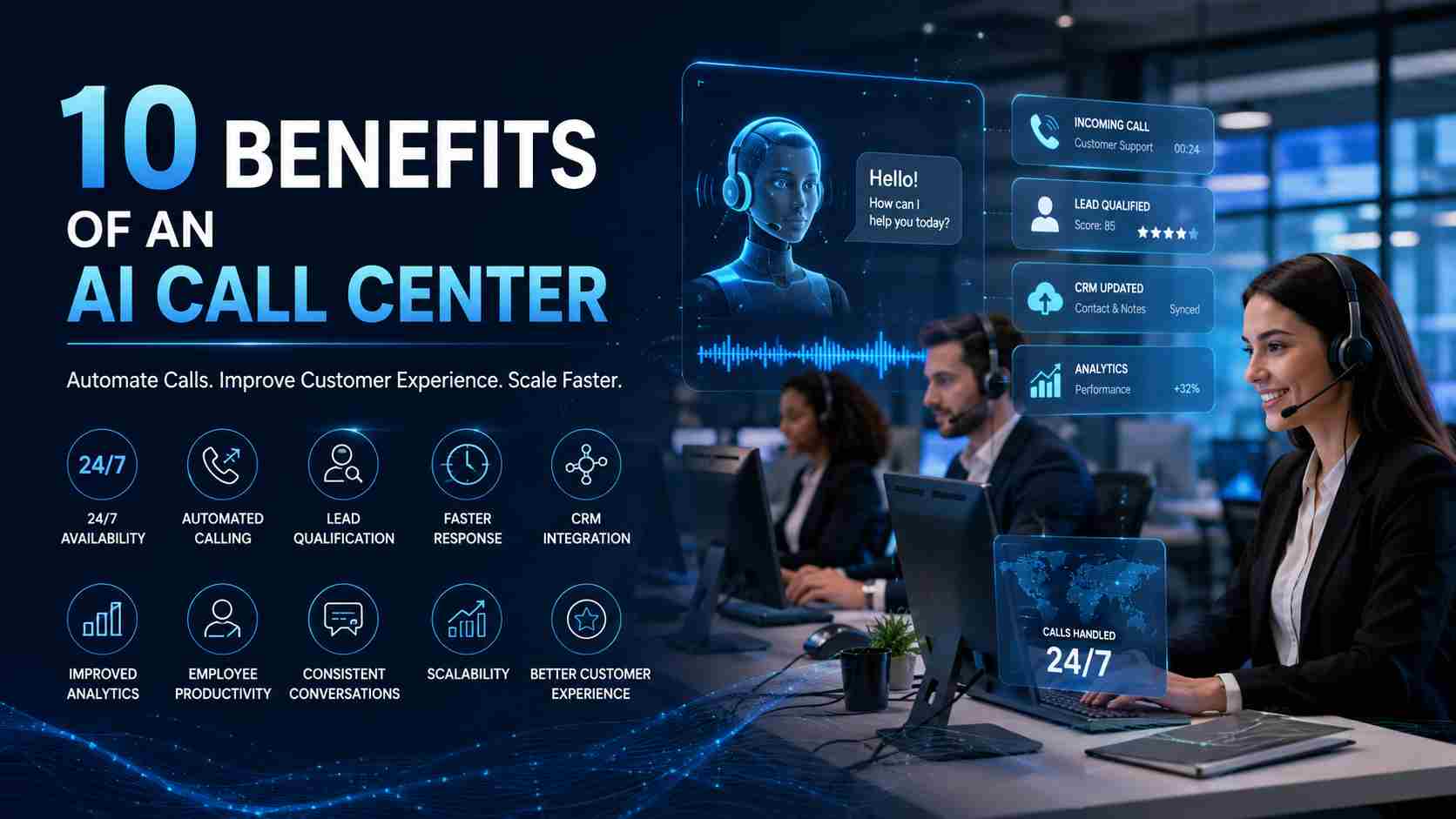
Businesses in Noida, Greater Noida, and the wider Delhi NCR market handle a large number of customer conversations every day. These conversations may include sales inquiries, lead follow-ups, appointment requests, customer support, service requests, verification calls, reminders, and general information requests.
An AI Calling Agent Provider in Noida can help businesses automate suitable phone conversations using artificial intelligence, speech recognition, natural language processing, voice technology, telephony, and business integrations.
Unlike a basic automated phone menu, an AI-powered calling agent can be designed to understand spoken requests, respond conversationally, collect information, qualify leads, schedule appointments, answer common questions, trigger business actions, and transfer selected conversations to human representatives.
For businesses considering this technology, the important question is not simply whether AI calling is available. The more important question is whether the selected AI Calling Agent Provider in Noida can connect the technology to real business processes.
This guide explains what AI calling agents are, how they work, what they can do, which businesses can use them, what features should be compared, how implementation works, what pricing factors matter, and how businesses can evaluate providers.
What Is an AI Calling Agent?
An AI calling agent is a software-based voice assistant that communicates with customers through telephone conversations. An AI Calling Agent Provider in Noida can configure such an agent to answer calls, make calls, understand spoken requests, provide information, qualify leads, schedule appointments, automate follow-ups, and transfer conversations to human representatives when required.
An AI calling agent combines several technologies to create a voice-based communication system.
These technologies can include:
Speech-to-text
Natural language understanding
Artificial intelligence
Text-to-speech
Telephony connectivity
Business rules
CRM integrations
Appointment systems
Call routing
Reporting and analytics
Human-agent escalation
The basic concept is straightforward.
Instead of requiring a human representative to manage every conversation from beginning to end, suitable parts of the conversation can be handled automatically.
For example, a real estate company may receive many property inquiries. An AI calling agent can ask about the preferred location, property type, budget, and purchase timeline. The collected information can then be passed to the sales team.
Similarly, a clinic can use an AI appointment booking agent to handle suitable appointment-related conversations and collect basic information.
The exact capabilities depend on the AI platform, telephony infrastructure, integrations, business rules, language support, and implementation.
How Does an AI Calling Agent Work?
An AI calling agent generally works through a sequence of call connection, speech recognition, intent understanding, response generation, business action, and conversation completion or human transfer. An AI Calling Agent Provider in Noida configures these stages around the company's objectives.
Call Initiation and Customer Identification
The process begins when a customer calls a business number or when an outbound call is initiated as part of an approved workflow.
The system may work with information such as:
Caller number
Customer record
Campaign information
Previous interaction information
Call purpose
Department or service requirement
For an inbound call, the agent may begin with a simple greeting.
For an outbound call, the opening can explain the reason for the communication.
For example:
"Hello, this is the automated assistant from the company. The call is regarding the inquiry submitted recently."
The opening should be clear and appropriate to the business purpose.
Speech Recognition and Intent Detection
The customer's speech needs to be converted into information that the AI can understand.
For example, a customer may say:
"I want to know if there is an appointment available tomorrow."
The system can identify this as an appointment-related request.
Another customer might say:
"I am looking for a two-bedroom apartment near the expressway."
That conversation can be identified as a real estate inquiry.
Modern conversational AI systems use technologies such as speech recognition and natural-language understanding to process spoken requests.
AI Conversation and Response Generation
After identifying the customer's request, the AI calling agent provides an appropriate response.
The response may depend on:
Customer intent
Business rules
Available information
Previous conversation
CRM data
Knowledge base
Appointment availability
Product or service information
A good AI calling conversation should remain focused on the customer's objective.
The agent should avoid unnecessary questions and should not provide information that is not available in the connected business systems.
Action, Qualification, or Human Handover
The final stage depends on the business workflow.
The AI calling agent may:
Qualify a lead
Collect customer information
Book an appointment
Confirm an appointment
Answer a question
Trigger a follow-up
Route a call
Transfer the customer to a human representative
Complete the interaction
Human escalation is important for complex or sensitive situations.
AI calling should therefore be viewed as a business communication tool rather than an automatic replacement for every human conversation.
What Does an AI Calling Agent Provider in Noida Do?
An AI Calling Agent Provider in Noida helps businesses plan, configure, integrate, deploy, and manage AI-powered voice communication. Services may include AI calling agents, AI voice agents, AI call center solutions, IVR, lead qualification, appointment booking, customer support, analytics, and communication automation.
A provider's role can extend beyond supplying software.
A business may require assistance with:
Business-process analysis
Conversation-flow design
Voice-agent configuration
Telephony setup
CRM integration
Lead-management workflows
Appointment workflows
IVR configuration
Call routing
Reporting
Testing
Deployment
Ongoing optimization
The difference between a basic calling tool and a business-ready AI communication solution often depends on how well the technology fits the company's existing processes.
For example, a sales organization may already have thousands of leads in a CRM. Simply adding an automated voice system may not be enough.
The calling workflow should connect with the lead-management process so information collected during calls can be used by sales representatives.
Similarly, a healthcare organization may require appointment-focused workflows rather than a general-purpose sales calling system.
What Can an AI Calling Agent Do for a Business?
An AI calling agent can handle many structured business conversations, including lead qualification, appointment scheduling, customer support, follow-ups, verification, information collection, and call routing. The exact scope depends on the workflow, integrations, business rules, and information available to the AI system.
Lead Qualification
An AI lead qualification agent can ask predefined questions and organize responses.
For example, a real estate workflow may ask:
Which location is preferred?
What type of property is required?
What is the approximate budget?
Is the purchase for investment or personal use?
When is the customer planning to purchase?
The answers can help the sales team understand the prospect before the next conversation.
The AI does not necessarily need to make the final sales decision. Its role can be to collect and organize information according to the company's qualification process.
Appointment Booking
An AI appointment booking agent can communicate with customers about:
Preferred dates
Preferred time slots
Service type
Basic customer information
Appointment confirmation
Rescheduling requests
The usefulness of appointment automation depends on integration with the actual scheduling system.
Customer Support
Many companies receive repetitive questions.
These can include:
Business hours
Service availability
Appointment information
Basic product questions
Delivery information
Service-process questions
An AI customer support agent can handle suitable routine questions while complex cases are transferred to human support.
Follow-Ups and Customer Communication
Sales teams often spend significant time following up with prospects.
An automated calling workflow can contact customers based on predefined business rules.
Possible workflows include:
New lead follow-up
Appointment reminders
Inquiry follow-up
Service reminders
Customer notifications
Verification calls
Feedback calls
Calling schedules and communication rules should be designed according to the company's requirements and applicable customer-consent practices.
What Are the Main Benefits of AI Calling Agents?
The main benefits of AI calling agents include automated customer communication, faster response handling, structured lead qualification, scalable calling workflows, appointment automation, consistent conversations, and improved visibility into call activity.
Faster Response
Customers often expect quick responses to inquiries.
An automated calling workflow can respond according to predefined processes without requiring a salesperson or support representative to manually initiate every interaction.
Reduced Repetitive Work
Sales and support teams frequently perform repetitive activities such as:
Calling new leads
Confirming appointments
Asking qualification questions
Giving basic information
Sending follow-up reminders
Verifying customer details
Automation can reduce the manual effort associated with these tasks.
Scalable Communication
Human teams have limited working hours.
Automated calling workflows can support larger communication volumes when the technology and infrastructure are designed for the required scale.
This does not mean every conversation should be automated.
Human teams can remain responsible for conversations that require judgment, negotiation, expertise, or personal attention.
Consistent Workflows
An AI system can follow a defined business process across calls.
This is useful when every lead needs to be asked the same qualification questions.
Better Lead Organization
When an AI lead qualification agent collects structured information, sales teams can receive more organized lead data.
Appointment Automation
Appointment-related conversations can be automated when the required scheduling integrations are available.
Analytics and Visibility
AI voice systems can provide useful information about call activity and conversation outcomes.
AI Calling Agent vs Traditional Calling
Traditional calling usually depends heavily on human representatives to initiate and manage conversations, while an AI calling agent automates suitable parts of the process. The main differences can appear in repetitive communication, availability, follow-up workflows, scalability, and data handling.
Traditional CallingAI Calling AgentManual callingAutomated callingLimited availability24/7 availabilityHigher manpower requirementAutomated conversationsManual follow-upsAutomated follow-upsLimited scalabilityHighly scalableBasic reportingDetailed analytics
The comparison does not mean AI calling should replace every human interaction.
A business can instead divide responsibilities.
AI can handle:
Initial inquiries
Basic questions
Lead qualification
Appointment requests
Routine follow-ups
Information collection
Human teams can handle:
Complex negotiations
High-value sales discussions
Complaints requiring judgment
Sensitive situations
Exceptions
Strategic customer relationships
This combined approach can be useful for organizations with high call volumes.
Which Businesses Can Use AI Calling Agents in Noida?
Real estate, healthcare, education, e-commerce, sales, customer support, service businesses, startups, SMEs, and other organizations can use AI calling agents where repetitive or structured phone conversations are part of the business process.
Real Estate Companies
Real estate companies can receive inquiries through websites, advertising campaigns, property portals, social media, and phone calls.
An AI calling agent can support:
New lead follow-up
Property preference collection
Budget qualification
Location preference
Site-visit scheduling
Inquiry confirmation
Sales-team routing
For example, a new property lead could receive an automated call shortly after submitting an inquiry.
The agent could collect basic requirements and pass qualified information to the sales team.
Clinics and Healthcare Providers
Clinics can use AI voice agents for suitable administrative communication.
Possible workflows include:
Appointment requests
Appointment reminders
Basic clinic information
Doctor availability information
Follow-up reminders
Call routing
Healthcare workflows require additional care because conversations can involve sensitive information.
The system should be configured according to the organization's privacy, security, consent, and regulatory requirements.
Education and Training Businesses
Education companies and training institutes frequently receive inquiries about:
Courses
Fees
Admissions
Eligibility
Class schedules
Counseling appointments
An AI calling solution can handle initial information collection and route qualified prospects to counselors.
E-Commerce Companies
E-commerce businesses can receive customer calls related to:
Orders
Delivery
Returns
Product information
Basic support
Customer notifications
Where integrations are available, voice automation can connect customer conversations to order-management or support workflows.
Sales and Customer Support Teams
Sales teams can use AI calling for lead qualification and follow-up.
Customer support teams can use conversational automation for repetitive inquiries.
The key consideration is the workflow rather than the industry alone.
What Features Should Businesses Look for in an AI Calling Agent Provider?
Businesses evaluating an AI Calling Agent Provider in Noida should compare voice quality, conversation design, telephony integration, CRM connectivity, lead qualification, appointment booking, call routing, analytics, scalability, security, human handover, language support, implementation services, and ongoing support.
Voice and Conversation Quality
The voice should be understandable and appropriate for the intended audience.
Important areas include:
Voice clarity
Response timing
Natural conversation flow
Language support
Accent handling
Interruption handling
Error recovery
Telephony Integration
The system should connect with the required calling infrastructure.
Important questions include:
Can inbound calls be supported?
Can outbound calls be supported?
Can calls be routed?
Can calls be transferred to human representatives?
Can IVR workflows be connected?
Can call activity be tracked?
CRM Integration
CRM connectivity can be important for sales-driven businesses.
Potential integrations can support:
Lead creation
Lead updates
Customer information
Call outcomes
Follow-up status
Qualification information
Lead Qualification
A business should determine whether the system can ask the required questions and record responses in a useful format.
Appointment Booking
Appointment-based businesses should determine whether the AI system can connect to the relevant scheduling process.
Human Handover
A good workflow should define when human intervention is required.
Examples include:
Customer requests a human
AI cannot understand the request
Complaint requires human handling
Customer reaches a high-value sales stage
Business rules require manual review
Analytics
Businesses should understand what information is available after calls.
Potential metrics include:
Calls attempted
Calls answered
Conversation duration
Call outcome
Lead qualification result
Appointment result
Transfer rate
Unresolved conversations
How Can AI Calling Agents Support Lead Generation and Qualification?
AI calling agents can support lead generation by contacting new inquiries, asking qualification questions, identifying customer intent, collecting requirements, and passing structured information to sales teams.
Lead qualification is one of the practical applications of AI calling.
A company may receive hundreds of inquiries through digital marketing campaigns.
A traditional process may require sales representatives to manually call every lead.
An AI-assisted workflow can introduce an automated first conversation.
Example Lead Qualification Process
New inquiry is received.
Customer information enters the calling workflow.
AI calling agent initiates the approved communication.
Customer confirms interest.
AI asks qualification questions.
Responses are recorded.
Lead is categorized according to business rules.
Qualified lead information is passed to sales.
Follow-up activity is recorded.
For real estate, qualification may involve:
Location
Budget
Property type
Purchase timeline
Site-visit interest
For education:
Course interest
Education level
Preferred batch
Location
Enrollment timeline
For B2B sales:
Business requirement
Company size
Product interest
Purchase timeline
Decision-making stage
This makes AI calling adaptable to different business workflows.
Can AI Calling Agents Book Appointments?
Yes, an AI calling agent can support appointment booking when connected to an appropriate scheduling system and configured with clear booking rules.
An AI appointment booking agent can:
Collect preferred dates
Collect preferred times
Identify service requirements
Check available slots where supported
Schedule appointments
Confirm appointments
Handle suitable rescheduling requests
Escalate exceptions
A typical appointment workflow can follow these steps:
Customer requests an appointment.
AI identifies the required service.
AI asks for the preferred date.
AI asks for the preferred time.
Scheduling system checks availability.
Available options are communicated.
Customer selects an option.
Appointment is recorded.
Confirmation is provided.
The AI should not claim that an appointment is booked unless the connected scheduling system confirms the booking.
Can AI Calling Agents Provide 24/7 Customer Support?
AI calling agents can be designed to provide automated support outside normal human working hours, including nights, weekends, and holidays.
An AI calling system can answer suitable questions, collect requests, provide basic information, and route complex matters for human follow-up.
For example, customers may call after business hours to ask:
When does the office open?
Is a service available?
Can an appointment be requested?
What is the status of a request?
How can the relevant department be contacted?
The AI can provide approved information or record the request.
The system can also function as an after-hours communication layer.
For complex issues, the conversation can be transferred or converted into a callback request.
How Important Are CRM and Business Integrations?
CRM and business integrations are important because an AI calling agent becomes more useful when conversations connect with systems that manage leads, customers, appointments, orders, and support.
An isolated calling system can conduct a conversation.
An integrated workflow can connect:
Customer → AI Call → Qualification → CRM Update → Sales Follow-Up
This creates a stronger connection between communication and business operations.
Possible integrations include:
CRM
Calendar
Lead-management software
Customer-support platform
ERP
Website forms
Appointment systems
Telephony systems
Messaging platforms
Businesses should ask providers how information moves between systems and what happens when an integration fails.
What Should Businesses Consider When Choosing an AI Calling Agent Provider in Noida?
Choosing an AI Calling Agent Provider in Noida should involve more than comparing monthly prices. Businesses should evaluate voice technology, business-process understanding, integrations, scalability, security, conversation quality, support, reporting, implementation, and customization.
A practical evaluation can include ten areas.
Business Understanding
The provider should understand the actual business objective.
The requirement may be:
Lead qualification
Customer support
Appointment booking
Outbound calling
Inbound call handling
Verification
Follow-up
Conversation Design
The provider should explain how conversations are designed.
Questions include:
What happens if the customer interrupts?
What happens when speech is unclear?
How does the system handle unexpected questions?
When does the AI transfer to a human?
How are conversations updated?
Integration
The provider should identify the business systems that need to connect.
Scalability
The architecture should match expected call volumes.
Reporting
Businesses should know what information becomes available after calls.
Security
The provider should explain how customer and call data is handled.
Human Escalation
The workflow should include clear conditions for human intervention.
Support
Implementation and ongoing support can be important when multiple business systems are involved.
Testing
A pilot or testing phase can identify issues before a larger deployment.
Total Cost
The total cost may include:
Setup
Telephony
AI usage
Integration
Development
Maintenance
Support
Call volume
Additional features
How Much Does an AI Calling Agent Cost?
AI calling agent pricing varies according to call volume, call duration, telephony charges, AI usage, voice technology, integrations, customization, deployment requirements, and support.
There is no single price that applies to every AI calling implementation.
A basic informational voice agent may have different requirements from an enterprise contact-center workflow.
Potential cost factors include:
Number of calls
Call duration
Inbound versus outbound usage
AI processing
Voice generation
Telephony
CRM integration
Custom conversation logic
Analytics
Recording or transcription
Human-agent transfer
Support
Businesses should request a clear pricing breakdown.
Useful questions include:
Is pricing based on calls?
Is pricing based on minutes?
Are setup charges separate?
Are integrations included?
Are telephony charges separate?
Is support included?
What happens when call volume increases?
This makes provider comparisons more useful.
How Is an AI Calling Agent Implemented?
AI calling implementation usually starts with defining business objectives, mapping conversations, preparing information, connecting telephony and business systems, configuring the AI agent, testing real scenarios, launching gradually, and monitoring results.
Step 1: Define the Business Objective
The company should identify the specific problem.
Examples:
Too many repetitive support calls
Slow lead follow-up
Manual appointment booking
High inquiry volume
Repetitive verification calls
Step 2: Map the Conversation
The conversation should be documented.
This includes:
Opening
Questions
Customer responses
Business rules
Answers
Escalation
Completion
Step 3: Prepare Business Information
The AI requires reliable information.
This can include:
Product information
Service details
Working hours
FAQs
Appointment rules
Qualification questions
Escalation rules
Step 4: Connect Systems
Required systems are connected to the calling workflow.
Step 5: Configure the Agent
The AI calling workflow is configured according to the business requirements.
Step 6: Test
Testing should cover normal and unusual conversations.
Examples include:
Clear customer response
Short answer
Long answer
Silence
Interruption
Unexpected question
Human-support request
Step 7: Launch Gradually
A limited rollout can help identify operational issues.
Step 8: Monitor and Improve
Conversation results and business outcomes should be reviewed regularly.
What About Security, Privacy, and Call Data?
Security and privacy should be considered before deploying an AI calling system that handles customer information.
Businesses should understand:
What data is collected
Whether call audio is stored
Whether transcripts are created
Who can access recordings
How long data is retained
How access is controlled
How integrations are authenticated
What happens when a customer requests human assistance
Which privacy requirements apply
Voice conversations can contain valuable business information and personal customer information.
Different industries may have different requirements.
Healthcare, finance, education, and other sectors can involve sensitive information that requires additional controls.
Security should therefore be treated as part of solution design.
Why Should Businesses Consider UR AI CONNECT for AI Calling Solutions in Noida?
UR AI CONNECT is positioned as a technology solutions provider specializing in AI, voice, messaging, and customer engagement solutions.
For businesses evaluating an AI Calling Agent Provider in Noida, UR AI CONNECT offers a range of communication-focused solutions that can support different business requirements.
Relevant solution areas include:
AI Calling Agents
AI Voice Agents
AI Call Center
Voice Calling Solutions
IVR Solutions
Lead Generation and Qualification
Appointment Booking
Automated Customer Support
Call Verification
Customer Communication Automation
Businesses may require more than an individual AI calling feature.
For example, a company may initially need an AI calling agent for lead qualification and later require:
IVR
SMS notifications
RCS communication
Customer alerts
Automated follow-ups
Customer support workflows
A broader communication approach allows businesses to consider voice and messaging requirements together.
More information about the company's solutions is available through the official website:
AI calling solutions from UR AI CONNECT
Businesses should still compare providers according to their specific requirements, integrations, implementation needs, support, security, and commercial terms.
How Should a Business Start With AI Calling Automation?
A business can start AI calling automation by identifying one clear communication problem, defining the desired outcome, mapping the conversation, checking required integrations, selecting a suitable provider, testing the workflow, and measuring results after launch.
A practical process can include:
Identify the Most Repetitive Call Process
Examples include:
New lead follow-up
Appointment confirmation
Customer FAQ
Verification
Service reminders
Define the Desired Outcome
The objective should be clear.
For example:
Capture lead requirements
Schedule an appointment
Answer a common question
Collect a callback request
Transfer qualified prospects
Document the Conversation
The business should identify:
Opening statement
Required questions
Expected responses
Business rules
Escalation points
Completion conditions
Identify Required Integrations
The provider should understand which systems need to communicate with the AI calling workflow.
Run a Controlled Pilot
A pilot can help evaluate:
Voice quality
Conversation flow
Customer response
Qualification accuracy
Integration reliability
Human handover
Review Business Outcomes
The evaluation should focus on useful business metrics rather than call volume alone.
AI Calling Services in Noida and the Local Business Environment
Noida and Greater Noida have a broad mix of technology companies, startups, SMEs, service providers, real estate businesses, healthcare organizations, educational institutions, and sales teams. These business environments create practical use cases for lead response, appointment handling, customer support, qualification, notifications, and repetitive communication.
The local business environment matters because AI calling is not a one-size-fits-all technology.
A technology startup may need automated customer support.
A real estate company may need outbound lead qualification.
A clinic may need appointment communication.
An education company may need inquiry follow-up.
An e-commerce company may need customer-service automation.
A B2B company may need structured lead qualification.
Therefore, an AI Calling Agent Provider in Noida should understand the communication requirements of different business models.
Businesses operating across Noida, Greater Noida, Gurugram, Faridabad, and Delhi may also require multiple communication channels.
A broader communication strategy may include:
AI calling
IVR
Voice calling
SMS
RCS
Customer notifications
Automated campaigns
The appropriate combination depends on the customer journey and business requirements.
AI Voice Agent vs AI Calling Agent
An AI voice agent is a broader conversational technology that communicates through spoken language, while an AI calling agent generally refers to a voice agent used specifically for telephone-based inbound or outbound business calls.
The terms can overlap depending on the provider and implementation.
Both technologies may use:
Speech recognition
Natural language understanding
AI response generation
Text-to-speech
Business logic
Telephony
CRM integrations
For businesses searching for an AI voice agent in Noida, the important consideration is the actual functionality rather than the terminology.
The provider should clearly explain:
Where the agent operates
What calls it can handle
What integrations are available
What actions it can perform
When human support is required
AI Call Center Solutions for Small Businesses
Small businesses can use AI call center solutions for repetitive customer communication without building a large traditional calling team for every workflow.
Suitable use cases include:
Answering routine inquiries
Missed-call follow-ups
Lead qualification
Appointment requests
Call routing
After-hours assistance
Customer notifications
Small companies often have limited staff.
A business owner or small support team may need to manage:
Customer calls
Sales inquiries
Follow-ups
Appointment requests
Service questions
AI automation can support repetitive activities while human employees focus on conversations requiring expertise.
For example, a small service company can use an AI calling agent to collect basic customer requirements before connecting a qualified customer with a representative.
AI Calling Agent for Sales Teams
An AI sales calling agent can support sales teams by contacting leads, collecting requirements, asking qualification questions, recording responses, and routing suitable prospects to representatives.
Sales teams can use AI calling at different stages of the sales funnel.
Initial Follow-Up
New leads can enter an automated follow-up workflow.
Qualification
The AI can ask predefined questions.
Information Collection
Customer requirements can be collected in structured form.
Appointment Scheduling
Qualified prospects can be directed toward a meeting or appointment.
Human Handover
When a lead reaches the appropriate stage, a sales representative can take over.
This creates a practical division of responsibilities.
AI can handle: repetitive qualification and information gathering.
Sales teams can handle: consultation, negotiation, relationship building, and closing.
AI Calling Agent for Customer Support
An AI customer support agent can answer suitable routine questions, guide customers through simple processes, collect information, and route complex issues to human representatives.
Support automation can be useful when customers repeatedly ask similar questions.
For example:
Customer:
"What are the business hours?"
AI:
Provides the approved business-hours information.
Customer:
"I have a complicated billing problem."
AI:
Collects the necessary information and routes the issue to the appropriate support team.
This creates a practical balance between automation and human assistance.
The system should have clearly defined boundaries.
How AI Calling Can Connect With Other Customer Communication Channels
AI calling can become part of a broader customer communication strategy that includes voice, IVR, SMS, RCS, and other engagement channels.
Businesses can select the appropriate channel for each stage of the customer journey.
For example:
Lead Generation
Website form
↓
AI Calling
↓
Lead Qualification
↓
Sales Representative
↓
SMS Confirmation
Another workflow can be:
Customer Inquiry
↓
Phone Call
↓
AI Support
↓
Human Escalation
↓
Customer Notification
This creates a connected customer communication journey.
For businesses evaluating UR AI CONNECT, the combination of AI, voice, messaging, and customer engagement solutions can be relevant when several communication channels are required.
What Makes a Good AI Calling Conversation?
A good AI calling conversation is clear, focused, easy to follow, capable of handling common variations, and designed around a specific customer task.
A strong AI Calling Agent Provider in Noida should consider conversation flow, interruption handling, error recovery, escalation, and the information required to complete the business objective.
A useful conversation can follow this structure:
Clear introduction
Reason for the call
Simple question
Customer response
Appropriate follow-up
Completion or next action
For example:
"Hello, this is the automated assistant from the company. The call is regarding the service inquiry. Is this a suitable time to discuss the request?"
The next question should depend on the customer's response.
Telephone conversations are different from text chats.
Customers can:
Interrupt
Speak unclearly
Change topics
Give incomplete answers
Ask unexpected questions
Request a human representative
A well-designed system should account for these situations.
Measuring AI Calling Performance
AI calling performance should be measured using business and customer-experience metrics rather than call volume alone.
Useful measurements can include:
Answered calls
Successful task completion
Lead qualification
Appointment completion
Transfer rate
First-call resolution
Average handling time
Misrouting
Customer satisfaction
Unresolved conversations
Different businesses can prioritize different KPIs.
A real estate company may focus on:
Qualified leads
Site visits
Lead-response activity
A clinic may focus on:
Appointment requests
Confirmations
Successful scheduling
A customer-support team may focus on:
Resolution rate
Human transfers
Average handling time
Customer satisfaction
The provider and business should define meaningful metrics before implementation.
Frequently Asked Questions About AI Calling Agents
What is an AI calling agent?
An AI calling agent is a software-based voice assistant that communicates with customers through phone calls, understands spoken requests, provides responses, collects information, qualifies leads, schedules appointments, and supports customer-service workflows.
What does an AI Calling Agent Provider in Noida do?
An AI Calling Agent Provider in Noida helps businesses implement AI-powered calling workflows. Services may include AI voice agents, AI call centers, IVR, lead qualification, appointment booking, customer support, outbound calling, integrations, analytics, deployment, and ongoing support.
How does an AI calling agent work?
An AI calling agent connects to a phone system, receives or initiates calls, converts speech into information, understands customer intent, generates an appropriate response, and completes an action or transfers the conversation to a human representative.
How much does an AI calling agent cost?
The cost depends on call volume, duration, telephony, AI usage, integrations, customization, support, and deployment requirements. Businesses should request pricing based on their actual workflow.
Is an AI calling agent suitable for small businesses?
Yes. Small businesses can use AI calling agents for suitable repetitive workflows such as lead follow-ups, appointment requests, basic customer support, call routing, notifications, and qualification.
Can AI calling agents qualify leads?
Yes. An AI lead qualification agent can ask predefined questions, identify customer requirements, collect responses, categorize leads according to business rules, and pass qualified information to a sales team.
Can an AI calling agent book appointments?
Yes, when connected to an appropriate scheduling system. The agent can collect preferences, check available slots where supported, schedule appointments, provide confirmations, and escalate exceptions.
Can AI calling agents provide 24/7 support?
Yes. AI calling systems can provide automated assistance outside normal business hours, answer suitable questions, collect requests, and route complex matters for human handling.
How can businesses choose an AI Calling Agent Provider in Noida?
Businesses should compare conversation quality, voice technology, telephony, CRM integration, scalability, security, analytics, human handover, customization, implementation support, and pricing.
Which industries can use AI calling agents?
Real estate, healthcare, education, e-commerce, sales, customer support, service businesses, startups, SMEs, and other organizations can use AI calling agents where repetitive or structured phone conversations are part of the business process.
Can an AI calling agent replace a human call center?
An AI calling agent can automate selected calling activities, but it does not automatically replace every human call-center function. Complex conversations, negotiations, sensitive cases, complaints, and situations requiring human judgment may still require trained representatives.
What is the difference between an AI calling agent and IVR?
Traditional IVR generally routes callers through predefined menu options, while an AI calling agent can understand natural spoken language and conduct more flexible conversations. Advanced systems can combine AI voice technology with IVR.
Conclusion
An AI Calling Agent Provider in Noida can help businesses automate suitable voice-based communication while connecting calling workflows with sales, customer support, lead management, appointments, and other business processes.
An AI calling agent can support:
Lead qualification
Customer support
Appointment booking
Follow-ups
Verification
Call routing
Customer information collection
Automated communication
The technology can be useful for real estate companies, clinics, educational organizations, e-commerce businesses, sales teams, startups, SMEs, service businesses, and customer-support operations.
However, choosing an AI calling solution should involve more than comparing prices.
Businesses should evaluate:
Voice quality
Conversation design
Telephony
CRM integrations
Scalability
Security
Analytics
Human handover
Customization
Implementation
Support
Total cost
A focused implementation can begin with one repetitive communication workflow and expand after the business understands the results.
For businesses exploring AI calling, voice automation, IVR, customer support, lead qualification, appointment booking, and broader customer communication solutions, UR AI CONNECT provides a technology-focused approach covering AI, voice, messaging, and customer engagement.
Businesses can learn more about AI calling solutions from UR AI CONNECT and evaluate which communication workflows may be suitable for automation.
The most effective AI calling strategy is ultimately one that connects the technology to a clear business objective, provides useful customer experiences, and gives human teams the right information to take the next action.