
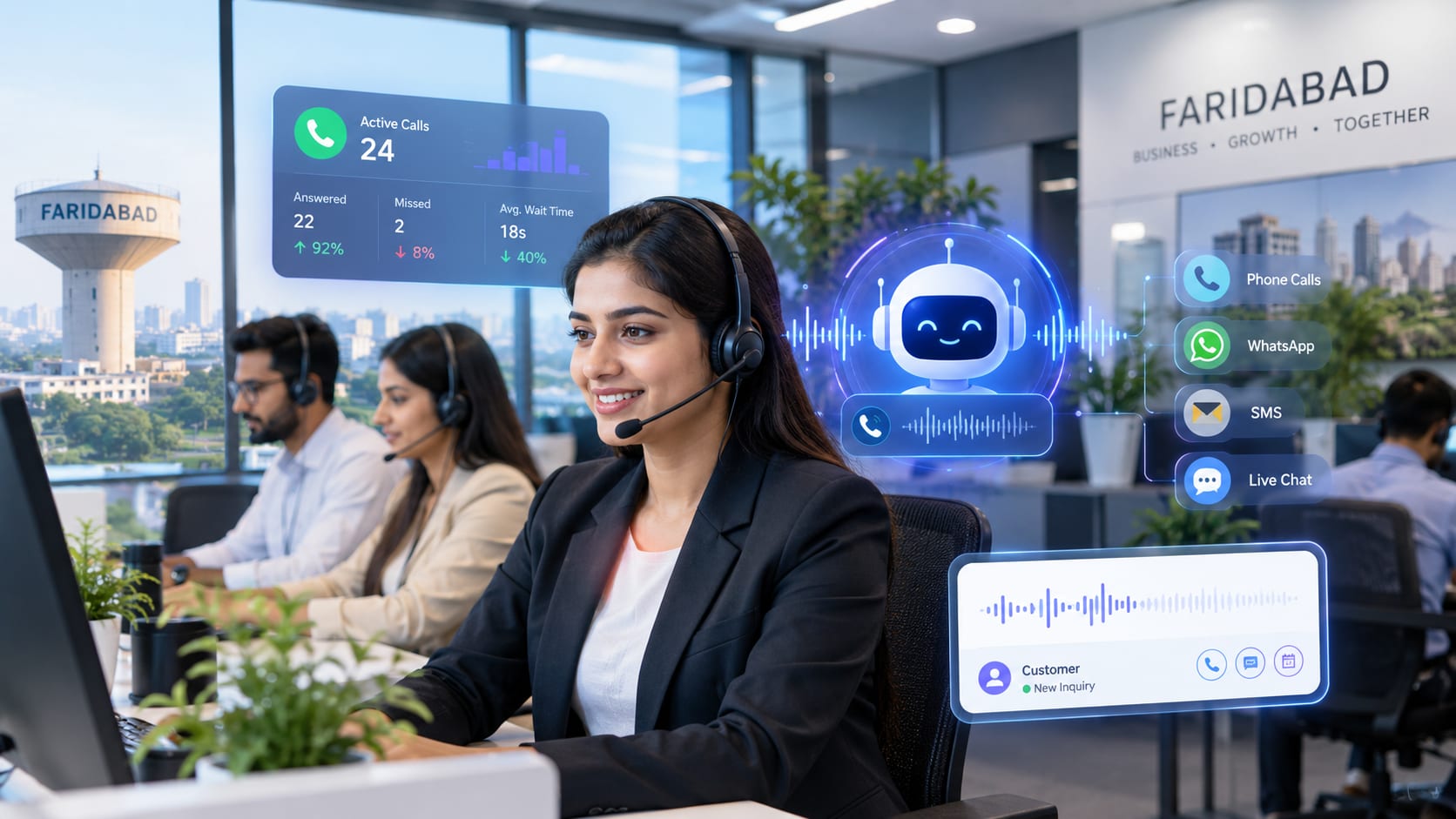
Business calls often contain repetitive work: answering common questions, collecting basic customer information, following up with enquiries, confirming appointments, and routing calls to the appropriate team. For companies handling a growing number of conversations, these activities can consume significant staff time.
An AI Voice Agent for Business Faridabad can automate suitable parts of this communication process through conversational voice technology. Instead of relying only on manual call handling, businesses can use voice AI for selected inbound and outbound workflows while keeping human employees involved when judgment, empathy, negotiation, or complex problem-solving is required.
For businesses in Faridabad, the practical value of voice AI depends less on simply adding an AI system and more on identifying the right calls to automate. A real estate company may need lead qualification, while a clinic may focus on appointment-related calls. An automobile dealership may need enquiry follow-ups, while a local service company may need call routing and customer support.
This guide explains what an AI voice agent does, how voice automation works, where it can fit into business operations, what different industries can consider, how pricing is generally determined, and what businesses should evaluate before implementation.
What Is an AI Voice Agent for Business Faridabad and How Does It Work?
An AI voice agent is a software-based conversational system that can interact with people through telephone calls using speech recognition, conversational AI and text-to-speech technology. AI Voice Agent for Business Faridabad , Depending on the workflow, it can answer questions, collect information, qualify enquiries, support appointment processes, make suitable outbound calls and transfer conversations to human employees.
What is an AI voice agent for business?
An AI voice agent is designed to conduct a voice conversation rather than simply play a fixed recorded message.
Traditional automated phone systems generally follow predefined menu paths. A caller may hear options such as:
Press 1 for sales.
Press 2 for support.
Press 3 for accounts.
Press 4 to speak with an employee.
An AI voice agent can be designed around a more conversational interaction. The caller can speak naturally, while the system processes the spoken input and determines an appropriate response based on the configured business workflow.
The exact capabilities depend on the technology, configuration, integrations and use case.
For example, a business enquiry could follow a workflow such as:
Incoming Call → Customer Conversation → Information Collection → Qualification → Action or Human Handoff
A real estate enquiry could involve questions about the preferred property type, location, budget range and purchase timeline. A clinic workflow could focus on appointment requirements, available services and routing to the appropriate staff member.
The objective is not to replace every human conversation. The objective is to automate suitable repetitive interactions while allowing employees to focus on conversations that require human involvement.
How does an AI voice agent handle a business call?
A typical voice AI interaction can involve several stages.
1. Call connection
The telephone system connects the caller with the configured voice agent.
2. Speech recognition
The system processes the caller's spoken words and converts speech into information that the conversational system can interpret.
3. Intent identification
The AI determines what the caller is trying to accomplish.
Possible intents can include:
Product enquiry
Service enquiry
Appointment request
Existing customer support
Lead follow-up
Pricing enquiry
Location enquiry
Callback request
Human assistance
4. Response generation
The system determines an appropriate response according to its configured knowledge and workflow.
5. Voice response
Text or generated response content is converted into spoken language so that the caller can continue the conversation.
6. Business action
Where the system supports the required workflow, the conversation may result in an action such as collecting lead details, recording a request, scheduling an appointment, sending the conversation to another system or transferring the call.
7. Human escalation
If the conversation falls outside the AI workflow or requires human judgment, the system can be designed to route the interaction to a human employee.
The quality of the overall experience therefore depends on more than the AI model itself. Call flows, business information, escalation rules, integrations, testing and monitoring all matter.
What technologies are involved in voice AI?
Voice AI generally combines several technologies to create a conversational calling experience.
Speech recognition
Speech recognition converts spoken language into machine-readable information.
For a business call, this allows the system to interpret statements such as:
"I need a property in Faridabad."
"I want to book an appointment."
"Can someone from sales call me back?"
"What services does the company provide?"
Recognition quality can depend on factors such as language, accent, background noise, call quality and the underlying technology.
Conversational AI
Conversational AI determines how the system interprets and responds to a caller.
A useful business implementation needs clearly defined workflows and business information. Without appropriate configuration, a voice agent may not provide reliable answers for a specific company's products, services or policies.
Text-to-speech
Text-to-speech converts the system's response into spoken audio.
Voice selection, pronunciation, language support and response speed can affect the naturalness of the conversation.
What is the difference between an AI voice agent and an IVR?
An IVR, or Interactive Voice Response system, generally guides callers through predefined menus and options. An AI voice agent can provide a more conversational interaction by interpreting spoken requests and responding according to configured workflows.
The two systems can also work together.
For example:
IVR → Basic routing → AI Voice Agent → Human Team
A business may use an IVR for straightforward department selection while using conversational AI for specific customer interactions.
The appropriate approach depends on call complexity. Simple routing may not require a conversational AI system, while repetitive conversations involving natural-language questions may benefit from voice automation.
Can AI voice agents handle inbound and outbound calls?
AI voice systems can be designed for both inbound and outbound workflows, although the exact functionality depends on the provider, infrastructure, configuration and applicable regulations.
Inbound use cases may include:
Customer enquiries
Service information
Appointment requests
Lead capture
Basic support
Call routing
Frequently asked questions
Callback requests
Outbound use cases may include:
Lead follow-ups
Appointment reminders
Customer notifications
Re-engagement workflows
Basic surveys
Enquiry callbacks
Outbound commercial communication requires particular attention to applicable telecom and consent requirements. In India, TRAI provides specific guidance concerning commercial communications, registered senders, customer consent and preferences.
What happens when a call needs human assistance?
A practical voice automation strategy should include a human handoff process.
Human involvement may be appropriate when:
A customer has a complex complaint.
A negotiation is required.
A sensitive situation needs personal attention.
The caller requests an employee.
The AI cannot confidently handle the request.
A business decision requires human authorization.
The conversation falls outside the configured workflow.
A human handoff does not mean that voice automation has failed. It can be an intentional part of the workflow.
For example, an AI agent may collect basic information from a real estate prospect and then transfer the qualified enquiry to a sales representative. This allows the employee to begin with useful context instead of starting the conversation from zero.
What makes an AI voice workflow reliable?
Reliability depends on several components working together.
A business should consider:
Accuracy of the business information provided to the system
Quality of call flows
Clear escalation rules
Appropriate response design
Speech recognition performance
Language requirements
Integration quality
Call recording and data policies
Testing across different scenarios
Ongoing monitoring
NIST's AI Risk Management Framework identifies characteristics such as validity and reliability, safety, security and resilience, accountability and transparency, explainability, privacy and fairness as important considerations in trustworthy AI. The framework is voluntary and designed to help organizations manage AI-related risks.
For a business voice system, these principles can translate into practical questions about data handling, access controls, escalation, monitoring, testing and human oversight.
How Can an AI Voice Agent Help Businesses in Faridabad?
An AI voice agent can help suitable Faridabad businesses automate repetitive calls, collect lead information, handle common customer questions, support appointment workflows, conduct appropriate follow-ups and route complex conversations to employees. The value depends on the business process, call type, customer expectations and the level of human involvement required.
How can AI voice agents support lead qualification?
Lead qualification is one of the practical areas where voice automation can assist sales teams.
A business may receive enquiries from different sources, but not every enquiry has the same level of relevance. Sales employees can spend time asking the same initial questions repeatedly.
An AI calling agent can potentially collect predefined information such as:
Customer name
Contact details
Service requirement
Product interest
Preferred location
Budget range where appropriate
Preferred appointment time
Purchase or service timeline
Basic qualifying information
The collected information can then be used to classify the enquiry according to the business's own criteria.
A simple workflow could be:
New Enquiry → AI Conversation → Information Collection → Qualification → Sales Follow-Up
The classification rules should be defined by the business rather than assumed by the AI.
For example, a real estate company may define a qualified enquiry based on property type, location, budget and purchase timeline. A B2B company may use company size, business requirement and purchase timeframe.
The AI should assist with the initial process rather than make high-impact business decisions without appropriate oversight.
How can businesses use AI voice agents for customer support?
Customer support often contains repetitive questions.
Examples can include:
Business hours
Service availability
Appointment information
Basic product information
Order-related queries
Service status
General process questions
Callback requests
Automating suitable questions can reduce repetitive manual work.
However, customer support should not be reduced to automation alone. Complex complaints, emotional situations, technical issues and exceptions may require human employees.
A practical support workflow can therefore combine both:
Common Request → AI Assistance
Complex Request → Human Support
Unclear Request → Human Escalation
This approach gives the voice agent a defined operating boundary.
Can AI voice agents help with appointment scheduling?
Appointment-related communication is another possible application.
Businesses such as clinics, coaching centres, service providers, consultants and automobile businesses may receive calls asking about appointments or service slots.
Depending on the actual system and integration, a voice agent may help with:
Understanding the appointment request.
Collecting required information.
Identifying the requested service.
Checking available scheduling information where integration exists.
Confirming or forwarding the request.
Sending the request to a human employee where required.
A business should not assume that every voice agent automatically has access to a live calendar. Calendar or booking functionality depends on the provider's capabilities and integrations.
How can automated outbound calls support sales teams?
Outbound voice automation can support structured follow-up processes.
Potential workflows include:
New lead callbacks
Enquiry follow-ups
Appointment reminders
Customer notifications
Re-engagement
Basic feedback collection
Service follow-ups
For example, a sales team may receive a new enquiry during a busy period. A configured voice workflow could initiate an appropriate follow-up process rather than leaving every callback entirely dependent on manual staff availability.
However, outbound calling requires careful planning. Consent, customer preferences, applicable telecom requirements and the purpose of the communication should be considered before a campaign is launched.
TRAI's guidance explains that commercial communications in India are governed through a framework involving registered entities, customer preferences and consent requirements. TRAI also provides specific information on unsolicited commercial communications and DND/NCPR preferences.
How can businesses manage inbound calls with voice AI?
Inbound calls can be difficult for businesses when employees are simultaneously handling customers, sales activities, operations and administration.
A voice agent can potentially handle suitable initial conversations and identify why the caller is contacting the company.
For example:
Caller: Service enquiry
AI: Identifies service requirement
AI: Collects basic information
AI: Provides approved information
AI: Routes the conversation if human assistance is required
This can be particularly useful when the same questions appear repeatedly.
The goal should be to create a clear division between tasks suitable for automation and tasks requiring employee involvement.
How can after-hours call handling work?
Businesses may receive calls outside normal staff availability.
An automated voice system may provide a way to handle suitable after-hours conversations, depending on its actual capabilities.
Potential examples include:
Recording an enquiry
Collecting contact information
Answering approved frequently asked questions
Taking a callback request
Providing basic business information
Routing urgent requests according to predefined rules
The phrase "24/7" should therefore be used carefully. Continuous system availability does not automatically mean that every customer issue can be fully resolved without human support.
What business processes can benefit from voice automation?
Voice automation is most useful when the process is structured, repetitive and measurable.
Common candidates include:
Lead qualification
Customer enquiry handling
Appointment workflows
Follow-up calls
Reminder calls
Customer notifications
Basic surveys
Call routing
Initial support
Re-engagement
A process may be less suitable when it depends heavily on negotiation, emotional intelligence, complex decision-making or unusual exceptions.
How does traditional phone handling compare with an AI voice agent?
The comparison depends on the business process rather than a universal preference.
FeatureTraditional Phone HandlingAI Voice AgentCall handlingHuman-dependentAutomated for suitable callsAvailabilityDepends on staffCan support extended availabilityRepetitive questionsStaff handles manuallyCan automate suitable queriesLead qualificationHuman-ledCan automate initial qualificationAppointment handlingStaff-dependentCan automate suitable scheduling workflowsHuman escalationNaturalCan route suitable cases to humans
The table highlights why a combined approach can be practical. Automation can handle structured work while employees remain responsible for conversations that require human judgment.
AI voice agent use cases across Faridabad industries
Faridabad has businesses operating across manufacturing, services, retail, healthcare, education, real estate, automotive and other sectors. The suitability of voice AI varies according to the specific workflow.
Real estate businesses
Business problem:
Real estate teams may receive enquiries about properties, locations, budgets and site visits.
Current handling:
Sales employees often make initial calls, collect requirements and decide which prospects require further follow-up.
Where AI can help:
A voice agent can potentially conduct initial conversations, collect basic property requirements and identify enquiries that match predefined criteria.
Where humans remain involved:
Property negotiation, site-visit discussions, pricing discussions and complex customer requirements can remain with sales employees.
What to measure:
Businesses can monitor completed conversations, qualified enquiries, callback requests, appointment requests and successful human handoffs.
Clinics and healthcare businesses
Business problem:
Clinics can receive repeated calls about appointments, timings, services and basic administrative questions.
Current handling:
Reception staff typically answer calls and manage appointment-related communication.
Where AI can help:
Voice automation may assist with basic appointment enquiries, information collection and routing.
Where humans remain involved:
Clinical decisions, medical advice, emergencies and sensitive patient situations require appropriate human involvement.
What to measure:
Appointment requests, successful routing, unanswered enquiries and escalation frequency can provide useful operational measurements.
Education and coaching institutes
Business problem:
Admissions teams may receive repeated questions about courses, schedules, eligibility and enquiry follow-ups.
Current handling:
Counsellors handle calls manually.
Where AI can help:
A voice agent can potentially collect basic student or parent requirements and arrange follow-up.
Where humans remain involved:
Detailed counselling, course selection, fee discussions and complex admission questions may require counsellors.
What to measure:
Qualified enquiries, appointment requests, follow-up completion and human handoffs can be monitored.
Automobile businesses
Business problem:
Dealerships and service centres may receive sales and service-related enquiries.
Current handling:
Sales or service employees handle calls and callbacks.
Where AI can help:
Initial enquiry collection, callback requests, appointment-related workflows and basic information can potentially be automated.
Where humans remain involved:
Vehicle negotiations, technical diagnosis, purchase decisions and complex service issues require employees.
What to measure:
Enquiries, appointments, callbacks and conversion through the human sales process can be tracked.
Local service businesses
Home services, maintenance companies, professional services and other local businesses may receive calls throughout the day.
A voice agent may help collect:
Service requirement
Location
Preferred time
Customer contact information
Nature of the enquiry
The information can then be routed to the appropriate team.
B2B companies
B2B businesses often deal with more detailed enquiries.
Voice AI may be useful for initial qualification, callback scheduling and basic information collection, while sales representatives handle product demonstrations, commercial negotiations and technical discussions.
Retail and hospitality businesses
Retailers and hospitality companies may receive calls concerning availability, timings, reservations, services, locations or general information.
Voice automation can assist with repetitive enquiries where the required information is stable and clearly defined.
The actual workflow should be tested before broad deployment because customer expectations can vary significantly between industries.
How Should a Business Choose and Implement an AI Voice Agent in Faridabad?
A business should choose an AI voice agent by first identifying the calls that need automation, defining the desired workflow, checking language and integration requirements, establishing human escalation rules, reviewing compliance requirements and deciding how performance will be measured. Implementation is usually more practical when started with a focused use case rather than every call at once.
What should businesses evaluate before choosing an AI voice agent?
A business can evaluate a voice AI solution across several areas.
1. Use case
The first question should be what problem the system needs to solve.
Examples:
Lead qualification
Customer support
Appointment handling
Follow-ups
Call routing
Notifications
2. Conversation requirements
The business should determine how complex the conversations are.
A simple FAQ workflow has different requirements from a sales qualification workflow.
3. Language requirements
Indian businesses may serve customers who communicate in English, Hindi or other languages. Language and accent requirements should be tested against actual customer conversations.
4. Human handoff
The system should have clear rules for when an employee takes over.
5. Integrations
Potential integrations can include:
CRM
Calendar
Customer database
Helpdesk
Lead management system
Telephony infrastructure
Business applications
The required integration depends on the workflow.
6. Data handling
Businesses should understand what information is collected, where it is stored, who can access it and how long it is retained.
7. Reporting
The solution should provide sufficient information to evaluate whether the workflow is working as intended.
How much does an AI voice agent cost?
There is no single price that applies to every AI voice agent.
Pricing can depend on factors such as:
Call volume
Call duration
Inbound or outbound requirements
Number of phone lines
AI technology used
Voice requirements
Language requirements
CRM integration
Calendar integration
Custom development
Analytics
Support requirements
Hosting or infrastructure
Compliance and operational requirements
For this reason, a business should obtain current pricing based on its actual call workflow rather than relying on a generic market figure.
Ur Ai Connect can be evaluated as part of the provider research process through its official website: Ur Ai Connect
What integrations may be required?
Integration needs vary by business.
A lead-generation workflow may need CRM integration.
An appointment workflow may need calendar or booking integration.
A customer-support workflow may need access to approved business information or a support system.
A sales workflow may need lead status updates.
The integration should support the actual business process rather than being added simply because it is technically available.
How should businesses measure AI voice agent performance?
A voice AI implementation should have measurable objectives.
Useful operational measurements can include:
Number of calls handled
Call completion rate
Human transfer rate
Lead qualification rate
Appointment requests
Appointment completion
Callback requests
Frequently asked questions
Escalation reasons
Unresolved conversations
Customer feedback
Average conversation duration
The most relevant measurements depend on the business objective.
For example, a clinic may focus on appointment-related outcomes, while a real estate business may focus more on qualified enquiries and sales-team follow-ups.
Measurement should also consider quality, not only volume. A system that handles many calls but provides incorrect information may create additional operational problems.
What role should human employees continue to play?
Human employees remain important when a conversation requires judgment, empathy, negotiation or authorization.
Examples include:
Complex complaints
Negotiations
Sensitive customer situations
Medical decisions
Financial decisions
Technical troubleshooting
Contract discussions
High-value sales
Exceptions to standard policies
A useful model is therefore:
AI handles suitable repetitive work.
Humans handle complex or sensitive work.
This division can help businesses automate routine communication without removing human responsibility from processes that need it.
How can businesses implement voice AI without disrupting operations?
A staged implementation can reduce operational risk.
Step 1: Identify repetitive calls
Businesses can review recent call categories and identify recurring questions or workflows.
Step 2: Select one use case
A business may begin with lead qualification, appointment reminders, basic enquiries or another clearly defined process.
Step 3: Document the workflow
The business should define:
Opening message
Questions
Approved information
Qualification rules
Actions
Escalation conditions
Closing message
Step 4: Test different conversations
Testing should include normal, incomplete, unexpected and difficult conversations.
Examples:
Customer changes the subject.
Caller provides incomplete information.
Caller asks an unsupported question.
Caller requests a human.
Caller uses a different language.
Caller speaks in a noisy environment.
Step 5: Start with controlled traffic
A limited rollout can reveal problems before the workflow is expanded.
Step 6: Review performance
Call outcomes and escalation reasons should be reviewed regularly.
Step 7: Improve the workflow
Business information, conversation logic and escalation rules can be refined based on actual interactions.
What compliance considerations apply to commercial calls in India?
Commercial calling requires careful attention to India's telecom framework.
TRAI's official guidance states that commercial communication is subject to requirements concerning registered senders, headers, content templates and customer consent. TRAI also distinguishes commercial communications based on consent and registered preferences.
TRAI's information on unsolicited commercial communication also explains that customers can register preferences through the National Customer Preference Register and use mechanisms for reporting unwanted commercial communication.
TRAI has also published information concerning the implementation of a Voice DLT solution for commercial communications, showing that voice-based commercial communication is part of the telecom regulatory framework.
For that reason, businesses considering automated outbound calling should verify the current requirements applicable to their specific campaign, telecom setup, consent status and communication type before deployment.
This is especially relevant for promotional calling. A voice automation platform does not remove the business's responsibility to follow applicable communication requirements.
How can Ur Ai Connect fit into an AI voice automation strategy?
Ur Ai Connect is positioned around AI, voice, messaging and customer engagement solutions. For a business exploring voice automation, the evaluation can begin with the operational requirement rather than the technology label.
A business can define:
What calls are received?
What calls are made?
Which questions are repetitive?
Which information must be collected?
Which calls need human assistance?
What systems need integration?
What should happen after qualification?
What outcomes need measurement?
This creates a clearer basis for discussing an AI voice solution.
The official Ur Ai Connect website is available at www.uraiconnect.com.
Why should AI voice implementation include risk management?
Voice AI interacts directly with customers, so errors can affect customer experience and business operations.
Possible risks include:
Incorrect information
Misunderstood speech
Poor escalation
Privacy concerns
Unauthorized access
Inappropriate automated responses
Compliance issues
Customer frustration
Incorrect lead classification
NIST's AI Risk Management Framework recommends considering trustworthiness throughout the design, development, deployment, use and evaluation of AI systems. It identifies characteristics including reliability, safety, security, accountability, transparency, privacy and fairness.
For a business voice system, practical controls can include testing, access management, clear escalation, approved information sources, monitoring and human oversight.
How can businesses get started with an AI voice agent?
A practical starting process can be simple:
Review call patterns.
Identify repetitive conversations.
Select one high-value workflow.
Define the conversation flow.
Identify required business information.
Define human handoff rules.
Check integration requirements.
Review applicable telecom and privacy requirements.
Test the workflow.
Measure the results and improve the process.
This approach allows a business to evaluate the technology through a real operational problem rather than adopting automation without a defined purpose.
Frequently Asked Questions
What is an AI voice agent for business?
An AI voice agent is a software system that communicates with people through voice calls using technologies such as speech recognition, conversational AI and text-to-speech. Depending on its configuration, it can support customer enquiries, lead qualification, appointment workflows, follow-ups, call routing and other suitable business processes.
How can an AI voice agent help a business in Faridabad?
An AI voice agent can help suitable Faridabad businesses automate repetitive customer conversations, collect enquiry information, support lead qualification, manage appointment-related workflows and route calls to employees. The appropriate use depends on the company's industry, call types, customer expectations and operational requirements.
Can an AI voice agent handle customer calls?
Yes, voice AI can be configured for suitable inbound customer-call workflows. It may answer approved questions, collect information, identify the caller's intent and route conversations. Complex or sensitive issues can remain with human employees.
Can AI voice agents qualify leads?
Yes, lead qualification can be structured as a voice workflow. The system can ask predefined questions, collect relevant information and classify an enquiry according to business-defined criteria. Human sales teams can then follow up with suitable prospects.
Can an AI voice agent schedule appointments?
An AI voice agent can support appointment workflows when the required scheduling system or integration is available. Depending on the implementation, it may collect appointment requirements, check connected scheduling information or forward the request to an employee.
Which businesses can use AI voice agents?
Potential users include real estate companies, clinics, education businesses, automobile businesses, retail companies, hospitality businesses, B2B organizations, local service providers and other organizations with suitable repetitive calling workflows.
Not every business process is equally suitable for automation. Complex conversations may still require substantial human involvement.
Is an AI voice agent better than a traditional receptionist?
Neither approach is universally appropriate for every situation. A traditional receptionist provides direct human interaction and can handle unexpected or complex conversations. An AI voice agent can support repetitive and structured call workflows. Many businesses may use both, with AI handling suitable routine interactions and employees handling conversations requiring human judgment.
How much does an AI voice agent cost?
Pricing varies according to call volume, duration, integrations, languages, infrastructure, customization, reporting, support and other requirements. A business should request current provider-specific pricing based on its actual workflow rather than relying on a generic figure.
How can a business get started with an AI voice agent?
A business can begin by reviewing call types and identifying repetitive interactions that are suitable for automation. The next steps generally include defining the conversation flow, identifying integrations, establishing human escalation rules, checking applicable compliance requirements, testing the system and measuring performance.
Choosing a practical voice automation strategy
An AI voice system should solve a clearly identified communication problem.
For one organization, the most useful workflow may be lead qualification. For another, it may be appointment handling. A customer-support business may focus on repetitive inbound questions, while a sales organization may concentrate on structured follow-ups.
The implementation process should therefore start with business operations rather than the technology itself.
Businesses evaluating an AI Voice Agent for Business Faridabad can review current call volumes, repetitive call types, customer-service requirements, lead-handling processes, appointment workflows, integration needs and human escalation requirements.
Ur Ai Connect can be considered as one option for organizations exploring AI, voice and customer-engagement automation. The appropriate solution should ultimately be determined by the business's specific requirements, technical environment, compliance obligations and customer communication model.
The practical value of voice AI comes from using automation where it fits and retaining human involvement where it matters. When those boundaries are clearly defined, an AI voice agent can become part of a broader business call automation strategy rather than simply another communication tool.
For businesses in Faridabad, the most useful starting point is a specific workflow: identify the calls that consume repetitive staff time, determine which parts can be automated, establish clear human handoffs, and measure whether the resulting process actually improves the way customer communication is handled.