
Introduction
The call center industry is entering a new era.
For decades, businesses have relied on human agents to answer customer questions, qualify leads, schedule appointments, provide support, and manage outbound calls. While traditional call centers remain valuable, they can also be expensive, difficult to scale, and limited by staffing availability.
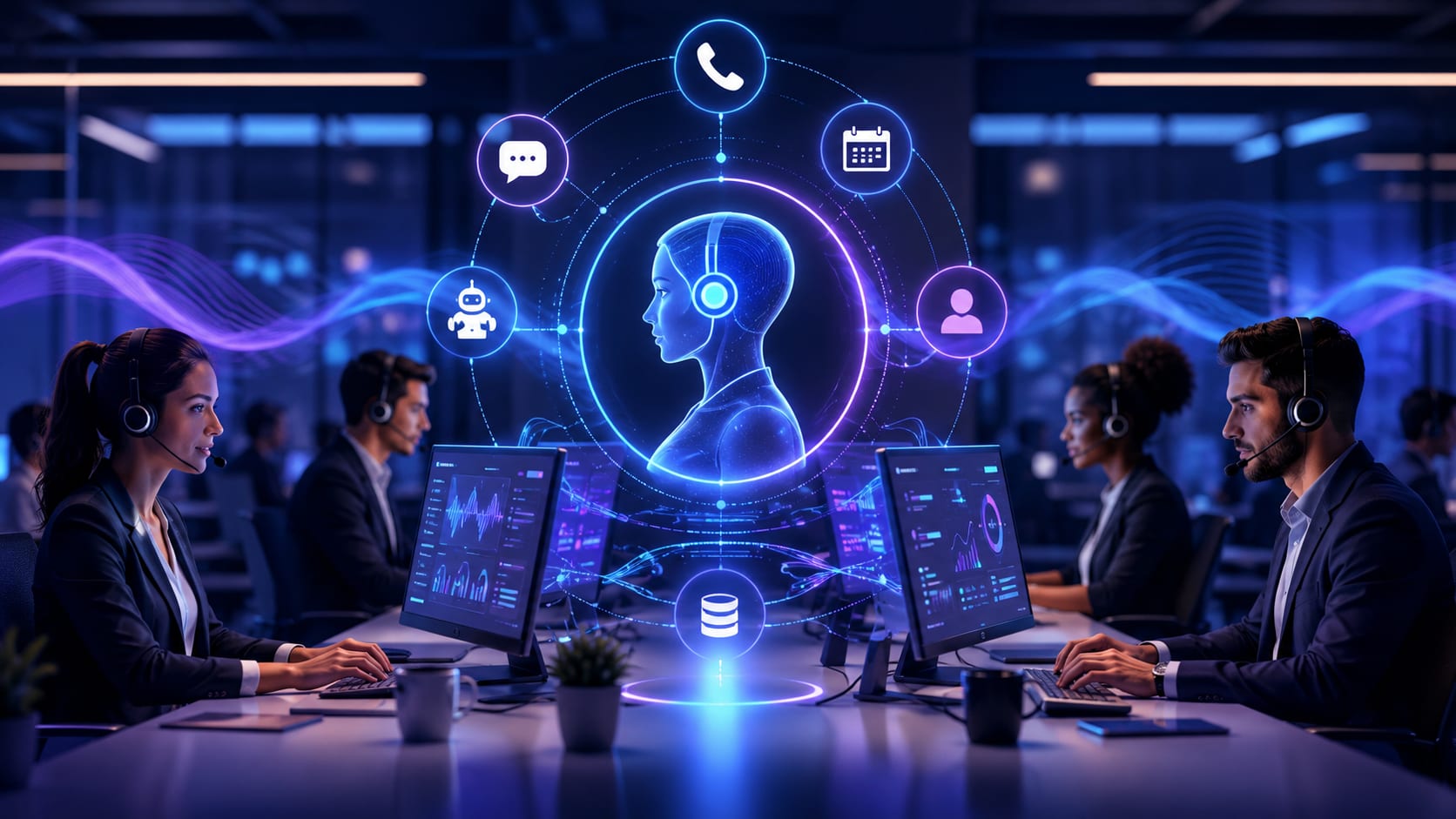
Urai Connect represents the growing shift toward AI-powered communication, where intelligent voice technology can help businesses answer calls, automate repetitive workflows, support customers, and connect conversations with business systems.
Instead of treating every phone call as a task that must be handled manually, an AI-powered call center can understand conversations, respond naturally, access relevant information, perform actions, and transfer complex situations to human employees.
For businesses looking to modernize their customer communication, Urai Connect can be explored as part of the broader movement toward intelligent call center automation.
What Is Urai Connect?
Urai Connect refers to an AI-driven approach to business communication in which artificial intelligence can help manage customer conversations and call center workflows.
Modern AI voice agents can do much more than simply answer a phone call. Depending on how they are configured, they can support tasks such as:
Answering inbound calls
Handling frequently asked questions
Scheduling appointments
Rescheduling or cancelling appointments
Qualifying leads
Following up with customers
Collecting information
Updating CRM records
Routing calls
Escalating conversations to human agents
Supporting outbound campaigns
Providing assistance outside normal business hours
AI voice-agent platforms are increasingly designed to connect conversations with tools such as calendars, CRMs, knowledge bases, and other business systems.
To learn more about the Urai Connect concept and its online presence, visit Urai Connect.
Why Are AI-Powered Call Centers Becoming So Important?
Customer expectations have changed.
People want fast answers. They do not necessarily want to wait in a queue, navigate complicated phone menus, or repeat the same information to multiple employees.
At the same time, businesses face their own challenges:
Rising customer-service costs
Difficulty hiring and retaining call center employees
High call volumes
Repetitive customer questions
Missed calls
After-hours inquiries
Manual data entry
Slow lead response
Inconsistent customer experiences
AI-powered call centers address many of these challenges by adding automation to the communication process.
An AI voice agent can potentially answer a call immediately, understand the customer's request, retrieve information, and take the next appropriate action.
The result is a model in which AI handles routine conversations while human employees focus on situations that require judgment, empathy, expertise, or negotiation.
How Urai Connect Can Transform a Traditional Call Center
The biggest difference between a traditional call center and an AI-powered call center is automation.
A traditional call center generally follows a process like this:
Customer calls → Agent answers → Agent searches for information → Agent performs task → Agent records the interaction
An AI-powered approach can streamline the process:
Customer calls → AI understands intent → AI accesses information → AI performs the task → System records the interaction → Human escalation when necessary
This can make customer communication faster and more scalable.
1. 24/7 Call Handling
One of the biggest advantages of AI call center technology is availability.
Human teams typically work scheduled shifts. AI voice agents can be designed to operate continuously, allowing businesses to respond to customers outside traditional working hours.
This can be particularly useful for:
Healthcare organizations
Property management companies
E-commerce businesses
Professional services
Hospitality
Automotive businesses
Financial services
Home-service companies
Global businesses
A customer who calls at night should not necessarily have to wait until the next morning for a basic answer.
2. Intelligent AI Voice Agents
Modern conversational AI is moving beyond rigid phone menus.
Instead of asking customers to select options such as "Press 1 for sales" or "Press 2 for support," an intelligent voice agent can allow customers to explain what they need using natural language.
For example:
"I'd like to move my appointment from Tuesday to Thursday."
An AI voice system could identify the intent, check available appointment times, and potentially complete the rescheduling workflow.
Modern Urai voice-agent technology describes capabilities such as appointment scheduling, lead qualification, outbound follow-ups, order intake, and CRM updates during conversations.
3. Faster Lead Qualification
Speed matters when a potential customer contacts a business.
If a lead calls and nobody answers, the business may lose that opportunity to a competitor.
An AI-powered call center can help businesses respond immediately.
An AI agent can ask qualifying questions such as:
What service are you interested in?
When do you need it?
What is your approximate budget?
Which location are you contacting us about?
How soon would you like to speak with a specialist?
The resulting information can then be passed to the sales team or CRM.
This allows human sales representatives to spend more time with qualified prospects rather than manually collecting basic information.
4. Automated Appointment Scheduling
Appointment scheduling is one of the clearest use cases for AI call center automation.
Instead of having an employee spend several minutes checking calendars and confirming availability, an AI voice agent can potentially handle the conversation automatically.
A typical workflow might look like:
Customer calls → AI identifies appointment request → Calendar is checked → Available times are offered → Customer selects a time → Appointment is confirmed
This can be useful for:
Clinics
Dental offices
Salons
Consultants
Repair businesses
Real estate companies
Fitness centers
Professional services
AI phone agents can also be configured for rescheduling and cancellation workflows.
5. Better Customer Support
Many call center questions are repetitive.
Customers frequently ask about:
Opening hours
Pricing
Order status
Account information
Policies
Services
Locations
Appointment availability
Basic troubleshooting
An AI call center can use a business knowledge base to provide answers to these common questions.
This allows human support representatives to concentrate on more complex issues.
The goal is not necessarily to eliminate human customer service. Instead, the goal is to create a hybrid customer service model.
AI handles:
Routine questions
Basic requests
Information retrieval
Scheduling
Qualification
Simple workflows
Humans handle:
Complex complaints
Sensitive situations
High-value customers
Exceptions
Negotiations
Problems requiring human judgment
6. Seamless Human Handoff
One of the most important features of a modern AI call center is knowing when not to rely on AI.
A good system should have escalation paths.
For example, if a customer says:
"I have already contacted support three times and my problem still isn't fixed."
That situation may require a human representative.
Instead of forcing the customer to repeat everything, the AI-assisted workflow can pass relevant context to the human employee.
Human handoff is a key part of responsible conversational automation because not every customer interaction should be fully automated.
7. CRM Integration and Automated Data Entry
Traditional call centers often require agents to manually document conversations.
After a call, employees may have to:
Write notes
Update contact information
Change lead status
Create follow-up tasks
Record call outcomes
Schedule reminders
This administrative work consumes valuable time.
AI-powered systems can connect conversations to business applications and automate some of these activities.
Modern Urai materials describe voice agents performing CRM updates, calendar bookings, knowledge lookups, and other tool calls while a customer is still on the call.
That means the call can become more than a conversation—it can become an automated business workflow.
Urai Connect and the Future of Call Center Automation
The future of call centers is unlikely to be simply "AI versus humans."
Instead, the future will likely be AI + humans.
AI can provide speed, consistency, scalability, and 24/7 availability.
Humans provide empathy, creativity, judgment, relationship building, and the ability to handle unusual situations.
The strongest call center model combines both.
The future call center may look like this:
AI receives the call
↓
AI understands the customer's intent
↓
AI retrieves relevant information
↓
AI completes routine tasks
↓
AI records the interaction
↓
AI identifies complex situations
↓
Human agent takes over when needed
This model can help businesses scale customer communication without requiring every interaction to be handled manually.
AI Call Centers vs Traditional Call Centers
FeatureTraditional Call CenterAI-Powered Call CenterAvailabilityUsually scheduledCan operate 24/7Routine questionsHuman agentsAI can automateAppointment bookingOften manualCan be automatedLead qualificationHuman-ledAI-assisted or automatedData entryManualCan be automatedScalabilityRequires more staffSoftware can scaleResponse timeDepends on staffingCan be immediateHuman escalationPrimary workflowUsed for complex casesCustomer dataOften entered manuallyCan be connected to CRMRepetitive tasksTime-consumingHighly automatable
The exact capabilities depend on the AI platform, integrations, configuration, and business workflow.
Key Benefits of Urai Connect
Businesses considering AI-powered call center technology should focus on measurable business outcomes.
Reduced Call Handling Costs
Automating repetitive interactions can reduce the amount of manual work required for high-volume call handling.
Faster Response Times
AI agents can answer calls immediately, helping reduce missed opportunities and waiting times.
Improved Availability
Businesses can provide customer assistance outside normal office hours.
Increased Employee Productivity
Employees can spend less time answering repetitive questions and completing administrative tasks.
Better Lead Management
AI can collect information and qualify leads before passing them to sales teams.
More Consistent Customer Experiences
AI agents can follow standardized workflows and access approved business information.
Greater Scalability
When call volumes increase, businesses can use automation to handle additional demand without relying entirely on hiring more staff.
Who Can Benefit From an AI-Powered Call Center?
Almost any organization that receives significant phone traffic can potentially benefit.
Healthcare
Healthcare organizations can use AI phone agents for appointment-related requests, basic information, reminders, and routing.
Sensitive healthcare workflows require appropriate privacy, security, and regulatory controls.
E-Commerce
Online retailers can automate order-status questions, returns information, shipping inquiries, and basic customer support.
Real Estate
Real estate businesses can use AI to capture leads, answer property-related questions, qualify prospects, and schedule appointments.
Financial Services
Financial organizations can explore AI for routine inquiries and customer routing, subject to applicable security, compliance, and regulatory requirements.
Hospitality
Hotels and hospitality businesses can use conversational AI for reservations, frequently asked questions, and guest assistance.
Home Services
Plumbers, electricians, HVAC companies, cleaning companies, and other service businesses can use AI call agents to capture leads and schedule jobs.
What Makes an AI Call Center Successful?
Simply installing an AI voice agent does not guarantee better customer service.
Successful implementation requires careful planning.
1. Build a Strong Knowledge Base
The AI needs accurate information.
Businesses should maintain up-to-date information about:
Products
Services
Pricing
Policies
Locations
Business hours
FAQs
Escalation procedures
2. Define Clear Workflows
The AI should know what it is allowed to do.
For example:
Can it cancel an appointment?
Can it issue a refund?
Can it change customer information?
Can it transfer calls?
Clear permissions help reduce errors.
3. Create Human Escalation Rules
Define situations where AI should transfer the conversation to an employee.
4. Connect Business Systems
The real value of conversational AI increases when the voice agent can interact with calendars, CRM systems, knowledge bases, ticketing systems, and other business tools.
5. Monitor Performance
Businesses should measure:
Call resolution rate
Transfer rate
Customer satisfaction
Average handling time
Lead conversion
Appointment bookings
Missed-call reduction
Escalation rate
The Role of Conversational AI in Modern Customer Service
Conversational AI is changing what customers expect from businesses.
A customer no longer necessarily needs to interact with a complicated menu system. Instead, they can communicate naturally.
The technology is also becoming more capable of connecting conversations to actions.
For example:
Customer: "Can you book me for tomorrow afternoon?"
AI: Checks calendar availability.
AI: Offers available times.
Customer: "Three o'clock works."
AI: Books the appointment.
System: Updates the calendar and records the interaction.
That is the fundamental difference between a basic chatbot and an intelligent AI agent: the agent can potentially take action instead of simply providing an answer.
Is Urai Connect the Future of AI-Powered Call Centers?
The broader direction of the industry strongly points toward intelligent automation.
AI voice technology is becoming more capable of natural conversations, tool use, CRM integration, scheduling, lead qualification, and automated workflows. Urai's current voice-agent materials specifically describe inbound and outbound calling, natural conversation, tool calls during calls, and integrations with business workflows.
For businesses, this creates an opportunity to rethink the traditional call center.
Instead of asking:
"How many agents do we need to answer all these calls?"
companies can increasingly ask:
"Which conversations should AI handle, and where should our human experts step in?"
That is a much more scalable approach.
How to Get Started With Urai Connect
Businesses interested in AI-powered call center technology should start with their highest-volume and most repetitive customer interactions.
A simple implementation process can include:
Step 1: Identify repetitive calls
Review call recordings, support tickets, and customer questions.
Step 2: Choose an initial use case
Start with something measurable, such as appointment scheduling or lead qualification.
Step 3: Prepare your business knowledge
Give the AI accurate information and clear instructions.
Step 4: Connect required tools
Integrate calendars, CRM platforms, knowledge systems, or other business applications where appropriate.
Step 5: Define escalation rules
Determine exactly when a human employee should take over.
Step 6: Test before full deployment
Run controlled tests to identify incorrect responses and workflow problems.
Step 7: Measure results
Track customer satisfaction, automation rates, transfers, conversion, and operational savings.
For more information, visit Urai Connect.
Frequently Asked Questions About Urai Connect
What is Urai Connect?
Urai Connect is a term associated with AI-powered business communication and call center automation. The broader Urai platform describes AI voice agents capable of handling inbound and outbound calls, scheduling, lead qualification, support, and business-system actions.
What is an AI-powered call center?
An AI-powered call center uses artificial intelligence to automate or assist with customer conversations. It can include AI voice agents, automated call routing, customer support, appointment scheduling, lead qualification, CRM updates, and human-agent escalation.
Can AI completely replace human call center agents?
Not necessarily. AI is best suited to repetitive, structured, high-volume interactions, while human agents remain important for complex, sensitive, emotional, or high-value conversations.
Can AI voice agents schedule appointments?
Yes. Modern AI voice-agent systems can be integrated with calendars to check availability and schedule, reschedule, or cancel appointments.
Can an AI call center qualify leads?
Yes. AI can ask predefined qualification questions, identify customer intent, collect information, and pass qualified leads to a sales team or CRM.
Can AI connect to a CRM?
AI voice systems can be integrated with CRM platforms and other business tools. Urai's materials describe CRM updates and tool calls during live conversations.
Is an AI call center available 24/7?
AI voice agents can be designed to operate continuously, making them suitable for after-hours and high-volume call handling.
How do I learn more about Urai Connect?
Visit Urai Connect to explore the platform and its available information.
Conclusion
The future of customer communication is becoming increasingly intelligent.
Urai Connect and AI-powered call center technology represent a major shift from traditional phone systems toward conversational, automated, and action-oriented customer experiences.
Instead of simply answering calls, modern AI agents can potentially understand customer intent, access business information, schedule appointments, qualify leads, update systems, and transfer complex conversations to human employees.
For organizations looking to improve customer experience while increasing operational efficiency, AI-powered call center automation offers an increasingly important opportunity.
The winning strategy will not be to remove humans from customer service.
It will be to give human teams better AI tools and let automation handle the repetitive work.
To explore more, visit Urai Connect and learn how AI-powered communication can become part of your business strategy.