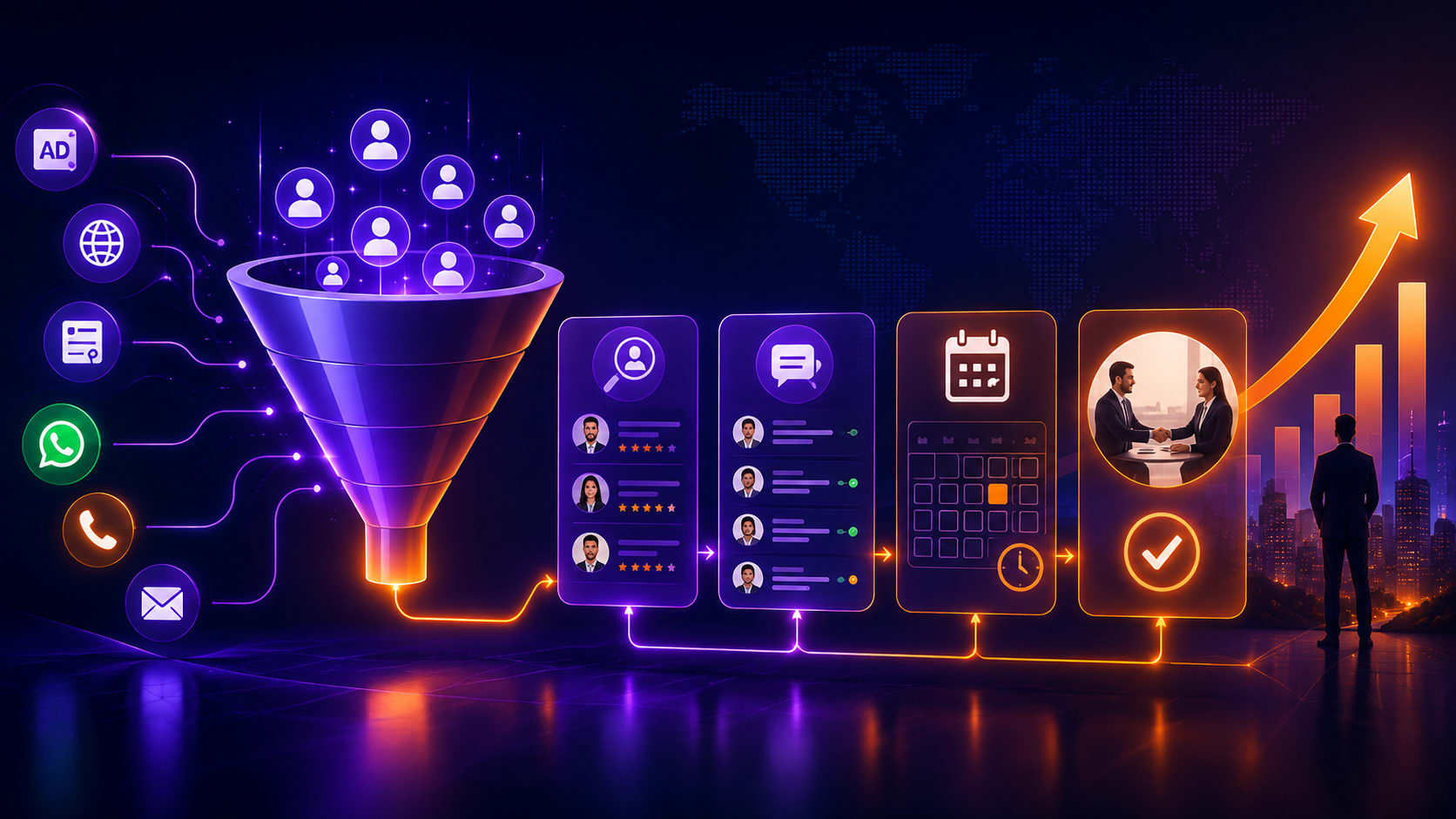

Businesses need a consistent way to connect with potential customers, understand their requirements, and turn genuine interest into sales opportunities. Professional Lead Generation Services in Delhi NCR can help businesses identify relevant prospects, manage inquiries, qualify potential customers, and support sales teams with a more organized customer acquisition process.
UR AI CONNECT provides technology-driven business communication and customer engagement solutions, including AI calling, voice agents, messaging, and related automation services. Businesses can explore the company's solutions at https://www.uraiconnect.com/ to understand how communication technology can support customer outreach and follow-up activities.
For businesses operating in Delhi, Noida, Greater Noida, Gurugram, Faridabad, and Ghaziabad, lead generation can support different commercial goals. A real estate company may need property inquiries, a clinic may want to manage appointment requests, an educational institution may seek student admissions inquiries, and a B2B company may want to connect with relevant decision-makers.
However, generating a large number of inquiries is not the same as generating quality leads. Effective lead generation starts with a clear target audience, a relevant offer, suitable communication channels, a structured qualification process, and consistent follow-up. This guide explains how businesses can build a practical lead generation strategy and evaluate solutions that fit their needs.
1. What Are Lead Generation Services in Delhi NCR and How Do They Work?
Lead generation services help businesses identify people or organizations that may be interested in their products or services and encourage them to take a meaningful next step. These steps may include submitting an inquiry, requesting a quotation, booking an appointment, responding to a campaign, or speaking with a sales representative. In Delhi NCR, a suitable strategy depends on the target location, industry, customer profile, budget, and sales process.
What is lead generation?
Lead generation is the process of attracting, identifying, and collecting inquiries from potential customers. A lead is someone who has shown some level of interest in a business's offering or has been identified as a potential prospect through an appropriate business development process.
For example, a person who fills out a form requesting information about a residential plot may become a lead for a real estate company. A business owner who requests a demonstration of customer communication software may become a lead for a technology provider.
A lead record may contain information such as:
Name or business name, where appropriately collected.
Contact details provided for the relevant purpose.
Product or service of interest.
Preferred location or service area.
Budget or purchase requirements, when relevant.
Preferred time or channel for follow-up.
Current status, such as new inquiry, contacted, qualified, or converted.
Businesses should collect only the information they need, explain how it will be used, and apply appropriate consent, privacy, and data-security practices.
What is the difference between a lead and a qualified lead?
A lead is a potential customer who has expressed interest or has been identified as a relevant prospect. A qualified lead has been assessed against defined criteria, such as service requirements, location, budget, purchase timeline, or decision-making authority.
For instance, a real estate inquiry may become qualified after the sales team confirms that the person is interested in a suitable property type, is considering the target location, and wants further information. Qualification criteria should match the business rather than rely on assumptions about the prospect.
Types of lead generation services
Businesses may use different approaches depending on whether they sell to individual consumers, other businesses, or both.
B2B lead generation services
Business-to-business lead generation focuses on identifying organizations and professionals who may need a company's products or services.
Common activities include:
Identifying businesses within a target industry.
Researching relevant company roles and decision-makers.
Developing prospect lists using appropriate, lawful sources.
Reaching out through suitable business communication channels.
Arranging product demonstrations or sales discussions.
Qualifying prospects before transferring them to a sales team.
For example, a software company serving businesses in Noida may target organizations that need customer support automation. The campaign can focus on identifying relevant companies, understanding their requirements, and inviting interested decision-makers to discuss the solution.
B2C lead generation services
Business-to-consumer lead generation focuses on potential individual customers. Lead Generation Services in Delhi NCR It is commonly used in real estate, education, healthcare, home services, financial services, and other consumer-facing industries.
Typical activities include collecting inquiries through advertising, websites, landing pages, appointment forms, or other appropriate channels, followed by relevant communication and qualification.
A clinic, for example, may receive appointment inquiries from prospective patients. The clinic can organize those inquiries by requested service and preferred appointment time, while protecting personal and health-related information.
Inbound lead generation
Inbound lead generation attracts prospects who actively discover or engage with a business. Channels may include:
Search engine optimization (SEO).
Helpful website content and blog articles.
Landing pages and contact forms.
Paid search advertising.
Social media content.
Webinars and downloadable resources.
Business listings and relevant referral channels.
Inbound strategies are useful when potential customers are already searching for a product, service, or solution. They can help businesses build visibility and capture inquiries over time, although results depend on market conditions, content quality, competition, and the effectiveness of the offer.
Outbound lead generation
Outbound lead generation involves proactively reaching suitable prospects rather than waiting for them to discover a business.
Depending on the audience and applicable rules, this may include targeted business outreach, follow-up to existing inquiries, consent-based calling, or relevant messaging campaigns.
Outbound campaigns should have a clear purpose, use appropriate contact data, respect communication preferences, and provide a way to opt out where required. Unsolicited bulk outreach is not automatically an effective or appropriate lead generation strategy.
How do lead generation campaigns work?
A structured campaign usually follows a series of steps.
Step 1: Define the target audience
Identify the people or organizations most likely to need the offering. Define industry, location, customer type, requirements, and other relevant characteristics.
Step 2: Choose the right channels
Select suitable channels such as SEO, paid advertising, inquiry forms, business outreach, voice calls, SMS, or WhatsApp Business, depending on the audience and applicable permissions.
Step 3: Capture and qualify inquiries
Record relevant details, identify the prospect's requirements, and determine whether the inquiry matches the business's service criteria.
Step 4: Follow up and arrange the next step
Respond within a reasonable time, answer questions, arrange appointments where appropriate, and pass qualified inquiries to the relevant sales representative.
Step 5: Measure and improve
Track lead quality, response time, appointment attendance, conversion rates, and campaign costs. Use the findings to improve targeting and follow-up.
Which lead generation channels can businesses use?
No single channel suits every business. The right combination depends on how customers research options, how urgently they need a solution, and how much information they require before making a decision.
Channel
Typical purpose
Important consideration
SEO and website content
Attract people searching for relevant solutions
Requires useful content and ongoing optimization
Paid advertising
Generate inquiries from targeted campaigns
Costs depend on competition, targeting, and campaign performance
Landing pages and forms
Capture customer requirements
Forms should be clear, relevant, and easy to complete
AI calling and voice agents
Support suitable call workflows and inquiry qualification
Requires accurate scripts, appropriate consent, and human escalation when needed
SMS and WhatsApp Business
Send relevant updates and follow-ups
Follow channel-specific consent and messaging rules
Business-to-business outreach
Connect with relevant organizations
Prospect selection and message relevance matter
A business can combine multiple channels, but it should first establish how each channel contributes to measurable outcomes. Running many campaigns without tracking their performance can make it difficult to identify what is working.
Lead generation services for different Delhi NCR locations
Delhi NCR includes different business districts, residential markets, commercial hubs, and service areas. A campaign should reflect where the business can genuinely serve customers rather than simply include multiple city names in its advertising.
Delhi: Businesses may target customers within specific service areas or relevant professional and commercial segments.
Noida: Technology providers, professional services, education businesses, and other organizations may build campaigns around their target customer profiles.
Greater Noida: Businesses may focus on locally relevant inquiries, depending on their services and coverage.
Gurugram: B2B providers and professional service companies may target organizations that match their ideal customer profile.
Faridabad: Local businesses can structure outreach around their actual service area and customer requirements.
Ghaziabad: Businesses may focus on suitable residential, commercial, or professional audiences.
These are possible campaign contexts, not claims about guaranteed demand or market performance in any particular city.
For businesses evaluating communication-based lead generation, UR AI CONNECT can be explored at https://www.uraiconnect.com/. Its AI calling, voice, messaging, and customer engagement solutions may be relevant to campaign workflows where automated communication is suitable.
What information should a lead generation campaign collect?
A campaign should collect enough information to determine the prospect's requirements without creating unnecessary friction.
A property inquiry form may ask about property type, preferred location, and an appropriate contact method. Lead Generation Services in Delhi NCR , A B2B inquiry form may ask for company name, business email, the solution required, and preferred time for a discussion.
A clinic should use a more careful approach to personal information and avoid collecting sensitive medical details through an ordinary marketing form unless the collection is appropriate and properly protected.
The most useful fields are those that help the business take a relevant next step. Long forms can discourage inquiries, while forms that collect almost no qualifying information may create additional work for the sales team.
How should leads be managed after collection?
Lead management is the process of organizing inquiries from their initial capture through follow-up and eventual closure. It helps businesses avoid losing track of prospects and provides a consistent view of campaign performance.
A simple lead management workflow can include:
Assigning a unique record to each inquiry.
Recording the source and time of the inquiry.
Checking whether the prospect's details are usable and relevant.
Assigning the inquiry to a responsible team member.
Recording contact attempts and the prospect's preferences.
Scheduling an appropriate follow-up.
Updating the status after each meaningful interaction.
Recording whether the lead converted, was disqualified, or requires further nurturing.
A customer relationship management (CRM) system can help centralize this information. Smaller businesses may begin with a carefully maintained spreadsheet, provided access, privacy, record accuracy, and follow-up responsibilities are managed appropriately.
The objective is not to contact every prospect repeatedly. It is to make each suitable interaction relevant, timely, and useful.
Example: Lead generation for a real estate business
Consider a real estate company that wants to generate inquiries for residential plots in a specific location. The company can create a campaign explaining the property's location, available facilities, relevant documentation, and the next step for interested buyers.
The lead generation process might include the following activities:
Identify the property type and location the company wants to promote.
Create informative advertising and landing page content.
Capture inquiries from people who voluntarily submit their contact details.
Ask relevant qualification questions, such as preferred budget and purchase timeline.
Arrange a call or site visit for prospects who request further information.
Track how many inquiries become qualified opportunities and completed transactions.
This example illustrates a possible workflow, not a reported UR AI CONNECT client result. The business should measure actual performance before deciding whether the campaign is commercially viable.
Example: Lead generation for clinics and healthcare providers
A clinic may need to manage appointment inquiries for consultations, diagnostic services, or other available treatments. A campaign can explain the services offered and direct interested people to an appropriate appointment channel.
The workflow can include collecting appointment requests, confirming the requested service, checking available appointment slots, and arranging follow-up when needed. Patient information should be handled carefully, and marketing communication should not disclose sensitive information unnecessarily.
Automated calling or messaging can support appropriate administrative tasks, but clinical questions, urgent concerns, and requests requiring professional judgment should be handled by qualified staff.
Example: Lead generation for B2B companies
A B2B technology company may sell software or communication solutions to other businesses. Its ideal prospects might include organizations with a customer service team, a sales department, or a need to manage a high volume of inquiries.
The company can identify relevant organizations, prepare useful educational content, invite interested prospects to request a demonstration, and qualify their requirements before assigning them to a sales representative.
For this type of campaign, the number of leads alone may not indicate success. A smaller number of relevant decision-makers can be more commercially useful than a large list of organizations that have little need for the offering.
Example: Lead generation for educational institutions
An educational institution may want to receive inquiries from students or parents who are considering a particular course or program.
A suitable campaign can provide information about courses, eligibility, admission timelines, fees, and the official application process. Follow-up communication can answer questions and direct interested applicants to the institution's admissions team.
The institution should distinguish general information requests from serious admission inquiries. It should also ensure that communications involving minors and their personal information are handled appropriately.
How AI calling can support lead generation
AI calling uses voice technology to handle defined parts of a telephone interaction. Depending on the system and its configuration, an AI voice agent may answer routine questions, collect basic information, direct callers to the right department, or support appointment-related workflows.
In a lead generation process, AI calling may help with:
Responding to suitable inbound inquiries.
Asking predefined qualification questions.
Sharing approved information about a service.
Identifying whether a prospect wants a follow-up.
Supporting appointment requests.
Routing complex queries to a human representative.
Recording interaction outcomes where permitted.
AI calling is not a replacement for every sales conversation. Prospects may ask questions outside the agent's capabilities, request a human representative, or require advice that needs professional judgment. Businesses should provide an effective escalation path and monitor call quality.
UR AI CONNECT offers AI calling and AI voice agent solutions as part of its broader business communication offering. Businesses interested in exploring these capabilities can visit https://www.uraiconnect.com/ and review the services relevant to their requirements.
How SMS and WhatsApp can support lead follow-up
Voice communication is only one part of customer engagement. Some prospects prefer written information that they can read later, share with a colleague, or use to compare options.
SMS and WhatsApp Business may support suitable activities such as:
Confirming a requested appointment.
Sending an inquiry acknowledgment.
Sharing a requested brochure or service link.
Providing relevant reminders.
Confirming a scheduled discussion.
Communicating important updates.
Directing customers to a human representative.
The choice of channel should reflect the customer's preferences and the applicable platform rules. Businesses should not assume that submitting a telephone number automatically authorizes every kind of promotional message or automated call.
For businesses considering integrated communication workflows, https://www.uraiconnect.com/ provides a starting point for exploring UR AI CONNECT's messaging and customer engagement solutions.
What is the role of a CRM in lead generation?
A CRM helps a business maintain an organized record of customer and prospect interactions. Instead of relying on separate spreadsheets, personal notebooks, and scattered messages, teams can use a centralized system to manage inquiries and track progress.
A useful CRM workflow can record:
Where the lead originated.
What product or service the prospect requested.
Which employee or team owns the inquiry.
When contact was attempted.
What information the prospect provided.
Whether the prospect requested a callback.
The current sales stage.
The outcome and reason for closing the record.
Automation can help with tasks such as assigning leads, creating reminders, or updating a status after a defined event. However, the usefulness of automation depends on data quality, workflow design, and team adoption.
A CRM should also support appropriate access controls, retention policies, and secure handling of personal information.
What is the difference between lead generation and lead nurturing?
Lead generation focuses on attracting and identifying potential customers. Lead nurturing focuses on maintaining relevant communication with prospects who need more time or information before making a decision.
For example, someone who requests a real estate brochure may not be ready to arrange a site visit immediately. With appropriate permission, the company might provide requested information and follow up according to the prospect's stated preferences.
Nurturing should be helpful rather than repetitive. Businesses should respect requests to stop receiving communications and avoid treating a lack of response as unlimited permission for continued contact.
A coordinated strategy can connect lead generation, qualification, nurturing, and sales handover into a single process. Businesses evaluating automation for this process can explore https://www.uraiconnect.com/ for information about relevant communication solutions.
2. What Are the Benefits of Lead Generation Services for Businesses in Delhi NCR?
Lead generation services can help businesses organize customer acquisition, reach relevant prospects, and improve how inquiries move from initial interest to a sales conversation. Their value depends on targeting, offer quality, channel selection, lead qualification, and follow-up. They can support business development, but they cannot guarantee that every inquiry will become a paying customer.
1. Reaching a more relevant audience
A campaign performs a useful business function when it reaches people who are likely to need the product or service being offered. Defining the audience helps reduce irrelevant inquiries and gives the sales team a clearer starting point.
A company offering business software may target organizations that fit its service capabilities rather than every business in a region. A clinic may focus on people seeking the services it actually provides. A real estate business may concentrate on its available locations and property categories.
Audience relevance depends on reliable information and clear targeting criteria. Demographic or geographic targeting alone does not prove that someone is interested in purchasing.
2. Creating a more consistent flow of inquiries
Many businesses depend on referrals, repeat customers, or occasional advertising. These sources can be valuable, but they may not provide a predictable process for reaching new prospects.
A planned lead generation campaign creates a repeatable method for attracting inquiries, recording their sources, and evaluating results. It allows businesses to test different offers, messages, and channels while learning which approaches produce relevant opportunities.
Consistency should not be confused with guaranteed volume. Inquiry levels can change because of budgets, seasonality, competition, audience behaviour, and other factors.
3. Reducing manual prospecting effort
Sales teams often spend time identifying prospects, entering information, arranging follow-ups, and updating records. Some of these tasks can be standardized or automated.
For example, an inquiry form can capture initial details, a CRM can assign the record, and an approved workflow can remind a representative to follow up. A voice agent may also handle defined routine interactions where automation is appropriate.
These systems can reduce repetitive administrative work, but they still require monitoring. Incorrect data, unsuitable automation, and poorly configured workflows can create additional problems rather than improve productivity.
4. Improving lead qualification
Not all inquiries have the same commercial value. A prospect may be interested in a different service, fall outside the company's service area, or have a requirement that the business cannot meet.
A qualification framework helps the team identify which inquiries deserve immediate attention and which require clarification or another response.
Useful criteria may include:
Relevance of the requested product or service.
Fit with the company's service area.
Budget or purchasing constraints, when appropriate.
Timing of the requirement.
Readiness to discuss the next step.
Decision-making role in a B2B purchase.
Qualification should be based on relevant information rather than arbitrary assumptions. It should also leave room for prospects whose needs may become suitable later.
5. Supporting faster responses to inquiries
When a prospect submits a request, a delayed response can make the experience frustrating. A structured lead management process can help a business acknowledge inquiries, assign responsibility, and follow up without unnecessary delays.
An acknowledgment message may confirm that the request was received. A callback workflow may direct the inquiry to the right team. Appointment automation may help arrange a suitable time when availability and system capabilities support it.
Automated acknowledgment does not replace a meaningful answer. Businesses should set realistic response expectations and ensure that unresolved or complex questions reach an appropriate employee.
6. Supporting appointment booking
Appointment booking can be an important objective for clinics, consultants, educational institutions, property businesses, and B2B service providers.
A suitable process may collect the prospect's preferred time, confirm available slots, and send an appointment confirmation. Reminders can help keep the prospect informed, provided the communication is relevant and permitted.
Businesses should measure more than the number of appointments booked. Attendance, suitability, completed consultations, and subsequent sales opportunities may provide a clearer picture of commercial value.
7. Making better use of marketing budgets
Campaign reporting helps businesses compare spending with the outcomes that matter to them. A low cost per inquiry may look attractive, but the inquiries might be irrelevant or difficult to convert.
A useful review compares the full cost of a campaign with lead quality, qualification rate, appointments, sales opportunities, and eventual revenue where that information is available.
Businesses should avoid choosing a provider solely because it promises a high number of leads at a low price. The definition of a lead, the quality checks applied, and the method of reporting should all be clear.
8. Improving visibility into the sales pipeline
A sales pipeline shows the stages an inquiry passes through, from initial contact to qualification, appointment, proposal, and eventual closure.
When these stages are recorded consistently, management can identify where prospects are being lost. For example, a campaign may generate relevant inquiries but struggle to convert them into appointments. Another campaign may produce fewer inquiries but a stronger proportion of sales opportunities.
This information helps businesses investigate problems rather than assume that the advertising channel is responsible for every disappointing result.
9. Supporting communication across multiple channels
Different prospects prefer different forms of communication. Some may want a telephone conversation, while others prefer a written message or a website form.
A multi-channel approach can make it easier to acknowledge inquiries, share requested information, and coordinate follow-up. The channels should work together rather than overwhelm the prospect with duplicate messages.
For example, a customer who requests an appointment may receive an appropriate confirmation through the agreed channel. A representative can then handle questions that require a personal discussion.
Businesses can explore UR AI CONNECT's communication and engagement solutions at https://www.uraiconnect.com/ when considering whether voice, messaging, or automation could support their lead management process.
10. Supporting business growth without immediately expanding administrative workload
As inquiry volume increases, manual tracking may become more difficult. A structured process can help the business assign responsibilities, maintain records, and standardize routine interactions.
Automation may support growth by handling repeatable tasks, but it does not eliminate the need for trained salespeople, customer service representatives, or managers. A business should evaluate its operational needs before automating a workflow.
Scaling also requires quality control. More inquiries are useful only when the business can respond appropriately and deliver the product or service being promoted.
Industry-specific benefits of lead generation
Real estate companies
Real estate businesses may use lead generation to attract property inquiries, understand buyer requirements, arrange site visits, and follow up with interested prospects.
The campaign should accurately describe the property, location, price information where available, relevant approvals, and the next step. Lead qualification can help sales representatives prioritize inquiries that match the properties actually available.
A campaign should never invent investment returns, guaranteed appreciation, project approvals, or property availability.
Clinics and healthcare businesses
Healthcare providers may use lead generation to help prospective patients discover available services and request appointments. Clear service information and an appropriate booking process can reduce confusion.
Marketing systems should handle personal information carefully. Automated communications should remain within their intended administrative role and direct clinical questions to qualified professionals.
Educational institutions
Schools, colleges, coaching centres, and training providers may generate inquiries from prospective students or parents. Helpful content about programs, eligibility, admissions, and deadlines can support informed decisions.
The institution should track the progression from initial inquiry to counselling, application, and enrolment rather than measuring success only by form submissions.
B2B companies
B2B organizations may use lead generation to identify suitable companies, reach relevant decision-makers, qualify requirements, and arrange demonstrations or consultations.
Because business purchasing decisions can involve several people and a longer evaluation period, the campaign may need a nurturing process rather than an immediate sales pitch.
Startups and small businesses
Startups may need to validate demand while working within limited budgets. A focused campaign with a clear target audience can help test whether the offer attracts relevant inquiries.
A small business can begin with a narrow audience, a measurable goal, and a manageable follow-up process. It can expand the campaign when the initial results justify additional spending.
How to measure lead generation performance
Performance measurement should connect marketing activity to meaningful business outcomes. The right metrics depend on the campaign objective.
Cost per lead (CPL) measures campaign cost relative to the number of leads generated.
\[ \text{CPL}=\frac{\text{Campaign Cost}}{\text{Number of Leads}} \]
If a campaign costs ₹20,000 and generates 100 leads, its cost per lead is ₹200. This is a mathematical illustration, not a benchmark or a prediction of what a campaign should achieve.
Lead qualification rate measures the proportion of leads that meet the business's qualification criteria.
\[ \text{Qualification Rate}=\frac{\text{Qualified Leads}}{\text{Total Leads}}\times100 \]
Lead-to-customer conversion rate measures the proportion of leads that become customers.
\[ \text{Conversion Rate}=\frac{\text{Customers Acquired}}{\text{Total Leads}}\times100 \]
Businesses may also track response time, appointment attendance, cost per qualified lead, proposal acceptance, customer acquisition cost, and revenue attributable to the campaign.
Each metric has limitations. Attribution can be difficult when customers interact with multiple channels before purchasing. Reporting should state how leads and conversions are counted and what period is being measured.
Important limitations and realistic expectations
Professional lead generation services can support customer acquisition, but their effectiveness depends on several factors beyond the service provider's control.
These include:
The strength and relevance of the product or service.
The accuracy of audience and contact information.
The competitiveness of the offer.
The campaign budget and duration.
The quality of the landing page or inquiry process.
The sales team's response time and follow-up.
Customer purchasing behaviour.
Compliance with applicable communication and privacy requirements.
A campaign can generate inquiries without producing sales. A low inquiry volume does not always indicate failure if the leads are highly relevant and the sales value is substantial. Results should be assessed against clear objectives and realistic business economics.
For businesses evaluating technology-assisted outreach, https://www.uraiconnect.com/ can be used to review the company's available communication solutions and determine whether they fit the intended workflow.
How AI automation can support the lead generation process
AI automation may help organize certain repetitive tasks, classify incoming inquiries, provide approved information, and support follow-up workflows. The exact capabilities depend on the technology, integration, and configuration.
For example, an AI voice agent may ask a predefined set of questions, identify the reason for a call, or route an inquiry to a relevant team. A messaging workflow may send a requested confirmation or reminder.
Businesses should test automated workflows before deployment, check how they handle unexpected questions, and provide a clear path to human support. AI systems should not be assumed to understand every customer accurately or make every decision correctly.
Automation works best when it supports a well-designed process rather than compensating for unclear offers, poor data, or missing sales ownership.
3. How Can Businesses Choose the Right Lead Generation Company in Delhi NCR?
Businesses should choose a lead generation company based on its understanding of the target audience, service capabilities, lead qualification process, reporting standards, pricing transparency, and data-handling practices. The right provider should explain how the campaign will work, what counts as a lead, which outcomes will be measured, and what limitations may affect performance.
1. Define the campaign objective before selecting a provider
Before comparing providers, the business should decide what it wants the campaign to achieve.
Possible objectives include:
Generating inquiries for a particular product or service.
Finding relevant B2B prospects.
Increasing requests for quotations.
Supporting appointment booking.
Qualifying existing inquiries.
Improving follow-up for interested prospects.
Reducing the administrative effort involved in managing inquiries.
The objective should be measurable. For example, a clinic may focus on suitable appointment requests, while a B2B company may prioritize qualified discussions with decision-makers.
The provider should understand this objective before recommending channels, automation, or campaign volume.
2. Check whether the provider understands the industry
Lead generation requirements vary significantly between industries. A real estate company, clinic, educational institution, and B2B technology provider do not necessarily need the same targeting criteria or follow-up process.
A suitable provider should ask about the offering, ideal customer, service area, buying process, and qualification requirements. It should also understand any industry-specific restrictions that affect advertising and communication.
Businesses should ask providers to explain their proposed process rather than rely on broad claims that the same strategy works for every industry.
3. Evaluate the available services and channels
Some providers specialize in advertising, while others focus on data research, appointment setting, outbound outreach, or customer communication automation. Businesses should identify which activities they need and which tasks will remain their own responsibility.
Questions to consider include:
Can the provider explain its campaign workflow?
Does it support the channels required by the target audience?
How are inquiries recorded and assigned?
Is lead qualification included?
Are appointment requests or follow-ups part of the agreed scope?
What reporting will be supplied?
Can the process integrate with the business's existing tools, if needed?
Businesses considering AI calling, voice agents, messaging, or communication automation can review the available solutions at https://www.uraiconnect.com/. They should confirm the exact features, integrations, and scope with the provider before making a purchase decision.
4. Understand what counts as a lead
A clear lead definition is essential when comparing providers. One provider may count every form submission, while another may exclude duplicate, incomplete, or irrelevant inquiries.
Before starting a campaign, agree on the criteria for an accepted lead. These may include valid contact information, a relevant service requirement, a suitable geographic area, and the absence of duplicate records.
Also clarify how invalid leads, unreachable contacts, cancellations, and duplicate inquiries will be handled. If replacements or refunds are offered, the terms should be documented rather than assumed.
A transparent definition makes campaign reporting more meaningful and reduces disputes over the quantity and quality of delivered leads.
5. Compare pricing models carefully
Lead generation pricing can vary according to the scope of work, channel, target audience, campaign duration, technology, and reporting requirements. There is no single price that applies to every business or campaign in Delhi NCR.
Common pricing arrangements include:
Fixed project fee: A defined amount for an agreed scope of work.
Monthly service fee: A recurring fee for ongoing campaign management or services.
Advertising management fee: A fee for managing advertising, which may be separate from the advertising budget.
Cost per lead: Payment based on an agreed definition of a lead.
Performance-based arrangements: Payment tied to specified outcomes, subject to the agreed measurement and attribution rules.
These are general pricing models, not a statement that every provider offers each option.
Businesses should ask whether advertising spend, taxes, software, messaging charges, calling charges, data costs, creative production, and integration work are included. They should also understand minimum commitments and cancellation terms.
A low headline price may not represent the lowest overall cost if the campaign requires significant additional spending or produces unsuitable inquiries.
6. Evaluate lead quality instead of quantity alone
Lead quality determines how useful an inquiry is for the sales process. A business should review whether the leads match its target audience, contain usable information, and have a relevant requirement.
A useful evaluation process includes:
Define qualification criteria before the campaign starts.
Review a sample of leads using the agreed criteria.
Record invalid, duplicate, and irrelevant inquiries.
Track how quickly the team reaches prospects.
Measure qualified opportunities and subsequent outcomes.
Share feedback with the provider to improve targeting.
Businesses should avoid judging lead quality solely by whether a prospect immediately purchases. Some genuine prospects need more time, information, or internal approval before making a decision.
7. Check reporting and transparency
A professional reporting process should make it possible to understand what the campaign has done and where improvements may be needed.
Depending on the service, reports may include:
Campaign dates and expenditure.
Number of inquiries received.
Lead sources and channel performance.
Duplicate or invalid lead counts.
Qualification results.
Response and follow-up status.
Appointment bookings and attendance.
Conversion outcomes, where trackable.
Recommendations for the next campaign period.
The reporting frequency should be agreed in advance. Businesses should also clarify who owns the campaign data and how records can be accessed or exported when the engagement ends.
Avoid relying on screenshots or total lead counts without the underlying definitions and context needed to interpret them.
8. Assess data privacy and communication compliance
Lead generation may involve personal information, contact details, call recordings, messaging records, or information about a prospect's interests. Businesses must consider applicable Indian laws, relevant regulatory requirements, and the rules of the communication channels they use.
Depending on the campaign, important considerations may include:
Whether the contact information was collected and obtained appropriately.
Whether the intended communication is permitted.
Whether the necessary consent or other lawful basis applies.
Whether channel-specific preferences and opt-out requests are respected.
Whether personal information is protected from unauthorized access.
Whether records are retained only as needed.
Whether third-party providers have appropriate data-handling arrangements.
Voice calls, SMS, and other communications may be subject to specific requirements under applicable Indian telecom regulations and provider rules. Businesses should verify current requirements for their campaign instead of assuming that a contact list can be used for unrestricted outreach.
A provider's assurance alone does not remove the business's responsibility to understand its obligations. For legal or regulatory questions, seek qualified advice.
9. Ask the right questions before signing an agreement
A short evaluation checklist can help a business compare providers objectively.
Provider evaluation checklist
0 of 8
The campaign objective and target audience are clearly defined.
The lead qualification criteria are documented.
The service scope and exclusions are written down.
Pricing, additional charges, and cancellation terms are clear.
Reporting frequency and performance metrics are agreed.
Data ownership, security, and retention are addressed.
Consent, contact preferences, and opt-out procedures are covered.
The provider explains limitations without guaranteeing results.
Reset checklist
The checklist can be used when reviewing proposals or discussing campaign requirements with a potential provider.
10. Why businesses may consider UR AI CONNECT
UR AI CONNECT focuses on technology-driven business communication and customer engagement. Its listed solution areas include AI calling and voice agents, voice calling solutions, IVR, cloud call centre services, lead generation and qualification, appointment booking, automated customer support, bulk SMS, RCS messaging, and WhatsApp Business solutions.
These capabilities may be relevant to businesses looking to connect inquiry handling with communication workflows. For example, a business may need to manage incoming requests, route calls, communicate relevant updates, or organize follow-up activities.
Businesses can explore https://www.uraiconnect.com/ to review the company's services and identify which options align with their requirements. The appropriate scope, availability, pricing, integrations, and expected deliverables should be confirmed directly before an engagement begins.
A sensible evaluation should focus on the actual business problem, the proposed workflow, and the results that can be measured. The provider should not be assumed to deliver every lead generation activity or advertising service unless it is included in the agreed scope.
11. Build a clear campaign plan before launch
Once a provider has been selected, the business should agree on a practical campaign plan.
A plan may cover:
Objective: What the campaign is intended to achieve.
Audience: Which prospects or organizations are relevant.
Offer: What the prospect will receive or be invited to do.
Channels: Which communication methods will be used.
Budget: What the business will spend and what the fee covers.
Qualification: Which inquiries count as suitable leads.
Follow-up: Who responds and within what expected timeframe.
Reporting: Which metrics will be reviewed and how often.
Compliance: How contact permissions, data security, and opt-outs will be managed.
Review period: When the team will evaluate results and decide whether to continue, adjust, or stop.
The campaign should begin with a realistic scope that the business can manage. A smaller, carefully measured test may provide useful information before a larger commitment is made.
12. Improve campaigns through regular reviews
Lead generation should be treated as a process that can be improved over time. After launch, the business and provider should review performance against the original objectives.
If inquiry volume is low, the team may need to investigate audience reach, offer relevance, channel selection, or landing page usability. If inquiries are plentiful but poorly qualified, the targeting or qualification process may need adjustment. If qualified prospects do not progress, the business may need to examine response time, pricing, product fit, or sales follow-up.
Changes should be based on observed results rather than assumptions. Where possible, test one major variable at a time so the team can better understand what affected performance.
A lead generation provider can support the process, but the business also needs to provide accurate service information, timely feedback, and an effective sales response.
A practical approach for businesses in Delhi NCR
Businesses comparing lead generation providers should prioritize fit over broad promises. A suitable provider understands the intended audience, explains the work clearly, defines what will be measured, and communicates the limits of the service.
Companies exploring AI-assisted customer communication can also visit https://www.uraiconnect.com/ to review UR AI CONNECT's available solutions. The final decision should be based on the company's specific requirements, verified service capabilities, transparent terms, and an agreed measurement plan.
The strongest starting point is a clearly defined business objective, a realistic budget, and a process for turning relevant inquiries into useful customer conversations.
Common mistakes to avoid when choosing a provider
Businesses can make better decisions by recognizing several common mistakes before committing to a campaign.
Choosing only by price: A low price does not establish that leads are relevant, valid, or commercially useful. Compare the full scope and the definition of an accepted lead.
Expecting guaranteed sales: A provider may influence targeting, communication, and lead management, but the business's offer, pricing, service quality, and sales process also influence the outcome.
Ignoring follow-up responsibilities: Even relevant inquiries can be lost when nobody owns the next step. Assign responsibility for calls, messages, appointments, and CRM updates.
Collecting unnecessary data: Asking for excessive information can discourage prospects and create additional privacy risks. Collect only what is reasonably required for the stated purpose.
Automating without testing: Automated systems should be tested with realistic scenarios before being used with customers. Check how they respond to unclear requests, incorrect information, and requests for human assistance.
Failing to measure outcomes: Campaign reports should distinguish raw inquiries from qualified leads, appointments, and customers. This helps management make informed decisions about future spending.
For businesses that want to assess communication technology alongside these considerations, https://www.uraiconnect.com/ provides information about UR AI CONNECT's business communication and customer engagement offering.
How businesses can prepare for a lead generation consultation
Before approaching a provider, prepare a short brief containing the following information:
The product or service to be promoted.
The locations and customer segments the business can serve.
The types of inquiries it considers valuable.
The approximate campaign budget and preferred duration.
The communication channels currently used.
The process for responding to and qualifying leads.
The information and reports management needs to review.
Any consent, privacy, or industry-specific requirements that apply.
This preparation makes it easier to compare proposals and identify gaps before the campaign begins. It also helps the provider recommend an approach based on the business's actual needs rather than generic assumptions.
Businesses evaluating UR AI CONNECT can visit https://www.uraiconnect.com/ and use their requirements brief to discuss relevant services, implementation needs, and the scope of a potential engagement.
Frequently Asked Questions About Lead Generation Services in Delhi NCR
1. What are lead generation services in Delhi NCR?
Lead generation services help businesses identify and attract potential customers, collect relevant inquiries, and organize follow-up. In Delhi NCR, a campaign may target a defined audience in Delhi, Noida, Greater Noida, Gurugram, Faridabad, Ghaziabad, or another serviceable area. The approach can include digital marketing, inquiry forms, suitable outreach, lead qualification, and appointment support.
2. How do lead generation campaigns work?
A lead generation campaign begins by defining the target audience and objective. The business then selects suitable channels, prepares an offer, captures inquiries, checks lead quality, and follows up with relevant prospects. Campaign performance is measured using metrics such as cost per lead, qualification rate, appointment bookings, and customer conversion. The process is refined based on actual results.
3. What is the difference between B2B and B2C lead generation?
B2B lead generation targets businesses and relevant decision-makers, often to arrange consultations, product demonstrations, or sales discussions. B2C lead generation targets individual consumers who may be interested in a product or service. B2B campaigns may involve longer decision-making processes, while B2C campaigns often focus on individual inquiries, bookings, or purchases. The right approach depends on the offering and buying process.
4. How much do lead generation services cost in Delhi NCR?
The cost depends on the service scope, campaign channel, audience, duration, technology requirements, and advertising budget. Providers may charge a fixed project fee, a monthly fee, an advertising management fee, or an agreed cost per lead. Businesses should ask about additional charges, taxes, lead definitions, reporting, and cancellation terms before comparing proposals. No single price applies to every campaign.
5. Which industries can benefit from lead generation services?
Real estate companies, clinics, educational institutions, B2B technology providers, professional services, startups, and many other businesses can benefit when they have a clear target audience and a process for handling inquiries. The strategy should reflect each industry's requirements. For example, real estate may prioritize qualified property inquiries, while a clinic may focus on appropriate appointment requests.
6. How does AI calling support lead generation?
AI calling can support defined tasks such as answering routine questions, collecting basic information, routing calls, and assisting with suitable appointment workflows. Its usefulness depends on the system's capabilities and configuration. Businesses should test call quality, protect personal information, follow applicable communication rules, and provide access to human assistance when required. AI calling can support a lead generation process but cannot guarantee sales.
7. What is the difference between a lead and a qualified lead?
A lead is a potential customer who has expressed interest or has been identified as a relevant prospect. A qualified lead has been checked against criteria such as service requirements, location, budget, purchase timing, or decision-making role. These criteria should be defined in advance. Clear qualification helps a sales team prioritize relevant opportunities without assuming that every inquiry will convert.
8. How can businesses measure lead generation performance?
Businesses can track campaign expenditure, total leads, qualified leads, cost per lead, cost per qualified lead, appointment attendance, and customer conversion. They should also review response times and reasons for disqualification. For example, a campaign that generates many inquiries but few relevant opportunities may require different targeting. Metrics should be defined consistently and evaluated over an appropriate period.
9. What should a business check before choosing a lead generation company?
A business should review the provider's relevant capabilities, campaign process, pricing, qualification criteria, reporting, data security, and communication compliance practices. It should also confirm responsibilities, service exclusions, data ownership, and cancellation terms in writing. Ask how results will be measured and how invalid or duplicate leads will be handled. Avoid choosing a provider solely on the basis of promised volume or guaranteed outcomes.
10. How can businesses improve lead follow-up?
Businesses can improve follow-up by assigning each inquiry to a responsible person, recording its source, responding within a reasonable timeframe, and documenting the next action. A CRM or appropriately configured workflow can help manage reminders and status updates. Follow-up should be relevant to the prospect's request and communication preferences. Businesses should respect opt-out requests and avoid sending repeated, unwanted messages.
11. Can lead generation campaigns support appointment booking?
Yes. A campaign can be designed to encourage suitable prospects to request a consultation, demonstration, clinic appointment, or property visit. The process may include capturing preferred times, checking availability, confirming bookings, and sending appropriate reminders. Businesses should measure appointment attendance and subsequent opportunities, not only the number of bookings. Actual booking functionality depends on the systems and services included in the campaign.
12. How can a business contact UR AI CONNECT?
Businesses interested in AI calling, voice agents, messaging, and customer engagement solutions can visit https://www.uraiconnect.com/ to review the available services. They should identify the workflow they want to improve and confirm the relevant capabilities, pricing, integrations, and implementation requirements directly with the company before proceeding.
Additional considerations for a successful campaign
Beyond selecting a provider, businesses should establish a regular review process. The team should compare actual campaign performance with the original objectives, check whether qualified prospects are progressing through the sales pipeline, and document any changes made to targeting or follow-up.
When a campaign includes communication automation, businesses should also check that the automated messages remain accurate, the routing process works correctly, and prospects can reach a human representative when necessary. These operational checks are important because a campaign's value depends on both generating suitable inquiries and handling them effectively.
The final approach should be based on the business's requirements, verified service capabilities, available resources, and measurable outcomes.
Further guidance for businesses considering lead generation
For businesses that want to connect lead generation with customer communication, the following considerations can help translate the strategy into practical decisions.
Campaign workflow: Businesses can review https://www.uraiconnect.com/ when assessing whether the company's available communication solutions are relevant to their intended workflow.
Budget planning: Before requesting a proposal through https://www.uraiconnect.com/, businesses should define their budget, expected deliverables, and method for evaluating lead quality.
Industry requirements: Businesses can visit https://www.uraiconnect.com/ to explore the available service categories and confirm which solutions, if any, fit their industry's requirements.
AI calling: Companies considering AI-assisted calling can review https://www.uraiconnect.com/ and verify the features and operating requirements of the relevant services.
Performance tracking: Businesses can use https://www.uraiconnect.com/ to begin exploring UR AI CONNECT's offering while separately defining the metrics they will use to assess a campaign.
Provider comparison: When comparing proposals, businesses can review https://www.uraiconnect.com/ alongside other providers and evaluate each option using the same criteria.
Next steps: Businesses ready to investigate suitable communication and customer engagement solutions can visit https://www.uraiconnect.com/ for further information.